

Lynchian Lovesongs and Rock Romanticism: Bambara

Bambara (Photo: Rinko Heidrich)
“Lynchian” had already been an overused descriptor well before David Lynch’s death and the ensuing avalanche of eulogies. It’s a helpless yet urgent pawing at something ineffable that the director managed to give form to — a sprawling, refracted, complicated form beyond words.
The Lynchian cinematic gaze is, to me, deeply informed by an idiosyncratic Romanticism — not to be confused with the Romance of novels, but the transcendentalism of Ralph Waldo Emerson, the paranoia and irrational intensity of Edgar Allan Poe, and the uneasy vacillation between those poles in Emily Dickinson. Lynchian Romanticism is as American as these original exponents, only temporally transposed, gleaning the relics and debris of the late 20th and early 21st centuries: dive bars and highways, kitsch and dilapidation, a gaze trained on a culture’s underbelly not from haughty disdain, but from a genuine, anxious reverence for darkness.
Popular music and its concomitant aesthetics and gestures have always played a great role within this vision — from the siren-like torch singers, lone figures on dusky stages, to the indie bands hand-selected for the ending of each episode of Twin Peaks: The Return, to Lynch’s recurring fascination with the mythic imagery of rock ’n’ roll. It can strike the viewer as the trappings of danger — the demonic virility and annihilating drive of leather-clad Frank Booth in Blue Velvet — or as the embodiment of the highest spirits, the sideburns and Elvis pompadour of Sailor in Wild At Heart, his whirlwind romance with Lula defying the world’s encroaching cruelty.
Sieh dir diesen Beitrag auf Instagram an
“Miracle” is the last song in Bambara’s set at the 2025 Roadburn festival. When Lilah Larson plucks the strings, the song’s leitmotif drops by an uncomfortable half-note, weighted down with delay. While the feet-dragging blues of the studio version sounded dreary yet still portentous, this subtle adjustment manages to kick in its kneecaps. The riff is a not-so-distant echo of Angelo Badalamenti’s work on Twin Peaks: Fire Walk With Me: Laura Palmer topless and dazed in a meat market posing as a nightclub, red lights and trapped air, an atmosphere thick with sex and raucous laughter — but utterly joyless.
Bambara’s titular “Miracle” is a young pole-dancer, an orphan, with bits of her blonde wig stuck in her braces. She is a male fantasy — “they see her and they dream of young versions of their wives” — and she is strange enough, enough of a character to spill over the fantasy’s confines, to point toward where the leering gazes cannot follow.
“Serafina,” another cut from the 2020 album Stray, another live favorite, channels the live-wire energy of Wild at Heart for a lurid tale of a pair of death-defying lesbian arsonists, with a leading riff that sounds like skidding off the road into the blinding lights of oncoming traffic. One could very well imagine Bambara playing at the Roadhouse in an episode of Twin Peaks: The Return — or in every episode.
he annual Roadburn festival in Tilburg, Netherlands, started out as a strictly stoner rock-oriented event in the mid-90s and has since sprawled into an ambitiously curated, genre-transgressing gathering of everything too left-field, too unwieldy, too thorny and extreme for the open-air summer crowds. At Roadburn, such acts have the chance to play in some of the country’s most capacious venues, with state-of-the-art sound mixing and the undivided attention of full-blooded nerds who barely drink or dance.
Bambara struck me as almost a bit of an outlier among outliers in the 2025 line-up — almost too slick and inviting in style for the festival’s avant-garde leanings, almost ill-suited for the cerebral reverence it induces. I went in hoping to see sparks fly from the friction, and they did. Audience members piled up before the stage, not wishing to observe but to be part of something; feeling that there is something to be part of — something both connecting and dangerous. At times, I have seen (my fellow) Roadburn nerds rattled just enough out of their distantly appreciative stupor to let loose and dance, and I have seen enough of (my fellow) fanatics in the first rows of their lifelong favorites. What I had not seen until then was such a fast rate of conversion: people who admitted to having only just discovered the band slipping into states of utter abandon and devotion.

Sam Zaltac (Photo: JacQue Photography)
“Sparks fly from the friction”
Having played together since their teenage years, the ex-Athens, now-Brooklyn trio — twin brothers Reid and Blaze Bateh and William Brookshire — has honed their live presence into an air of assuredness that almost borders on routine. The live-only members, keyboardist Sam Zalta and guitarist Bryan Keller Jr., have similarly made a decade-long commitment. Lilah Larson, a prolific indie musician in her own right, covering for Keller on the Europe tour, does more than simply blend into the established dynamic — she adds new sonic and emotional depth.
Many of the songs are transposed to a faster tempo, and while the band’s studio work has acquired a high degree of polish and precision, the live setlist is a machine deliberately geared to the point of overload, whistling and fuming at the points of junction. The Roadburn cut of “Face of Love” may well be the first time I’ve witnessed (and been swallowed into) a mosh pit during a trip-hop song, and the smoky, stalking goth blues of “Stay Cruel” was transformed into blistering desperation. The latter especially benefitted from the affordances of the Roadburn stage — the uncommon clarity and balance of sound. Blaze Bateh’s heavy, rollicking drum fills pushed the song’s wistful finale into post-metallic territory.
In moments like these, the band shows its hand to the attentive — displaying a noisy sensibility cultivated in their earliest, reverberating, and disorienting records, which they have since grown beyond but never abandoned. This sensibility is part of the allure of danger that the music exudes — and to which the Roadburn audience reacted with such visceral intensity. The other part of it has always been present, yet noticeably restrained within the festival context, perhaps due to reverence, or pressure.

Bambara (Photo: JacQue Photography)
“He likes to ‘terrorize people’”
The other part is lead singer Reid Bateh — one of the most commanding, magnetic stage performers I know. He remained elevated above the crowd at the Roadburn gig, touching outstretched hands and faces open with wonder, but refraining from descending into the mosh pit, as he often does. Shortly after the European tour, Reid Bateh told me that he does not “have criteria for jumping into the crowd,” none that he could pinpoint, none that would make his being “in the moment” more predictable to himself.
On another occasion, he admitted to a sense of alienation attached to arena shows — the strangeness and impersonality of opening for Foo Fighters before a crowd of 22,000 people, all far off and secure behind barricades, invisible in the stage’s spotlights. The band’s allure of danger, rather than unfolding fully at arena shows or major festival stages — however welcoming they may be — comes to life most completely in small to mid-sized dingy venues with bad ventilation.
Reid Bateh, in his own words, likes to “terrorize people” — to hurl himself into the crowd, to run and thrash around, to get up in the faces of prey chosen at random, to suck into the vortex jaunty dancers and polite bystanders alike. He admires performers who “seem lost in what they’re doing,” who at the same time exude a confidence that “invites the audience to get lost with them.” Bateh’s way of carrying himself onstage channels the confrontational energy of ’80s underground pioneers like Lydia Lunch, Blixa Bargeld, Nick Cave, and Michael Gira — the obvious godfathers of the band’s earlier efforts — brave enough to go over the heads of their contemporary audiences and belligerent enough to terrorize them about it. (I am too young to have seen them in their thoroughly mythologized youth.) (I have absorbed the documentaries and the volumes of secondary literature.) (As a stage performer myself, I try and try to summon this dangerous energy until one day, finally, nobody dares to clap.)
It has more than a faint air of hardcore — the most self-consciously participatory and communal of all rock-adjacent subcultures.

Bambara (Photo: JacQue Photography)
“The sort that unabashedly demands devotion”
The difference is subtle but crucial: whereas hardcore (at least at its most orthodox) tries to undo ingrained rockist hierarchies, Reid Bateh’s stage habitus still depends on them. Even in inviting the audience to “get lost,” he remains the one leading the crowd into the void. The lunges from the stage usually happen far into the set — in songs like “Heat Lightning” and “Monument” — songs that careen through rock music’s catalog of gestures like a stolen car with barely enough fuel to get it over the Mexican border. (Mythologizing rockist imagery.) (The best music seduces you into complicity.)
Before that point in the gig, his presence borders on the theatrical — not as the opposite of authenticity (that over-valued, always implicitly masculine rockist gesture), but as the opposite of the mundane. Switching between deep croons, disdainful drawls, and teeth-baring barks, Reid Bateh paces around the stage as if in anticipation, sits down on an amplifier in a mock-conversational — more accurately: narratorial — monologuing pose. His poise and — yes — routine are that of a seasoned actor, familiar enough with his role to improvise. (Imagine Mercutio descending from the stage in the middle of his “Queen Mab” monologue to take a drag from your cigarette.)
It is, inevitably, rock’n’roll through and through — a manifestation of what Simon Reynolds and Joy Press, in their now perhaps démodé yet still influential 1995 study The Sex Revolts: Gender, Rebellion, and Rock’n’Roll, described as “penetration, self-aggrandizement, violation, acceleration and death-wish conflated in a single existential THRUST” (117). It applies to — and conflates — the messianic and the murderous. It is the vertiginous pull of charisma — the sort that unabashedly demands devotion, the sort that surrounded key protagonists of American popular mythology, from Elvis to Iggy Pop to Charles Manson.
It’s all fun and games — good old-fashioned violence. Audience members can always retreat to the venue’s outer corners, see a fuller and far more sober picture from a distance — perhaps something thoroughly solid and familiar, in the vein of fellow post-punk revivalists like Protomartyr, DITZ, or Gilla Band. Reid Bateh is cagey about that kind of categorization, saying that he has “always been distrustful of that impulse and any sort of praise or condemnation that comes with it,” that it “puts a limit on creation.” (Most artists would probably say that.) (I would say that.)
The rest of us, at the outskirts or close to the center of the vortex, believe in what we’re seeing. (I do.) (I do not believe in much.) (Or so I tell myself.) The rest is pulled in through the unadulterated ardor of Romanticism — not the transcendentalism of Ralph Waldo Emerson, but the kind that made its proponents see ghosts in every mirror, vampires in every half-remembered dream, and fuck on the grave of their mother. It pulls you in precisely because it indulges in what level-headed, healthy people with a regular sleep schedule would probably say is bad for you. (On the day after the Cologne concert, I woke with the rising sun, prepared my next seminar session, and probably ate a salad.)
The music and live shows of Bambara are deeply, fervently Romantic — in the same way as the core of rock mythology itself.

Photo: Maddie Finner
* * * * * * * * * * * * * * * * * * * * * * * * * * * * * * * * *
Bambara are also thankfully too smart to let all that Romanticism clog the arteries of their music and congeal into cliché. Their work is indebted to the past but never retro, as far from naive earnestness as from self-effacing irony — admirably serious and open about its multitude of influences. Birthmarks, the band’s fifth full-length album, released in March 2025 by Bella Union/Wharf Cat, is the best showcase of the level of sophistication to which the band’s aesthetic strategy has grown. This is already apparent from the first nimble cymbal hits of album opener “Hiss”, the repeated single keyboard note dropping like water from a melting icicle, the guitar tone distorted into a mechanical drone. Throughout its duration, the song’s instrumental backdrop consists chiefly of trapped air.
Having developed them to perfection on 2020’s full-length Stray and to a streamlined catchiness fit for arena shows on the 2022 Love On My Mind EP, Bambara have opted to shed their familiar, well-cultivated rockisms — the guitars’ country twang and the rousing percussive density — in favor of something altogether colder and more alien.
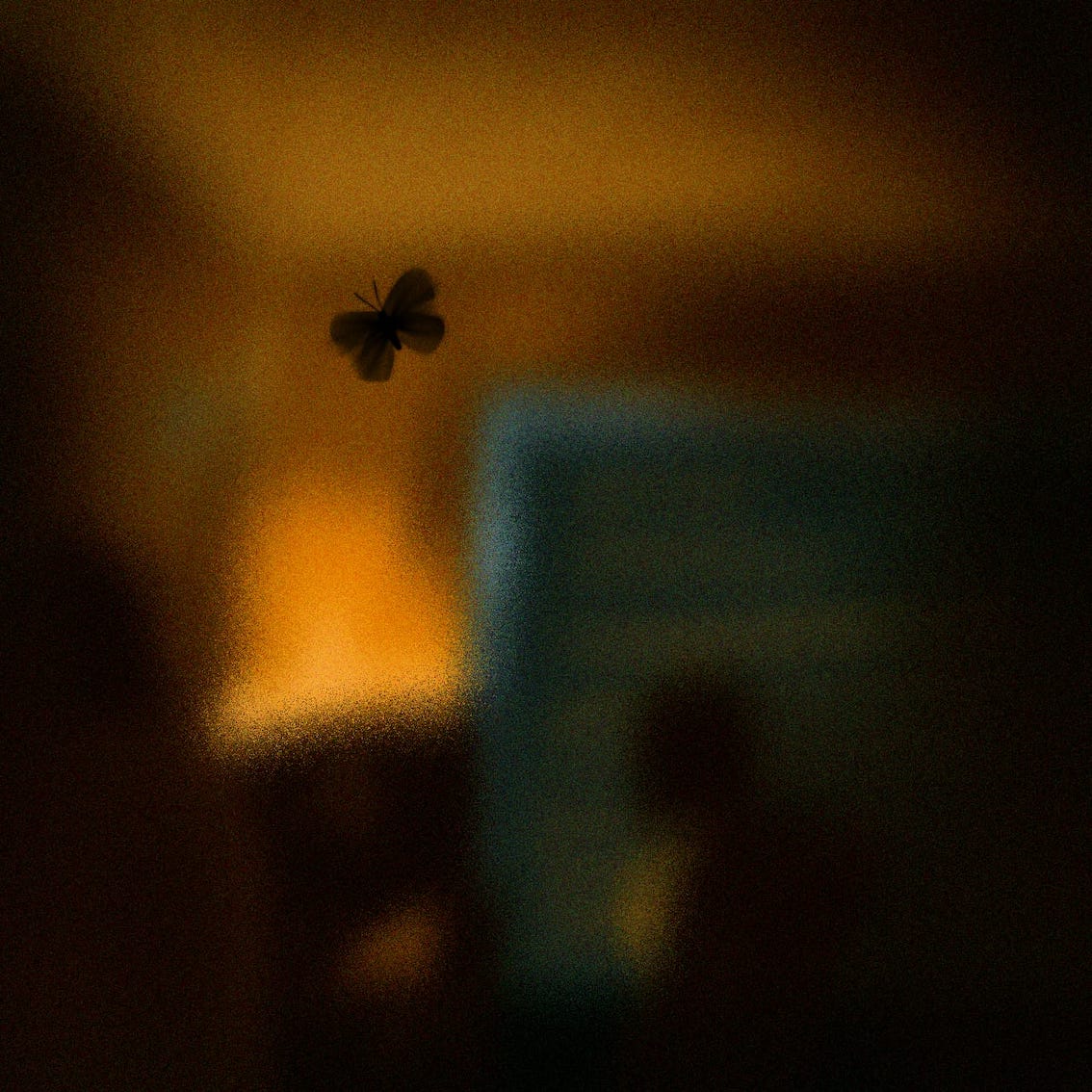
Photo: Maddie Finner
“To build structures out of emptiness”
The band’s approach to composition had always been collective and dynamic, Reid Bateh says, with the results often ending up a long distance from the initial creative spark. For Birthmarks, the band added a new element into the fold: the eminent British producer Graham Sutton, who has done sound engineering and remixes for artists as diverse as These New Puritans, Jarvis Cocker, Metallica, and Goldie.
Reid Bateh describes the recording process as follows: “We wrote a pretty substantial batch of songs for the record and during that process a different sort of sound started to come together. We knew we wanted to pursue this new approach to our music, and having been fans of Graham’s work for many years, we thought he would be the perfect person to help us bring these songs to fruition. Throughout his career he’s always had such an inspired and laser-focused attention to detail and textures, outside of the confines of the standard rock music setup. And that’s exactly what we wanted for Birthmarks. We’ve always explored textures and unconventional instrumentation in our music, but Graham was able to help us look at composition in a different way. He was really amazing to work with.”
In his own musical endeavors, Sutton may be best known for Bark Psychosis, an early post-rock outfit that, in their 1994 debut Hex, transposed the basic musical tenets of late Talk Talk from the ambiance of warm lagoons to the liminality of nighttime highways. That is to say: Sutton knows how to build structures out of emptiness.
The band’s furthest forays out of their comfort zone are “Elena’s Dream”, a misty, stumbling jazz interlude with a voicemail recording as the vocal track, and “Face of Love”. Approaching the cold-blooded grooves of Massive Attack with the means of rock’s organic instrumental warmth, the track follows Reid Bateh’s vocals like a flashlight in a forest with no beaten paths.

Photo: Maddie Finner
Face of Love is the most verbally dense track on Birthmarks, the words compressing the vocal delivery into a clipped, gritted-teeth rap — almost as an inevitable consequence. The track is among the best examples of Bambara’s sound being overtaken by literariness — less a stylistic seasoning than a full structural engine.
This literariness is also the key element that sets Bambara apart from their post-punk contemporaries. There is no shortage of strong lyricists among them, and someone like Protomartyr’s Joe Casey may slip enough canonical allusions into the classic three-to-four minutes of a song to make English grads’ brains rattle. Bambara’s literariness is of a different nature — less intertextual than novelistic in its own right.
Since 2018’s Shadow on Everything, Reid Bateh has been constructing his lyrics along the scaffolds of fully sovereign narrative worlds and arcs — prosaic, hard-edged, often more spoken than sung, heavily indebted to Flannery O’Connor’s laconic grimness as well as her Southern Gothic imagery, to which the singer-lyricist openly admits. Love On My Mind displayed more distinctly poetic qualities — softer, fluid rhythms. The songs on Birthmarks largely follow this trajectory. Often, the lyrics subtly veer away from the path that the steadfast beats and still mostly straightforward song structures project, offering instead a counter-structure through the inventive use of internal rhymes and unconventional cadences. This formal complexity animates even the songs that seem most simple on the surface.
Upon first hearing the album’s lead single “Pray To Me”, I had been tempted to file it under something like the band’s attempt at their own Mr. Brightside — but rather than in the plain, subdued chorus, the drama of the song all takes place in the verses. In a perfectly inextricable alignment of content and form, Reid Bateh draws the arc of Pray To Me from the quiet, expectant yearning of a lonely man for a beautiful stranger, to the hubristic hope of erotic possession and the aborted approach, to, finally, an act of brutality that lets the previously established sympathy for the song’s speaker collapse on itself. Each vocal melody is calibrated to project the words’ full dramatic impact; each elegant brushstroke is necessarily deceptive in its apparent simplicity. Pray To Me is a display of hard-won ease — of years and decades of routine resulting in unassailable confidence.
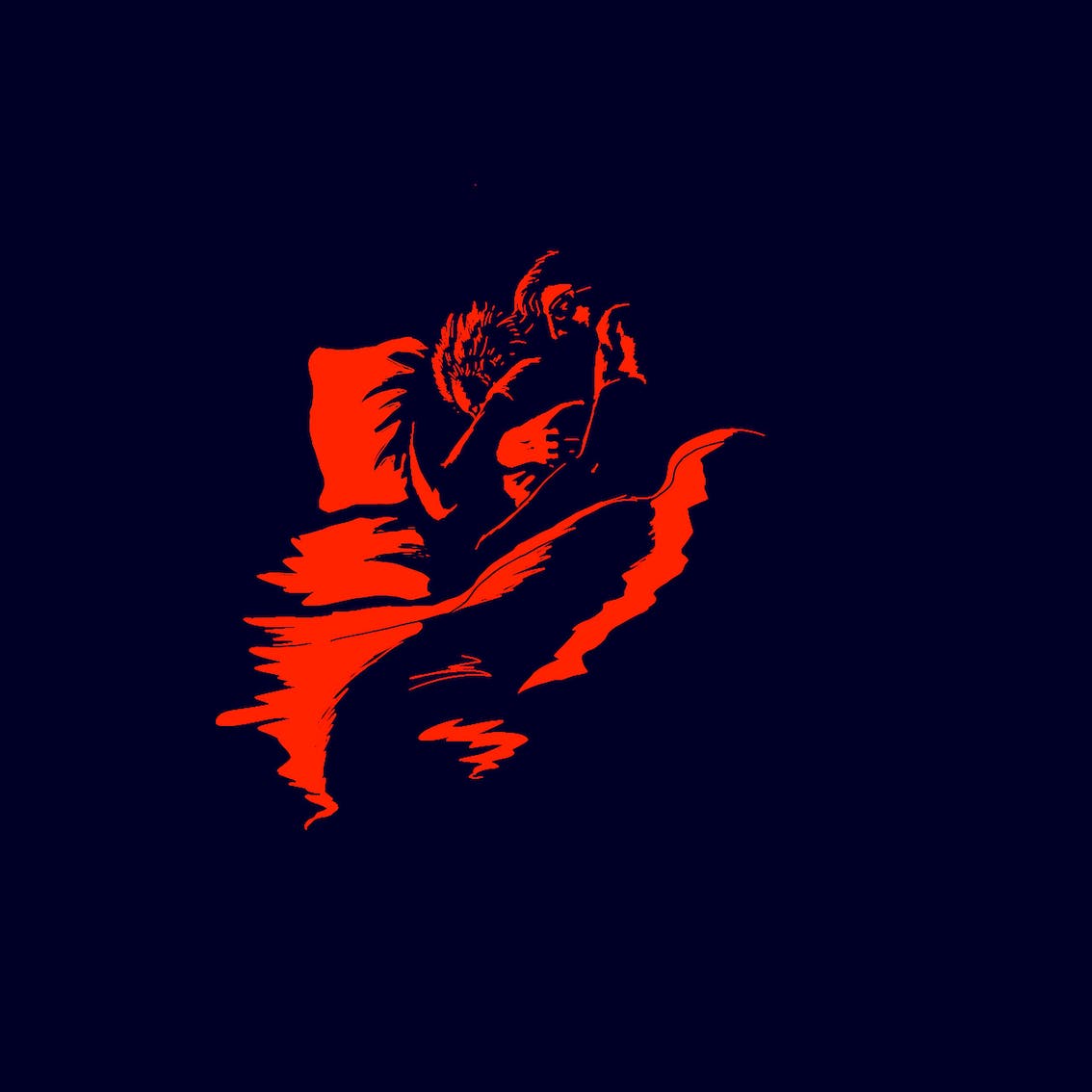
Photo: Maddie Finner
“The past as both inescapable and impossible to recover”
Pray To Me works as a kind of inciting incident within the larger, sprawling narrative spiderweb of Birthmarks. Reid Bateh had abandoned linearity on Stray already — scrambling the story of Death personified and the characters he encounters into closed but interconnected vignettes. But the dramaturgy felt more like a game there, a scavenger hunt for names and souvenirs that eventually fell into neat resolutions.
The non-linear form of Birthmarks, in contrast, reflects and carries its thematic preoccupations: losses and hauntings, reincarnations and doppelgängers, the past as both inescapable and impossible to recover, memory and its willful, obstinate sibling — projection. The structural organization is accordingly convoluted and obscure: some names, like Pray To Me’s unfortunate Elena, flit in and out; more often, nameless narrators and miscellaneous passers-by overlie each other in semi-transparency, each a different shade of the same obsession.
In this, Birthmarks showcases Reid Bateh’s lyricism at its most romantic — and capital-R Romantic. It can appear as tender melancholy in Smoke, a serenade by a lover already long doomed by the narrative, and Because You Asked — torch songs of the kind Bambara seldom include in their live sets, but which I personally always thought were their strongest suit.
The latter is especially heart-rending: piano tones drop into a droning void, dusty and out of tune as after years of neglect, and Reid Bateh’s voice enters faint and battered, scratching at the upper ranges of its natural register. Blaze Bateh’s searching drum beat and William Brookshire’s bass line pull it from its broken stupor — but only to push it into a stumbling gait, the choral harmonies picking up the piano motif, all in a state of quiet collapse, like wallpaper peeling off damp concrete.
The lyrics follow the idea of haunting a lover’s quarters in death — a gentle request, a keepsake. The lover long gone, the relationship years past, the ghost is trapped in the hypothetical, in what the real past self could not promise. It drafts an image of the lover from traces and debris, watches her from its transparent passivity, chains itself to her existence — all while Reid Bateh’s voice erodes to a whisper. And in the chorus — “Don’t get it wrong, I’m not trying to win you back / I swear, it’s just ‘cause you asked” — it’s still too weak to even believe in what it’s saying.

Photo: Maddie Finner
It can also — and more often does — come in tandem with violence. While Pray To Me’s tale of murderous possessiveness may be its clearest exponent, it’s telling that Holy Bones is the track that follows. Less densely plotted, the lyrics extend their megalomaniac reach all the way to Catholic relics to crown the head of the recurring, passive, absent Elena, and cross masochism with self-flagellation. The chorus is as syrupy and catchy as any song in the roster of karaoke bars like the ones in which Pray To Me and Dive Shrine take place; the bass line, the unnervingly regular single-key tone, and the vocal delivery in the verses sound downright sinister. One is tempted to indulge in the extravagance of such idolatry and such ruin, but Elena’s frequent presence as an addressee and near-total absence as a voice at some point becomes conspicuous. Romantic obsession and violence are connected through the need to turn a person into a suitable object of desire — and the person caught within suffocates.
If there is a chance in Birthmarks to gasp for fresh air, it is not for Elena — but for her time-transported twin, Loretta, in the album’s closer. The Dead Confetti zine, a supplementary booklet compiling process notes and inspirations, features a quote from a Townes Van Zandt song by the same title, sung from the viewpoint of a cynical man who seems as glad about the titular woman’s availability as he is to abandon her. Bambara’s Loretta takes the side of the young idealist, the believer, the Romantic against the cynic. It puts the preceding songs into a new perspective; it is as necessary to the narrative as the last, bitter, and ugly segment of David Lynch’s Mulholland Drive is to the dreamy haze of the film’s earlier portions.

Photo: Maddie Finner
Lynch has always undergirded the allure of his images and artifacts with an idiosyncratic approach to narrative structure. His mysteries have always gone beyond the generic marker “mystery” itself — their answers creating more shock, confusion, and implicit tragedy than the questions with which they began. And the tragedy in Lynch’s works is all too often connected to Romanticism — especially to romantic/erotic obsessions and projections, the posthumously idolized Laura Palmer, the character refractions of Patricia Arquette in Lost Highway.
Birthmarks is Bambara’s most Lynchian album — not only because it fits in archetypes and surfaces, but because of its will to irresolution, its narrative complexity and fragmented flow refusing to serve closure on a platter, its gaps as throbbing wounds. It is not perfect — or rather: imperfect by design — but if there is a band that comes close to what we are pawing at with the moniker “Lynchian,” it is Bambara.