

Five days before release: Interpol “Turn on the Bright Lights”
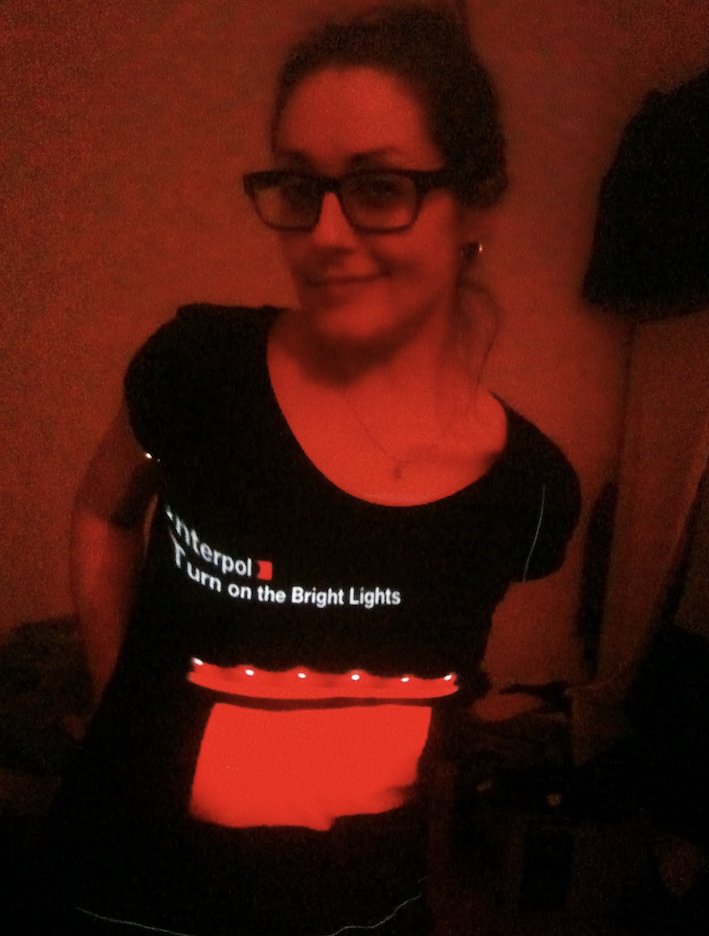
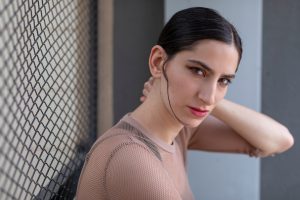
Die Autorin im Interpol Shirt
 Interpol
„Turn on the Bright Lights“
(Matador)
It’s the summer of 2002. My boyfriend at the time and I are living in Barmbek, and it’s not like we’re living the high life, so to speak. I’m just scraping by with crappy-paying jobs and, even at 26, I’m still dependent on the goodwill of my grandparents, who occasionally slip me fifty bucks in the mail or slide it across the table after a meal. It’s the end of the month, and for some reason we still go to the ugly giant Saturn store at Hamburg’s main train station, wander through the DVD and CD departments, look around, listen to stuff.
A few days ago, during my lunch break, I read a concert announcement for a band playing at the Logo: Interpol. The photo shows four young men wearing sunglasses and suits, looking in different directions. The text mentions something about “dark,” “melancholic,” The Smiths, Chameleons, and Joy Division, as well as “New York” and “The New Cool” or something like that. Aha, I think. Sounds great—and only twelve euros admission! But then: too bad, unfortunately it’s yesterday’s newspaper, so I missed it. Never mind, what the heck, I don’t have any money anyway.
At one of the “GEHEIMTIPP!” listening stations, a cover catches my eye. It is black with a blood-red screen (perhaps from a drive-in theater?) and above it is the name of the band—Interpol—and the album title: “Turn On The Bright Lights.”
I am an aesthete. I like to buy, listen to, or borrow books, films, and records if I like the cover—and most of the time, my instincts are right. Thanks to an appealing cover, I have often discovered beautiful, new, and abstruse things. And I think it’s great that the band, which I recently saw in the newspaper during my lunch break and then wasn’t allowed to see after all, has a keen sense of aesthetics. In any case, everything appeals to me.
Normally, I just put on the headphones at the preview stations and skip ahead every 20 to 30 seconds. Here, for some reason, I skip back to the beginning. “Untitled” is the name of the album’s opener. A reverberating guitar plays B flat minor, D, A minor; drums and bass kick in after a few bars, and something opens up beneath me or above me – I’m falling or floating.
„Surprise, sometimes, will come around / Surprise, sometimes, will come around / I will surprise you sometime, I’ll come around / When you’re down.“
That’s the whole song. A second guitar joins the first, and I have goosebumps from head to toe. I’m no longer at Saturn—I’m in New York, I’m at the sea, I’m at a funeral, I’m sitting in a basement, I’m crying, I’m sleeping, I’m having sex, I’m dreaming—all at once.
I listen to the whole song and stare like a moron at the ugly Saturn shelves with all the crappy bands. I am enlightened. As far as I’m concerned, the whole store can burn down – I’ll risk my life to get this CD out of here.
Second song: “Obstacle 1.” Excuse me?! “NYC,” “PDA” – I’m going CRAZY.
Where is my friend anyway? I run at full speed to the DVDs. I say, “I think I have a new favorite band,” and drag him behind me to the CDs and point my finger at the cover: “This one.”
“Ah, okay, cool – take it,” he says, and he’s right. However, it’s about five days before payday, and I have to weigh up the options: a CD or five days of breakfast at work – or just fare dodging. It takes about a minute, and I’m standing at the checkout with the CD, saying, “HURRY UP, YOU SATURN DOG…” — no, of course I don’t say that. I pay €14.99 with the last twenty I have and a few minutes later cheer on the subway driver to fly towards Barmbek at 1000 km/h.
At home, I immediately put it in the CD drawer. It’s the same magic as before. To be on the safe side, I burn the CD right away, no, twice, and transfer it to my MP3 player (128 MB) at the same time. For the next few weeks, I won’t listen to anything else but this band. I cry to “Stella Was a Diver and She Was Always Down,” I dance to “Roland,” “Leif Erikson” overwhelms me with its beauty: “She says it helps with the lights out / Her rabid glow is like Braille to the night.”
What a line. Even today.
I start dressing like the band—buying ties, black suit pants, shirts. I buy guitars and later get a bass for my birthday and try to play everything—with moderate success.
In 2004, the band releases its follow-up album, “Antics” – and once again, I’m on fire. In the wake of this, we finally see the band live for the first time, in a not-sold-out Markthalle in Hamburg, with Bloc Party as the opening act. I can hardly remember a minute of the concert, I was so excited. Later, we take a taxi with Paul Banks and Carlos Dengler because they don’t know where their after-show party is (spoiler: at Tino Hanekamp’s excellent Weltbühne), and then we all go out on the town and experience things… But that’s another story. I also got to know a group of people on this tour; later, we traveled with the band, and we’re still in touch today (hi there!), even though my passion has calmed down and changed somewhat over the years. Unfortunately, the band hasn’t reached me since the last three albums—but we’re all getting older and evolving.
But the door to the world that Interpol pushed open for me was one of the two or three most important ones in my musical self-discovery. In the early 2000s, post-punk wasn’t quite as inflationary a term as it is today—sometimes all it takes is a reverb effect and a bit of attitude, and suddenly the post-punk flag is being waved—and it was only bands like Interpol, The Strokes, and Bloc Party that brought it back into the spotlight.
In any case, after “Turn On The Bright Lights,” I began to intensively discover the originals from the eighties. Sure, everyone knows Joy Division and The Cure, but bands like The Chameleons, Mission of Burma, Talking Heads, The Fall, Wipers, et al. were only vaguely familiar to me. The good German-language stuff from Düsseldorf, Berlin, and Hamburg—Abwärts, Nichts, Mittagspause, and all the “Verschwende deine Jugend” bands—was also a never-ending source of joy.
I’m 100% sure that I wouldn’t be such a fan of bands like Die Nerven, Pisse, Friends of Gas, or Messer today (or maybe I wouldn’t even know them?) if it hadn’t been for that one day at Saturn. The uncoolest place to discover one of the coolest bands of all time—or at least for a few years.
Fan Girl