

Li-chin Li : “I enjoy exploring my own limits through the interaction of body, sound and space”
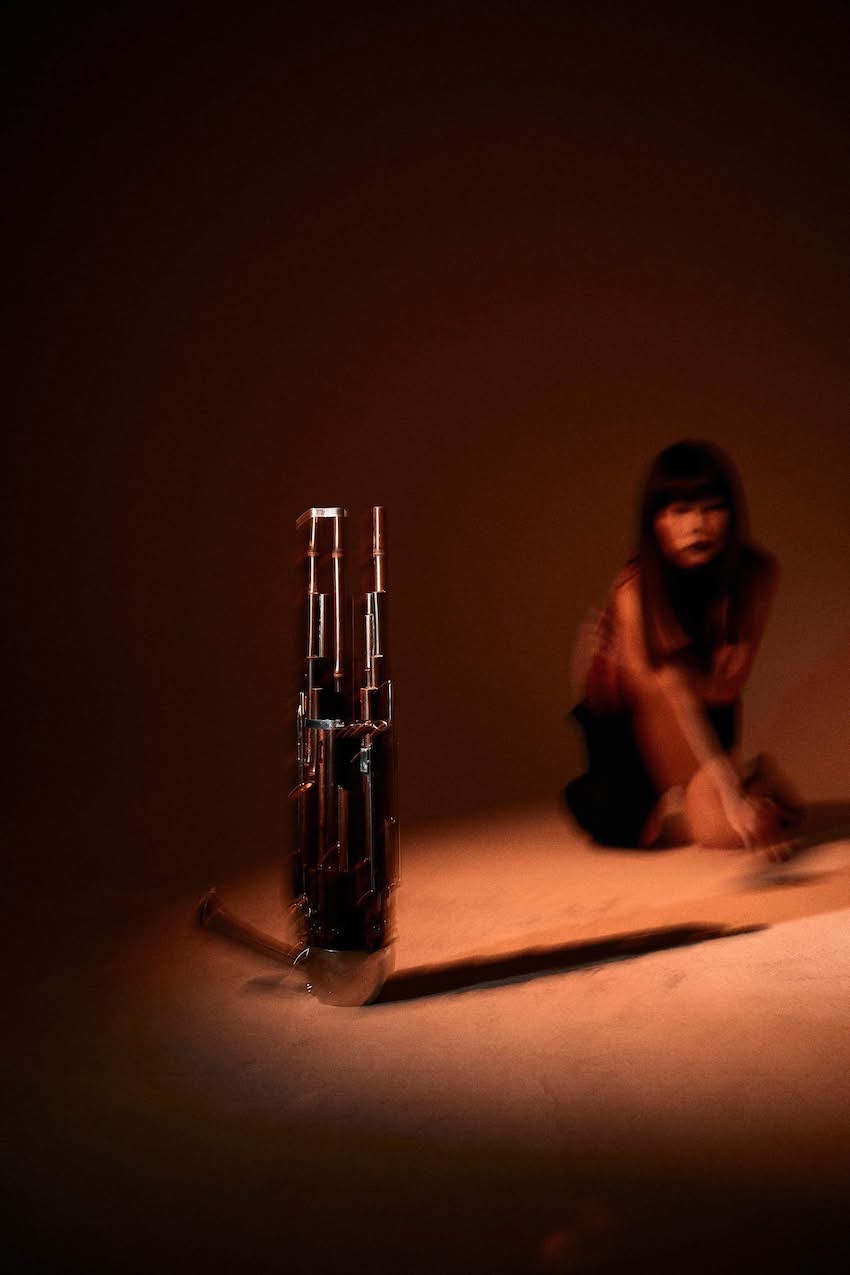
Li-chin Li (Photo courtesy of the artist)
There are evenings that quietly redraw one’s musical coordinates. Mine began around a dinner table at the Cologne home of musician and dentist Matthias Kaiser. The meal had mostly ended when Li-chin Li unpacked her sheng almost casually. What followed lasted only a few minutes, yet permanently introduced the sheng to me, an instrumentation like a fever dream of imagination—and that said not surpriseingly one of the oldest continuously played instruments in the world, carrying with it thousands of years of musical history. In Li-chin Li’s hands, it transformed in that night into breathing architecture, an extension of her body, producing sounds that opened unknown spaces of perception. I remember being stunned—not only by the instrument’s remarkable beauty, but by the extraordinary intensity with which she shaped those fleeting moments after dinner into something utterly immersive.
Since that evening, Li-chin Li has returned twice to Kapute Szene, the independent art venue Sarah Szczesny and I initiated in Cologne, where Mathias Kaiser and I co-curate the concert series Der Klang von Kaiwa. Both performances confirmed that unforgettable first impression. The two concerts, one alongside Matthias Kaiser, Fabian Neubauer and Bastian Buddenbrock, one in a duo constellation with Kaiser, give me deeper insides in her artistic language, one that remains remarkably singular, balancing precision and openness, fragility and physicality. It is hardly surprising that her work has increasingly attracted international attention, positioning her among the most compelling voices working with contemporary approaches to the sheng today.
Reading the conversation that follows, it becomes clear that this openness is not merely an aesthetic preference but the very foundation of Li-chin Li’s artistic thinking. Again and again she returns to the idea that the relationship between musician and instrument is never fixed. The sheng is not an historical artefact to be preserved behind glass, nor simply a vehicle for virtuosity. Instead, it has become an extension of her body—a companion in an ongoing dialogue with space, time and the surrounding world. Tradition, in her understanding, remains alive precisely because it continues to transform, while improvisation is less an expression of unrestricted freedom than an exacting practice of listening.
Throughout our conversation, she speaks with remarkable clarity about creation as a living process, one in which body, sound, architecture, memory and cultural identity continually reshape one another. It is this way of thinking—deeply rooted in history while uncompromisingly present—that makes Li-chin Li’s work resonate so profoundly today.
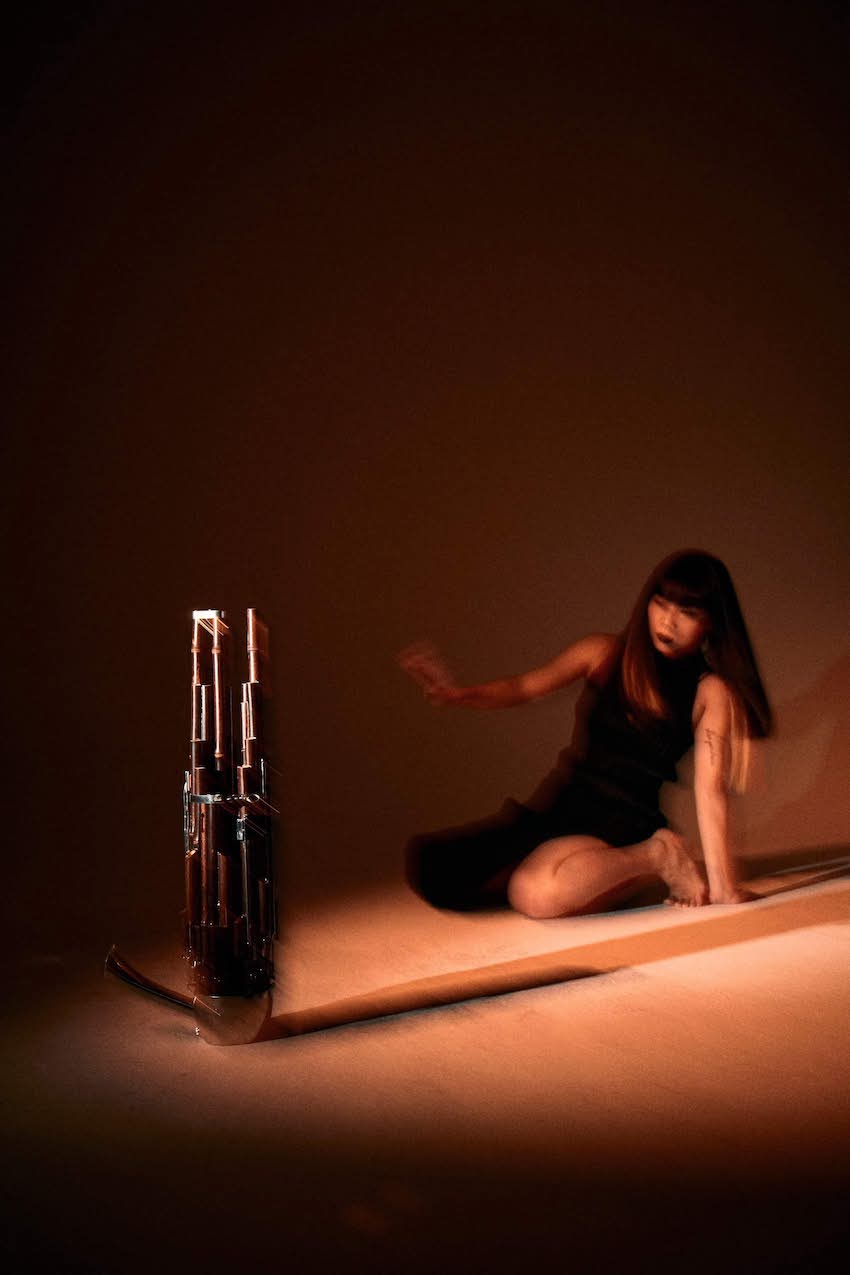
Li-chin Li (Photo courtesy of the artist)
Li, the sheng is one of the oldest continuously played instruments in the world, but your music feels deeply contemporary. When did the instrument become not just something you played, but something you thought through?
Li-chin Li: More precisely, my relationship with the instrument began to change when I started exploring body movement several years ago. Since then, both my approach to performance and my understanding of artistic creation have gradually transformed. Holding the sheng while performing is no longer simply a technical action. It has become a natural extension of my body. The instrument and my body exist in a constant state of interaction. Together they perceive stimuli from the surrounding environment, generating new ideas, sounds and possibilities in the moment.
Many musicians speak about mastering their instrument. Does mastery interest you, or are you more interested in maintaining a sense of discovery?
Li-chin Li: From my own experience, mastering an instrument begins with continuous and dedicated practice over a long period of time. Yet I believe that mastery is never solely about technical proficiency. It also requires the willingness to move beyond a solid technical foundation in order to discover possibilities that have not yet been explored.
I still consider myself to be on that path. Collaborating with different musicians has repeatedly introduced me to approaches to playing that I could never have imagined on my own. These encounters continue to expand my understanding of both the sheng and sound itself.
This becomes especially apparent during extended improvisations lasting thirty minutes or more. In those situations, maintaining a deep connection with the instrument requires constant listening, responding and moving beyond established habits. I believe this process not only deepens my relationship with the sheng, but continually expands the possibilities that exist between the instrument and myself.
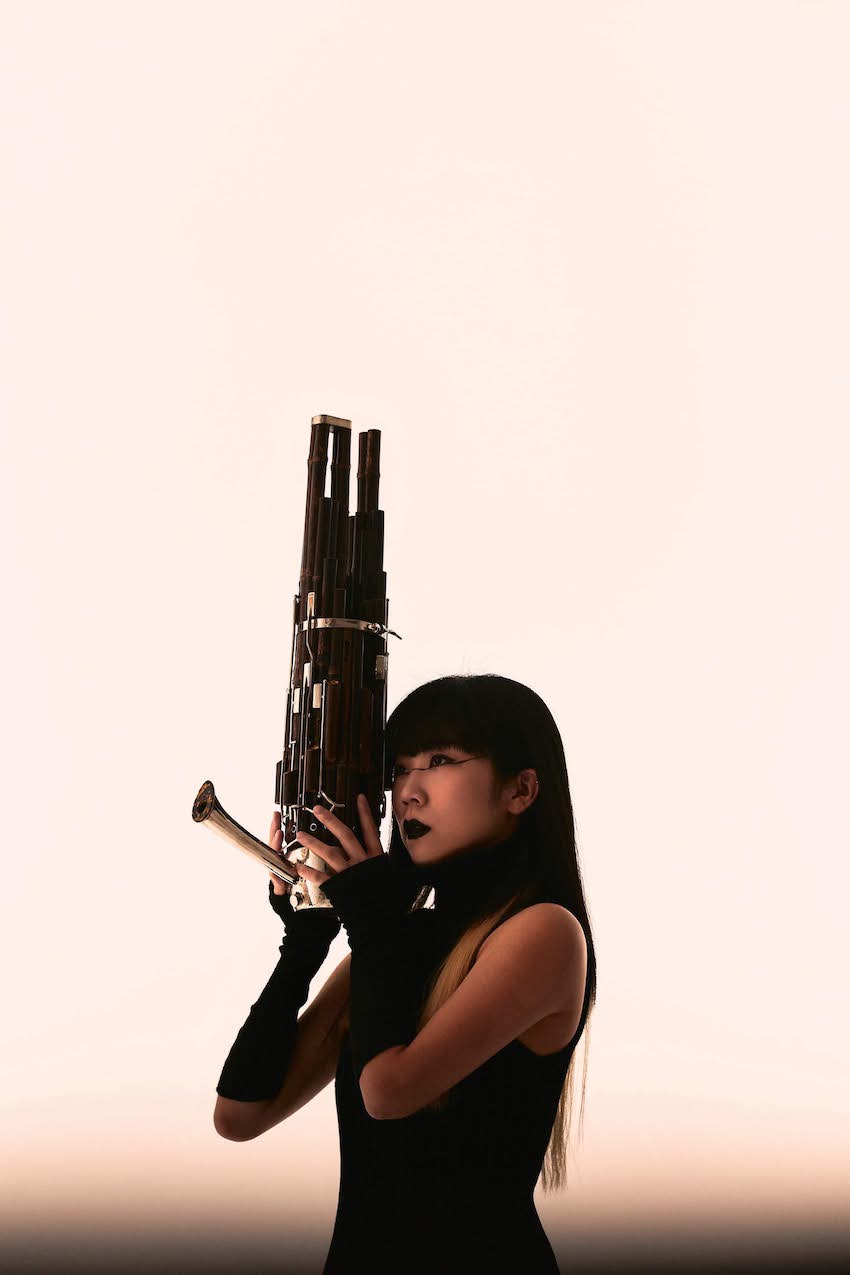
Li-chin Li (Photo: 58kg – courtesy of the artist)
The sheng carries centuries of history. Do you feel responsibility toward that history, or freedom from it?
Li-chin Li: Every performance I present through the sheng is my way of responding to the contemporary world together with this instrument. I do not experience the thousands of years of history carried by the sheng as a burden. Rather, I see it as a source of energy that continues to expand, evolve and generate new possibilities. For me, the instrument and the performer are not separate entities but a shared existence. Together with the sheng, I experience each moment as an opportunity to explore new forms of sound and expression within the continuous flow of time. For that reason, I hope each performance does more than simply continue the past. I hope it also leaves behind an artistic trace that belongs unmistakably to our own time.
How do you navigate the tension between preservation and transformation?
Li-chin Li: I would interpret this question as asking how my work positions itself between the continuation and the transformation of tradition.
What has always fascinated me most is the act of creation itself. In every performance I am not only working with sound; I am creating an environment, an atmosphere and an experience that involves hearing, vision and physical perception simultaneously. Rather than consciously seeking a balance between preservation and transformation, I am more interested in how different elements can come together within a single work, gradually shaping my own performance language, cultural context and artistic identity.
At the same time, my musical education was never rooted in a single fixed tradition. The sheng itself has always developed through exchanges between different cultures and musical languages, continuously transforming throughout its history. I therefore do not regard tradition as something that should remain static. To me, it is a living process that is constantly being reinterpreted and recreated.
The most meaningful way to continue a tradition is not by reproducing the past, but by allowing it to generate new forms of life and new possibilities within the present contemporary context.
Improvisation is often described as freedom, but it also requires discipline and deep listening. What does improvisation mean to you?
Li-chin Li: I enjoy exploring my own limits through long-duration improvisation.
If an improvisation lasts only five minutes, it is often possible to rely on abilities that have already been developed or simply demonstrate technical virtuosity. Once an improvisation extends to fifty minutes, however, the performer must invest far greater physical and mental energy. One begins to work together with time itself. For me, improvisation is therefore not simply the spontaneous creation of sound. It is a highly refined process of organising time and gathering energy. It demands deep concentration, attentive listening and the ability to respond sensitively to external impulses, interactions with other musicians and one’s own inner thoughts.
Long-form improvisation continually confronts me with the unknown. It challenges me to move beyond familiar ways of playing and into places I have never been before. That is where I find the true value—and the real possibility—of improvisation.
How important is physical presence to your work?
Li-chin Li: For me, the body is not something that merely accompanies the music—it is another way through which music comes into being. Over the years, as my artistic practice has evolved, performance has become inseparable from an increasingly profound awareness of the body. During a concert I move fluidly between different states: sometimes allowing sound to activate the body, at other times allowing the body to guide the sound. They continuously shape and respond to one another, rather than one simply serving the other. As a result, my performances are not only about enabling the audience to hear music, but also about allowing them to witness how the music comes into existence in real time. A traditional concert can certainly be experienced with closed eyes, but I am particularly interested in creating a sense of unpredictability within the unfolding of time. I want the audience to wonder what might happen next: how the body will move, where the sound will emerge from, and how it will interact with the surrounding space.
When the body becomes an integral part of the work, a performance is no longer simply the presentation of a musical composition. It becomes a living event that unfolds in the present moment. This uncertainty, this constant state of transformation, allows every performance to remain alive, unique and ultimately impossible to reproduce.
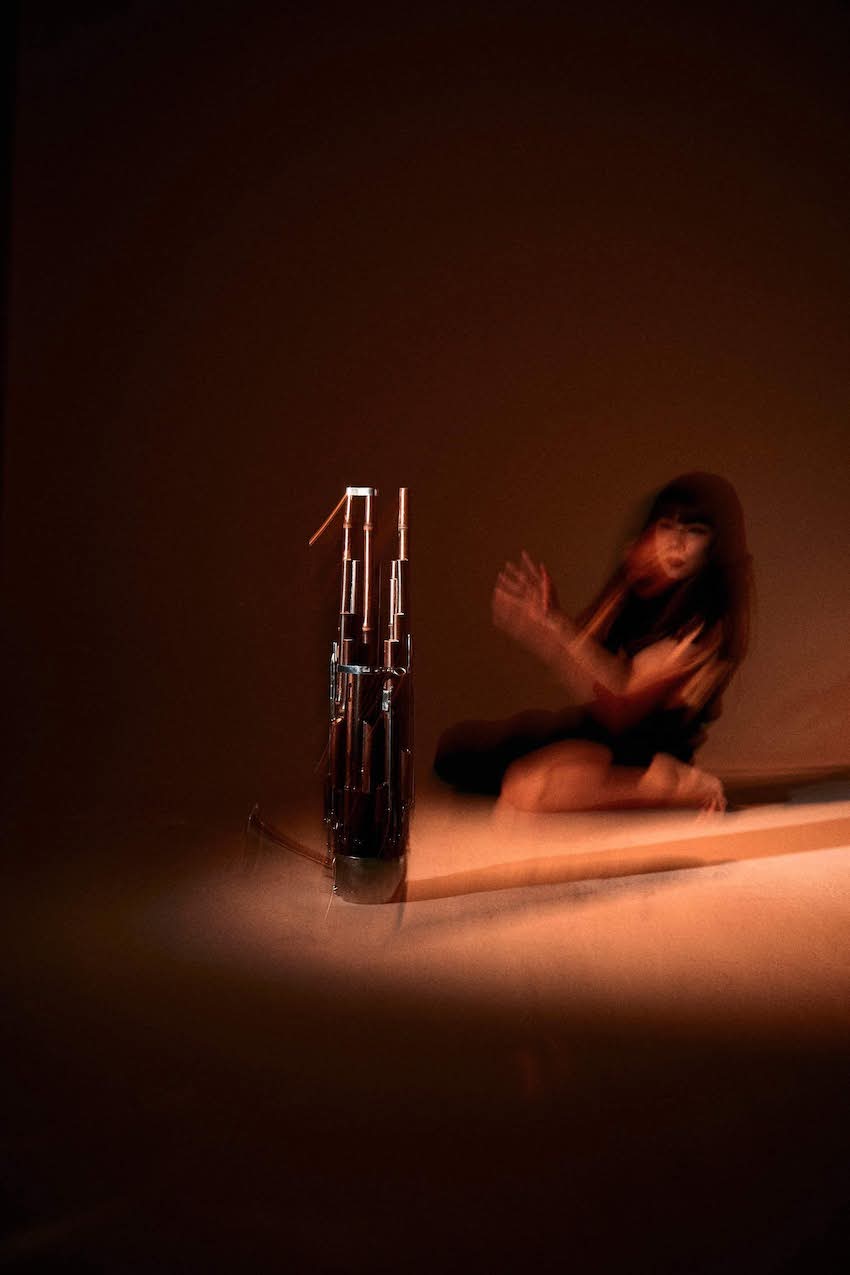
Do you think visually when composing or performing?
Li-chin Li: Yes, very much so. Whenever I create a performance, I think visually as well as sonically. Every performance is reshaped by the space it inhabits. Beyond the music itself, I think about the architecture, the quality of light, the audience’s position within the room and the ways in which they will experience the work through both listening and seeing.
I was once invited to perform in a church in Paris. When I arrived, I immediately realised the scale of the space. During the sound check I discovered that the reverberation was exceptionally long. Performing the piece exactly as I had originally conceived it would have caused the sound to dissolve into itself, making many of the musical details almost impossible to perceive. At that moment I understood that while the architecture offered extraordinary visual possibilities, it also imposed very specific acoustic limitations..
Rather than resisting those conditions, I decided to imagine the performance entirely. I treated the vast church as though it were my own small room and invited the audience to listen as if I were telling them an intimate story. I placed a single chair on the stage and positioned a lamp behind me, casting an enlarged side profile of mine onto the church wall. I began by playing the sheng in an almost whispered voice, creating a striking contrast between the monumentality of the architecture and the intimacy of the sound. The audience, who had only just settled into their seats, immediately fell silent and instinctively leaned forward to listen.
As the performance unfolded, I left the chair and gradually allowed my movements to connect the sound with the architecture. I walked slowly among the audience so they could observe both the instrument and my gestures from close proximity. At the very end, I disappeared through one of the church doors. My body vanished from sight, yet the sound continued to recede into the distance until it dissolved completely.
For me, a performance is never simply the presentation of a musical work. It is the creation of a particular way of seeing and listening within a specific place. I often begin by considering the relationships between space, body and sound before deciding how the music itself should exist. Visual thinking is therefore not an addition to my work; it is one of the fundamental dimensions through which I compose and perform.
As a Taiwanese artist working internationally, have you become more aware of cultural identity through distance?
Li-chin Li: Yes. Working internationally over many years has encouraged me to reflect much more deeply on the question of cultural identity. Whenever I encounter artists who engage with elements of their own traditions and respond to their backgrounds through their work, I inevitably ask myself how I might express who I am through my own artistic language and performance practice. At the same time, I have come to believe that cultural identity does not necessarily need to manifest itself through explicit references to traditional symbols or forms. What matters more to me is remaining faithful to the artistic directions I genuinely wish to pursue. Taiwan has shaped me through its cultural diversity, its openness and its spirit of freedom. The way I think, the decisions I make as an artist and the sounds I create already carry my own cultural experiences and sense of identity.
Presenting my work internationally is therefore not about representing a fixed image of a particular culture. Rather, it is about allowing my lived experience and artistic practice to become the natural way in which my cultural identity reveals itself.
Last question: What excites you about contemporary music today?
Li-chin Li: What excites me most about contemporary music is curiosity—the desire to discover new possibilities. As a sheng performer, I am especially interested in the ways composers and artists from different parts of the world encounter an instrument with more than three thousand years of history and reinterpret it through their own artistic languages.
I remain deeply open to collaborations across disciplines. The way I perform today is the result of countless encounters, experiments and exchanges accumulated over many years. Yet I do not regard my artistic practice as something fixed or complete. It continues to evolve. Every encounter with a new artist, a different medium or an unfamiliar creative environment has the potential to create unexpected connections and open entirely new directions. Perhaps that is also why I look towards the future with such optimism, even as artificial intelligence and emerging technologies become increasingly present in our lives. What inspires me is not technology in itself, but the possibilities it creates for continued discovery—for finding new relationships between sound, creativity and artistic expression.
For me, remaining curious is ultimately the most important artistic practice of all.