

“We Are Queer and We Are All German Rap” (Sir Mantis)
Queer people’s conquering place in rap is nothing new. But in recent years, the pace and force with which they’ve claimed their space has clearly intensified. Social scientist Benedict Weskott researches the positioning strategies of queer rappers in a field that has traditionally been anything but welcoming to them. For Kaput, they analyse developments over the past ten-plus years through music videos and song lyrics.
Where queer rappers were once allowed to exist at most on the sidelines – or saw no place for themselves in the genre or in hip-hop culture at all – there is now a wide range of queer and queer-feminist rappers with very different aesthetics and thematic approaches. Again and again, what must be emphasised is the truly rocky path of this partly individual, partly collective occupation of space, which queer-fem rap pioneer Sookee put into words in the track “Vorläufiger Abschiedsbrief” from her 2014 album Lila Samt:
„Rap war selten gut zu mir, Rap hat mich immer geboxt
Hab’ viel zu oft mit Stift und Blatt in meinem Zimmer gehockt
Ich hab’ niemals gefreestylet, ich hab’ mich niemals getraut
Ich wollte lieber MC sein, doch war immer wieder nur Frau“
„Rap was rarely kind to me, rap always knocked me down.
I sat in my room with pen and paper far too often.
I never free-styled, I never dared to.
I wanted to be an MC, but I was always just a woman.“
Accompanying the sombre lyrics and beats, Sookee sits alone on a chair in a dark room in the music video, as if in an interrogation: the image of a (lone) fighter who accuses, but is also caught in the crossfire. She declares:
„Es zeichnet sich ab, ihr gewinnt und ich kapitulier’
Ich bin seit zehn Jahren aktiv, nun ist mir alles zu viel
Wir haben Strukturen geschaffen, ’ne eigene Szene entwickelt
Doch ich vergifte mich an mir selbst, bin das Gegenmittel“
“It’s becoming clear that you’re winning and I’m surrendering.
I’ve been active for ten years, now it’s all too much for me.
We’ve created structures, developed our own scene.
But I’m poisoning myself, I’m the antidote.”
In the outro, Sookee adds the telling line: „Jahrelang geduldet, geduldet zu werden“. (‘Tolerated for years, tolerated to be tolerated.’ ) And asks: „Warum hat denn niemand dieses Patriarchat zerbombt?“ (‘Why didn’t anyone bomb this patriarchy?’)
Five years and one album (‘Mortem & Make-up’) later, Sookee’s ‘Vorläufiger Abschiedsbrief’ (‘Provisional Farewell Letter’) was followed by her actual departure from rap and a shift to music for children, under the name Sukini. At the time, she cited the pressure to commercialise and perform in the highly commercialised music industry as the main reason, but also the exhausting struggle against fellow rappers. At the same time, rapper and producer Sir Mantis sounds somehow vehement in his upbeat track ‘sorry not sorry’:
„Wir sind queer und uns gehören die Straßen
Du kannst uns nichts anhaben, auch wenn wir nichts anhaben
Digga, wir machen deinem Männerbund Stress
Wie kurdische Kämpferinnen dem IS
Meine Gang hält zusammen und wir tackeln dich weg“
“We are queer and we own the streets.
You can’t hurt us, even if we’re not wearing anything.
Digga, we’re going to give your men’s club a hard time,
just like Kurdish female fighters do to IS.
My gang sticks together and we’ll tackle you away.”
The video shows preparations for attack or defence: balaclavas, ‘feminism or brawl’ T-shirts, baseball bats, pyrotechnics, solidarity, readiness to fight. Sookee is also there, in keeping with the spirit of support within the scene. Haszcara launches a similarly direct frontal attack in ‘Lauter Rapper’ (Loud Rappers), also from 2018:
„Wasʼ los mit Rappern hier in Deutschland?
Alles, was ihr von euch gebt, ist voll krank
Lauter Rapper, aber kein Rap
Ihr definiert mein Feindbild
Ich scheißʼ auf eure Scheinwelt“
„What’s up with rappers here in Germany?
Everything you put out is totally aweful
All rappers, but no rap.
You define my enemy image.
I don’t give a damn about your illusory world.“
In the music video, she presents herself as the opposite: an established rapper, embedded in her crew, who all stand behind her.
„Ihr eckt nicht an, bleibt konform, gleicht der Norm
Denkt, es reicht vollkommen, wenn man ab und an ein Gesetz bricht
Ich setzʼ mich hin, schreibʼ was auf, nicht damit ihrʼs kauft
Sondern dafür, dass mein Willen sich verfestigt“
„You don’t rock the boat, you stay compliant, you conform to the norm.
You think it’s perfectly fine to only break the law every now and then.
I sit down and write something, not so that you’ll buy it,
but so that my will becomes stronger.“
In the same vein of self-empowerment, with which FLINTA (female, lesbian, inter, non-binary, trans and agender people) rappers no longer allow themselves to be degraded and reduced to participating in rap as simply members of the audience or as extras in videos, Ebow strikes a similar note in 2017 with her single ‘Punani Power’:
„Denn ich rapʼ wie ʼne Pussy, machʼ Tracks wie ʼne Pussy
Schreibʼ Texte und fuck it, ich flexʼ wie ʼne Pussy
Willkommen zu Punani Power
Punanis machen harte Jungs zu zarten Flowers
Mein Baba ist ein Feminist, deiner ist ʼn Weichei
Die Ära der Fuckboys ist vorbei, herzliches Beileid“
“Cause I rap like a pussy, make tracks like a pussy
Write lyrics and fuck it, I flex like a pussy
Welcome to Punani Power
Punanis turn tough guys into tender flowers
My baba is a feminist, yours is a wimp
The era of fuckboys is over, my condolences”
Rapper and beatboxer Lia Şahin also speaks out against misogyny and transphobia when she introduces herself to the scene in 2020:
„Hallo Hiphop, sehʼ mich lieber als die coole Schwester,
Süß und kurvenreich, vollster Respekt zum Game.
Hallo Hiphop, und nenn mich gefälligst Abla,
Sonst ruf ich deine Mama und erzähl über dich Kahba“
“Hello hip hop, think of me as the cool sister,
Sweet and curvy, full respect for the game.
Hello hip hop, and call me Abla,
Or I’ll call your mum and tell her about you, Kahba.”
Ten years after Sookee’s ‘Jahrelang geduldet, geduldet zu werden’ (‘Tolerated for years, tolerated to be tolerated’), things are looking very different for Lila Sovia. In ‘FLINTA’’, the rapper proclaims the queer takeover of the rap game in 2022:
„Ey, wir sind queer und wir sind alle Deutschrap
Doch wir chillʼn nur noch mit FLINTAs, digga, läuft jetzt
Wurden viel zu lange ausgebeutet
Doch jetzt wird nur verhandelt, nicht geleugnet
Ey, Junge, ich machʼ es nochmal deutlich
Die Community ist leider nicht mehr käuflich
LGBTQ, wir sind auch Deutschrap
Prophezeien keine Zukunft, sind das Zeugnis“
„Hey, we’re queer and we’re all German rap
But now we only chill with FLINTAs, digga, that’s how it is now
We’ve been exploited for far too long
But now we’re only negotiating, not denying
Hey, boy, I’ll make it clear again
Unfortunately, the community is no longer for sale
LGBTQ, we are also German rap
We don’t predict the future, we are the testimony”
Similar to Haszcara, Lila Sovia stages herself surrounded by friends and fans, rapping about alliance and solidarity. And just like her colleagues, Lila Sovia takes a hard line on the status quo. Because the conditions for access to rap – as in the rest of the music landscape – are still very unevenly distributed, and production and recording opportunities, labels, booking and venues are largely in male hands.
Lena Stoehrfaktor shows how this situation affects self-confidence in her old-school track ‘Schuldig’ (Guilty). In the church, she shows herself last year at the apology, because she sees her career as a lie due to her imposter syndrome:
„So sieht es aus, Mann. Wann kommt es raus, Mann?
Dass ich mein halbes Leben auf der Couch saß und gebaut habʼ
Und manche finden, ich kann rappen, und vielleicht habʼn sie auch recht
Ich verdankʼ das dem Kontrast, denn die anderen sind zu schlecht
Ich bin ʼne Hochstaplerin, die einfach Glück hatte
Denn eigentlich bin ich hart hängengeblieben auf ʼner Macke
Ich gehʼ mit mir durchʼs Leben und ich weiß, bin zu verrückt
Vielleicht haben sieʼs gemerkt, doch haben alle Augen zugedrückt“
That’s how it is, mate. When will it come out, mate?
That I spent half my life sitting on the sofa and building things.
And some people think I can rap, and maybe they’re right.
I owe it to the contrast, because the others are too bad.
I’m an impostor who just got lucky.
Because actually, I’m stuck in a rut.
I go through life with myself and I know I’m too crazy.
Maybe they noticed, but they all turned a blind eye.”
Despite occasional self-doubt, queer rappers have now largely come out of the defensive position and can use rap to empower themselves. Rapper Alice Dee puts it this way:
„Keine Panik, atme tief ein und aus
Nutz’ den Gegenwind, ey, und weiche aus
Ich kenn’ mein’ Kurs und ich bleibe drauf
Ich bleib’ in Bewegung und lass’ einfach freien Lauf
Ich schreib‘ es auf, schaffe, was es noch nicht gibt
Weder Mann noch Frau, weil’s mehr als zwei Pole gibt
Entweder-oder ist mir viel zu klein
Ich nehm’ den Stift und kann alles sein“
„Don’t panic, take a deep breath in and out.
Use the headwind, hey, and dodge it.
I know my course and I’m staying on it.
I’m keeping moving and just letting things run their course.
I’m writing it down, creating what doesn’t exist yet.
Neither man nor woman, because there are more than two poles.
Either/or is far too small for me.
I take the pen and can be anything.”
While Alice Dee negotiates her own non-binarity in ‘Odyssee’ 2024 and ultimately chooses an optimistic, determined conclusion, Katharina and Nina from the Eurorap duo 6euroneunzig hang out with a crush in Berlin-Friedrichshain:
„Sie schaut mich an und ja sie hat
Augen wie Swarovski, ich chillʼ mit ihr am Boxi
Hot so wie Toskana, sie beamt mich ins Nirvana
Himmel blau, Diamant, smoken Kippe auf entspannt
Blicke heiß, Summer Vibes, ziehʼ mich aus, wir ziehʼn uns an“
„She looks at me and yes, she has
eyes like Swarovski crystals, I chill with her at the boxi
Hot like Tuscany, she beams me into nirvana
Sky blue, diamond, smoking a cigarette, relaxed
Hot looks, summer vibes, take me off, we attract each other”
And Ebow also makes it clear in ‘Lesbisch’ from the album ‘FC Chaya’: Sapphic vibes are no longer told from a male heterosexual perspective; the tide has turned:
„Girl, ich checkʼs nicht, du weißt doch, ich bin lesbisch
Doch du schreibst und likest und dein Boyfriend ist hässlich
Yup, dein Boyfriend ist hässlich
Sag Bescheid, wenn du wegwillst
Sag Bescheid, wenn er dein Ex ist
Denn alle pretty Babes sind lesbisch“
„Girl, I don’t get it, you know I’m a lesbian
But you text and like and your boyfriend is ugly
Yep, your boyfriend is ugly
Let me know when you want to leave
Let me know when he’s your ex
Because all pretty babes are lesbians“
Despite this new, lasting self-confidence, rap by queer artists is still far from being as visible and successful as it should and could be, even twenty years after Sookee’s debut album ‘Kopf Herz Arsch’. But that could change quickly right now, in the wake of acts such as Ikkimel, badmómzjay and Shoki. One example is Baran Kok, who became the first gay rapper to play at splash! last year, Germany’s biggest hip-hop festival. He reproduces and objectifies gangsta rap images, possibly for the first time in this way in the German-speaking world:
„Deutschland, sie wünschen sich Apache
Ich wünsche mir ein’n AMG-Kanaken
Ich verkaufʼ mich nicht unter Wert
Er trägt seine Jogginghose und die Nike-Kappe umgekehrt
Fick meinʼ Kanackenarsch, tat so weh
und ich schickʼ ihn nach Hause, nenn’ mich AfD
Er hängt an mein’m Sip, als wärʼ ich deutscher pass
Ich hab’ unnormal Swag, mach’ sogar Deutsche nass“
„Germany, they want Apache
I want an AMG Kanaken
I don’t sell myself short
He wears his jogging bottoms and his Nike cap backwards
Fuck my Kanaken arse, it hurt so much
And I send him home, call me AfD
He hangs on my Sip as if I were a German passport
I have abnormal swag, I even make Germans wet”
In typical rap style, the music video for ‘AMG KANAKE’ shows Baran Kok with his masked posse and expensive limousine under a motorway bridge in the south of Neukölln: appropriation, subversion, takeover, reproduction, all at once. His lyrics in ‘Hey Alexa’, Baran Kok’s second single from 2024, are also unambiguous:
„Dasʼ kein Thug-Life, ich lebʼ das Fag-Life
Dein neuer Macker steigt grad in seinʼn Benz ein
Sagt, er geht Shisha, doch er fährt zu mir
Kommt um acht und lutscht meinʼn Kiro bis Viertel nach vier“
“This isn’t thug life, I live fag life.
Your new boyfriend’s just getting into his Mercedes.
He says he’s going for shisha, but he’s coming to my place.
He arrives at eight and sucks my dick until quarter past four.”
Bringing such acts to Splash! was previously unthinkable. In the festival’s wrap-up film, however, Baran Kok is still just a small sparkle amid festival bros wearing summer hats at the beer slide – incidentally, the headliner was once again Grammy winner Doechii, whose bisexuality has long been a matter of course in US rap 20 years after the establishment of the homohop scene. Baran Kok has been booked again for this year’s Splash! and the tide seems to be slowly turning in this country. However, it remains to be seen whether rap and hip hop can change permanently and comprehensively and whether queer rappers will gain easier access, more attention and greater success.
________________________________________________________________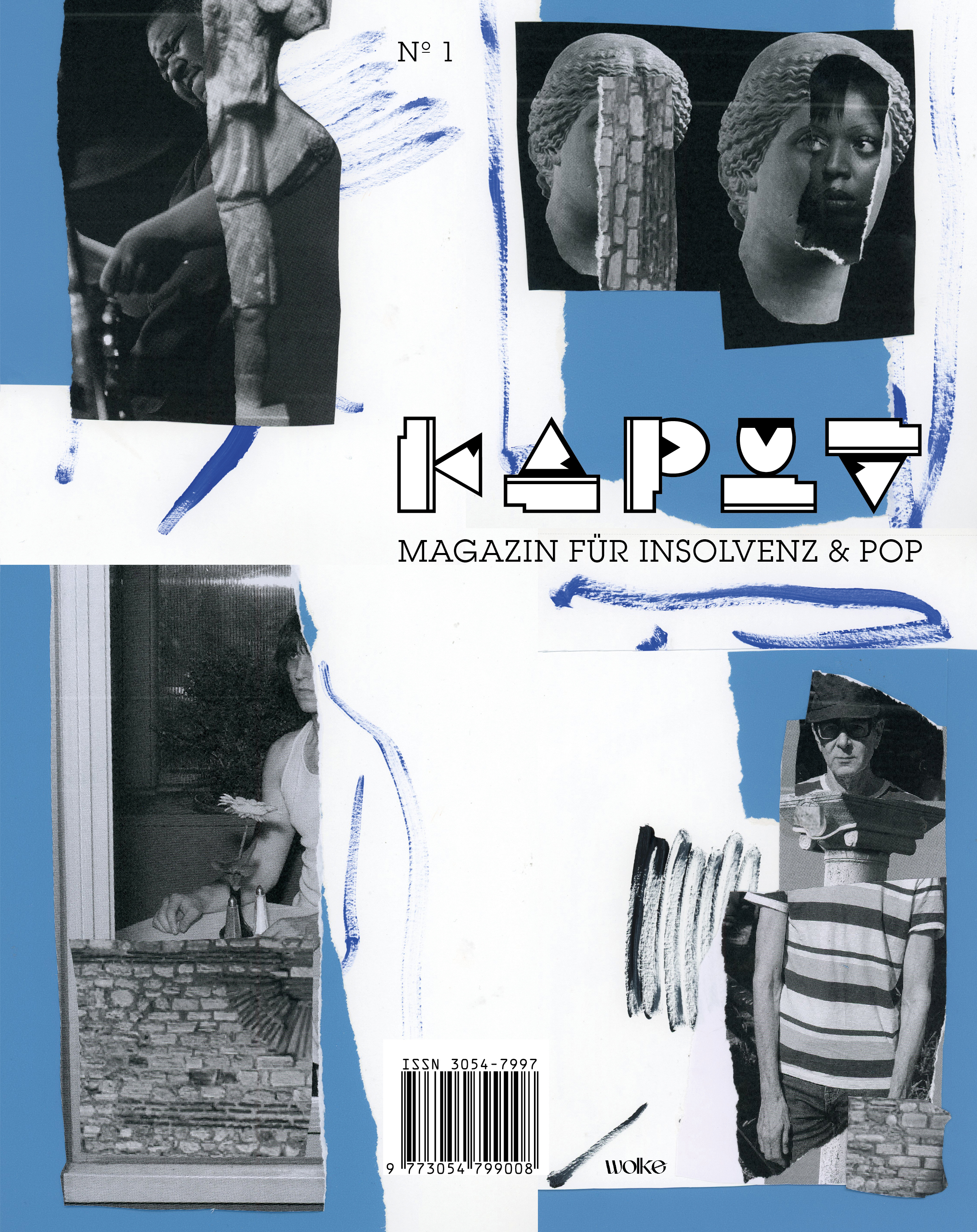
This article is featured in the first print issue of Kaput – Magazin für Insolvenz & Pop. Please order your copies of the kaput print magazine directly from Wolke’s website.
Bookshops and online retailers can find more information on Wolke’s worldwide distribution here.