

Resignation, denial, melancholy: Tocotronic “Kapitulation”
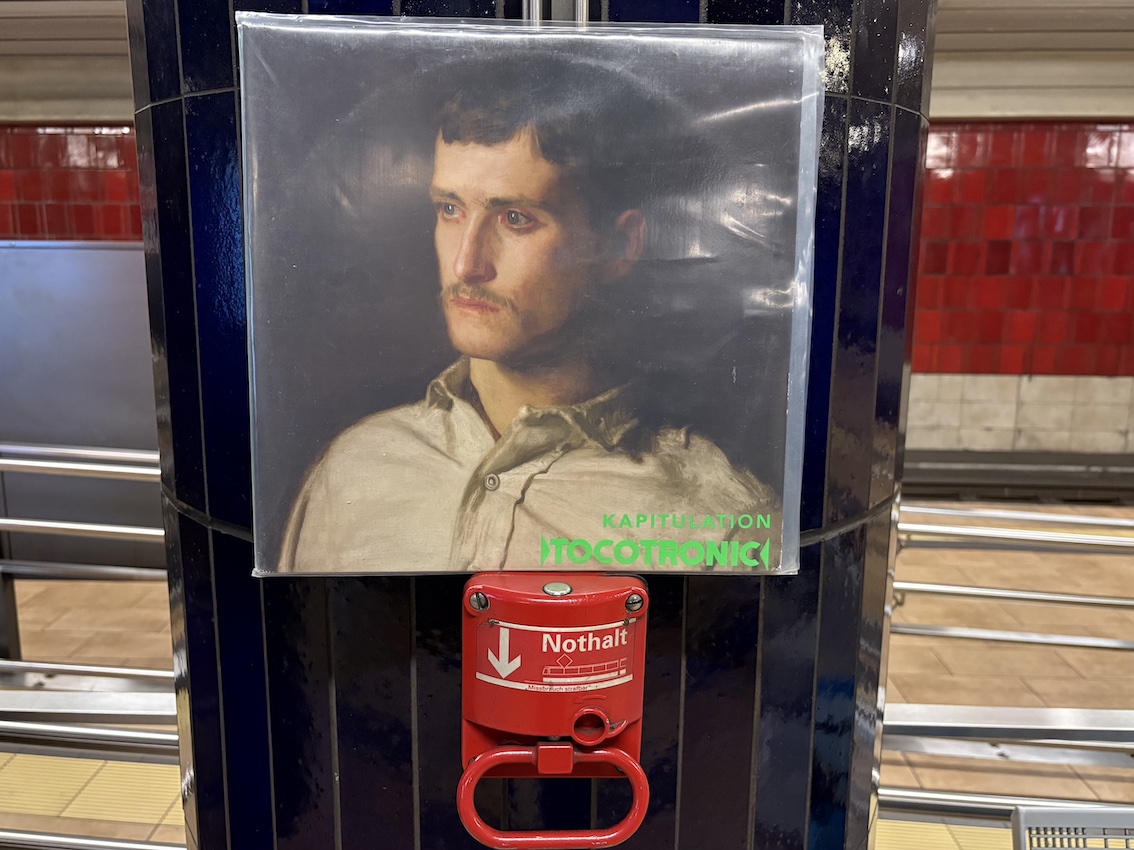
Facing the abyss helpless and defenseless: In the summer of 2007, the album “Kapitulation” was released, the second part of Tocotronic’s so-called Berlin trilogy. The cover is based on a painting by the American artist Thomas Eakins.
 Tocotronic
“Kapitulation“
(Universal)
In 2007, I was in high school and had just begun to take an interest in Camus and Sartre. Then, in my opinion, the perfect soundtrack to accompany this came out: “Kapitulation” by Tocotronic, whose early work I had discovered shortly before.
Resignation, refusal, melancholy—that was the vibe of this poetic and melancholic record, which even comes with a spoken manifesto. Sure, there were some things I didn’t understand, but that’s not always crucial when it comes to music. For me, it made the band even more interesting.
Years later, I listened to the album, produced by Moses Schneider, again. That’s possible because the lyrics are ambivalent. “Kapitulation” could be a new beginning and mean, for example, accepting unsolvable problems as such, admitting mistakes, or recognizing strength in supposed weakness. “My ruin is my triumph, sensitivity and unreasonableness.” However, the anti-nationalist note of the album title made sense to me even at the time of its release. According to the manifesto, “Ka-pi-tu-la-tion” is “the most beautiful word in the German language.”
This was also a necessary contrast to the advocates of German quotas and nationalization tendencies in the German pop landscape in the mid-2000s. Fuck it all!
On the other hand, no identity was postulated on “Kapitulation.” On the contrary: this is about loss of identity, perhaps even about the non-identical. “Whoever says ‘I’ has said nothing yet,” says “Wir sind viele” (We Are Many). And in the love song ‘Imitationen’ (Imitations), Dirk von Lowtzow sings: “There is no true self.” This can be understood as a commentary on the general pressure to be authentic; at the same time, the song seems to allude to Hubert Fichte’s novel “Detlevs Imitationen ‘Grünspan’” (Detlev’s Imitations ‘Grünspan’).
And then there are the references: “I accuse, I accuse, I accuse,” sings von Lowtzow in the enigmatic “Harmonie ist eine Strategie” (Harmony is a Strategy). I went looking for clues with my best friend. We came across a quote from the French author Émile Zola, who denounced anti-Semitism in France in an open letter in 1898: “J’accuse…!” Zola showed solidarity with the Jewish artillery captain Alfred Dreyfus, who was wrongfully convicted and publicly humiliated. In addition to Zola, the anti-Semitic scandal also preoccupied the journalist Theodor Herzl, the founder of political Zionism.
There is also an excellent live album accompanying “Kapitulation”. Shortly before the abrasive Hamburg School punk song “Sag alles ab” begins, von Lowtzow exclaims, “I would prefer not to.” This polite refusal comes from Bartleby, the main character in a story by Herman Melville. But regardless of such references, “Sag alles ab” is rousing and concrete protest punk against pressure to perform and self-optimization, which I grew very fond of at the time. “You never have to go to school again / You will see the light of your life before you.” Then there’s the quiet, tender song “Wehrlos” (Defenseless): Is it about heartbreak and loneliness or addiction problems? Ambiguity as a principle: What timelessly beautiful rock music!