

Art Brut: “Bang Bang Rock & Roll”
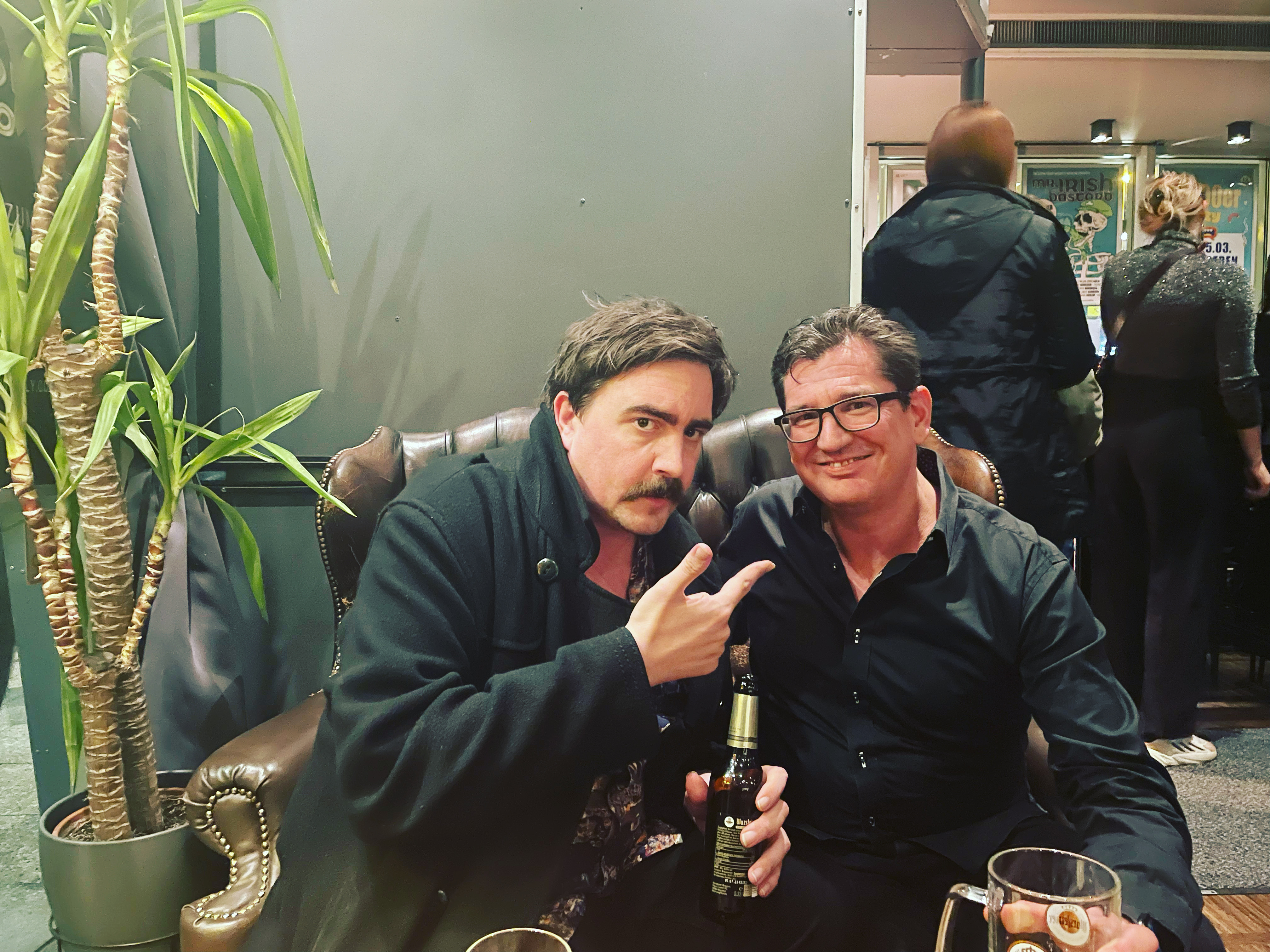
Eddie Argos & Marc Wilde
 Art Brut
“Bang Bang Rock & Roll”
In his autobiographical book, I Formed a Band, Eddie Argos recalls how he dreamt of being in a band ever since he was a kid. Years of longing and gradual exploration erupted in 2004 with Art Brut’s debut single – a three-minute exclamation mark: “Formed a band, we formed a band / Look at us, we formed a band”! With this statement, which also marks the beginning of their full album Bang Bang Rock & Roll released a year later, Eddie Argos puts into words his joy and amazement that his childhood dream has finally come true.
It must still be lying around somewhere in my basement: All Areas Volume 64 – the only promo CD from my pile of music magazine compilations that I still remember. Back then, I couldn’t get over the first song, Formed a Band. Repeat, repeat, repeat…
Bang Bang Rock & Roll was released at a time when guitar-heavy rock music was no longer confined to the die-hard Rolling Stone subscribers, but embraced by a younger, trend-setting crowd. In 2005, the debut albums by Bloc Party and Maxïmo Park hit the market, and shortly afterwards the Arctic Monkeys stormed to the top of the UK singles charts with I Bet You Look Good on the Dancefloor. Art Brut also benefited from the newly reignited rock band hype, but they set themselves apart from the staged coolness of their competitors and engaged their audience with raw punk energy – and, yes, a wink of irony!
The young Brits distanced themselves from the rock ’n’ roll revival, which was largely driven by bands such as The Strokes (“I can’t stand the sound of the Velvet Underground / The second time around” says Art Brut’s title track, offering subtle criticism), as well as from Franz Ferdinand’s sleek, wrinkle-free New Wave sound. The name Art Brut – meaning art born on the fringes of society, far from the pricey galleries of the big city – captures the band’s ethos perfectly: “that we didn’t go to art school, that we embodied the very definition of outsider art. We were punks.” (Eddie Argos: I Formed a Band, 2015).
This attitude permeates Bang Bang Rock & Roll from start to finish (12 tracks in under 35 minutes): from the first hesitant guitar riff, which comes before the opener rushes off with the lines quoted above, to the finale 18,000 Lira, which ends abruptly with the words “sounds like a lot of money”. Together with Stand Down, the two songs form a thematic unity. Both deal with the activities of an Italian terrorist group, a cell of the Red Brigades. Also, the title of Rusted Guns of Milan contains an allusion. According to Argos, the original idea was to make a concept album about the gang and its leader Enrico Gatti, with Luke Haines’ album Baader Meinhof (1996) serving as inspiration.
The project, however, was never realised, just like most of the Gatti Gang’s grand plans – apart from the one “coup”, that the terrorists from Milan pulled off: a robbery in which they stole 18,000 lire (around 9 euros). Lacking driving licences and armed only with ‘rusty guns’, they performed so poorly that their leader finally dissolved the gang in exasperation. Of course, the story sounds too good to be true, and research shows there was probably neither a Gatti gang nor a terrorist named Enrico Gatti. Instead, Argos drew inspiration from Stephen Pile’s humorous collection of incredible failures, The Ultimate Book of Heroic Failures, for his texts.
Another character featured on the album is Emily Kane. Although Art Brut narrowly missed the Top 40 with the single of the same name, the lyrics about unforgettable teenage love and the first shy attempts at kissing resonates with fans who continue to sing along loudly at every Art Brut concert: “Other girls went and other girls came / I can’t get over my old flame / I’m still in love with Emily Kane.” Clearly, lyrics can be simple and yet still hit hard. And here they become true in the memories of the many who listen to them.
Equally true: the album is packed with standout tracks! My Little Brother, Modern Art and Moving to L.A. are – alongside the single and the opener – timeless gems of punk and garage rock that have lost none of their lustre even after twenty years. The raw, three-chord sound is laced with playful, catchy guitar lines. Eddie Argos “sings” everyday stories in a melodic British accent, almost telling them in a casual manner. In the very beginning, he acknowledges his style in the lyrics themselves when he says: “And yes, this is my singing voice / It’s not irony.”
Argos undoubtedly has a talent for effortlessly creating a sense of intimacy and writes about situations that everyone can easily relate to. What’s more, his simple verses are full of vivid imagery that lingers: guns that don’t fire in the Gatti gang serve as a metaphor for erectile dysfunction in Rusted Guns of Milan. Indeed, apart from the title, that is the sole subject of the song, nothing else. Moving to L.A. evokes equally strong imagery: Faced with the English weather, the singer longs for the Californian sun, fantasizes about the Sunset Strip, where he sits shirtless on a Harley Davidson until he finally ends the day with a sundowner. “I am drinking Hennessy / With Morrissey / On a beach, out of reach, so much very far away.” Could wanderlust be put more beautifully into words? Admittedly, the ravages of time may have taken their toll and very few people would want to hang out with Morrissey for a drink these days. Maybe we’ll hear a new twist on those lyrics at one of their upcoming nostalgia concerts. (Watch out! A European tour as special guest of Maxïmo Park has just been announced for March 2026.)
Conclusion: Bang Bang Rock & Roll is an album that simply never gets old – no matter how many times around! A question still remains about the title: why the rock ‘n’ roll reference? Is it meant ironically, given that Art Brut wanted nothing more to do with this genre? After all, doesn‘t I Formed a Band say “it’s not rock and roll, we are just talking to the kids”?
Well, three points can be made here: first, Argos claims that he has never written an “ironic” lyric in his life – even though this is constantly assumed by outsiders. Second, he writes in the book mentioned at the beginning that the title is based on a line in Jonathan Richman’s song Cappuccino Bar, and that “Bang Bang” in this context sounds like “shooting at rock and roll itself with a gun, trying to kill it.” Third, one should not take everything he writes or says at face value. Eddie Argos is a trickster who knows how to entertain. And a punk.