

Unbuilding the Built: Klara Lidén at Kunstwerke
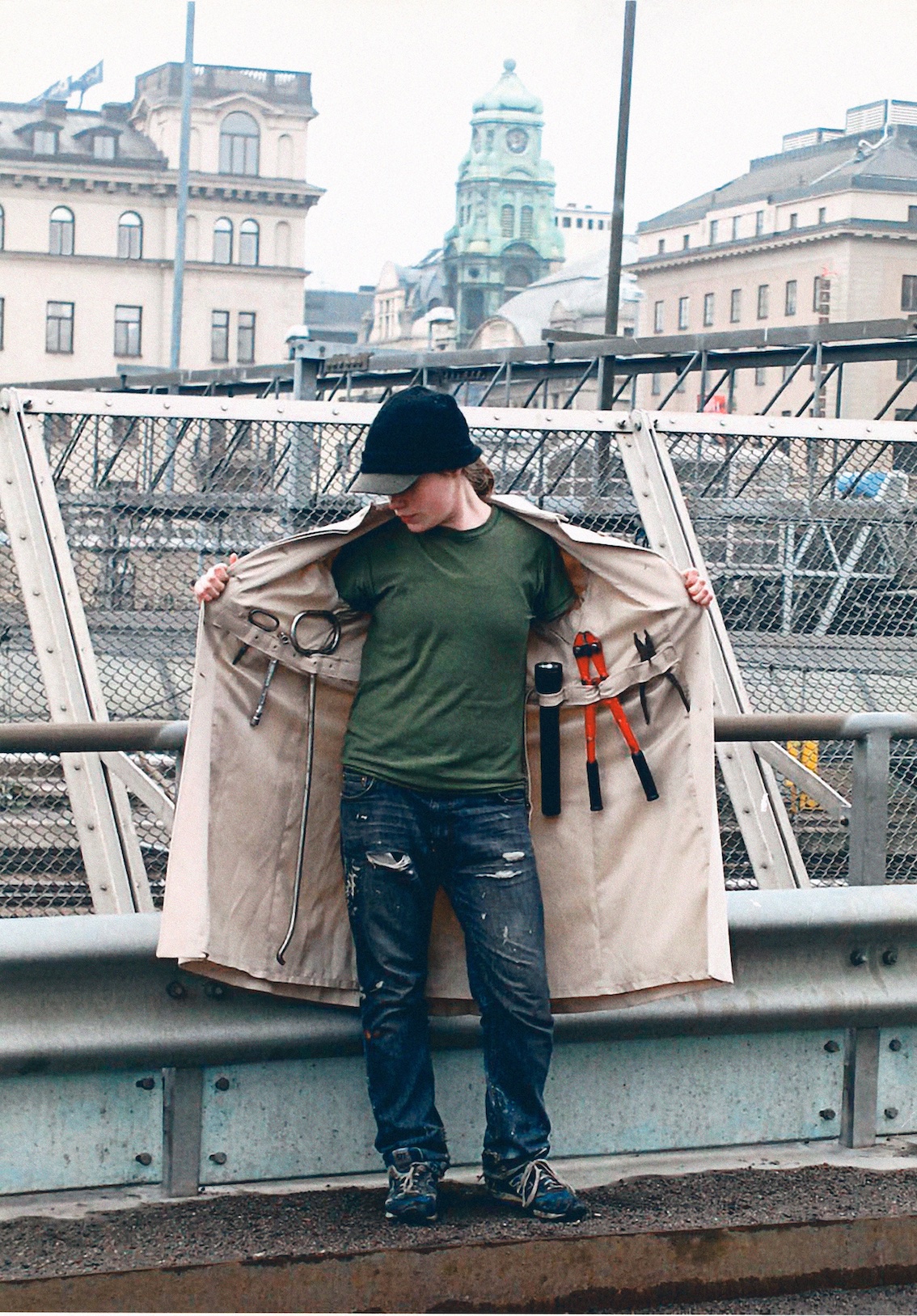
Klara Lidén, Self Portrait with Keys to the City, 2005. Courtesy the artist.
The presentation of Klara Lidén at KW Institute for Contemporary Art on this scale offers an inspiring encounter, marking a significant moment in the artist’s institutional recognition. What makes this encounter compelling, however, is not how Lidén’s practice settles into an institutional framework, but the extent to which it continues to unsettle its boundaries. The exhibition can be read, throughout, as a gesture oriented less toward building than toward dismantling, less toward defining than suspending: in the artist’s own terms, unbuilding.
If building implies the coming together of parts into a coherent whole over time, producing form, order, and continuity, Lidén’s practice reverses this process. Rather than stabilizing materials sourced from the urban environment into a new unity, the works detach them from their functional and spatial contexts, holding them in a state of indeterminacy. Positioned at the entrance of KW, Unheimlich Manöver (2007), in which the artist dismantled the entirety of her Stockholm apartment and reassembled it within the exhibition space, does not reconstruct the idea of ‘’home’’; instead, it disperses it, turning the familiar into something unsettlingly fragmented.

Photo: Klara Lidén, Unheimlich Manöver, 2007. Courtesy Moderna Museet, Stockholm. Stiftung 2011 von Lena und Per Josefsson, 2011 (Nordic Collection). Installationsansicht der Ausstellung Klara Lidén – Kunstwerke in den KW Institute for Contemporary Art, Berlin 2026. Foto: Frank Sperling.
Similarly, Rosie Rosie (2026) relocates temporary passageways from the streets of Berlin into the exhibition space; in doing so, it does not resolve their provisional nature but suspends it, leaving them caught between ‘’there’’ and ‘’here.’’
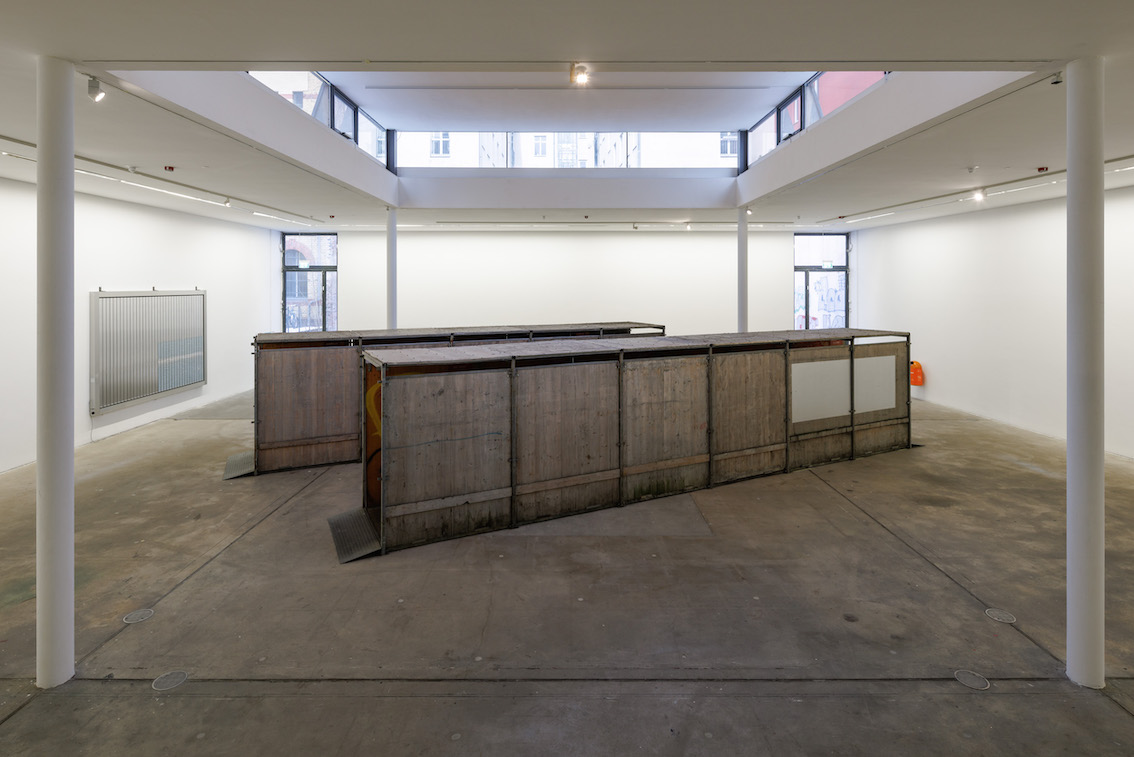
Photo: Installation view of the exhibition Klara Lidén – Kunstwerke at KW Institute for Contemporary Art, Berlin 2026. Courtesy the artist. Photo: Frank Sperling.
At this point, Lidén’s practice also unsettles established assumptions about how urban space is read and understood. Erased highway signs, disused streetlights, or layers of posters stripped of their images reconfigure the visual and utilitarian language of the city through subtraction. This subtraction does not produce absence so much as it opens a field in which meaning is held in suspension: space no longer appears as a singular, legible whole, but as a fragmented sequence requiring reassembly.
This dissolution does not remain at the level of objects alone; Lidén’s engagement with the body turns unbuilding into an action to be experienced. In Grounding (2018), the body repeatedly falling while walking through the streets of Manhattan, or in The Myth of Progress (2008), moving forward while seemingly slipping backward, interrupts the continuity that spatial order presumes. These gestures suspend core assumptions of modern spatiality, progress, direction and control, while rendering the choreography of everyday movement visible. It is here that Lidén’s figure of the ‘’amateur dancer’’ emerges: a counter-practice operating through rhythm, repetition, and deviation against disciplined and predictable patterns of movement.
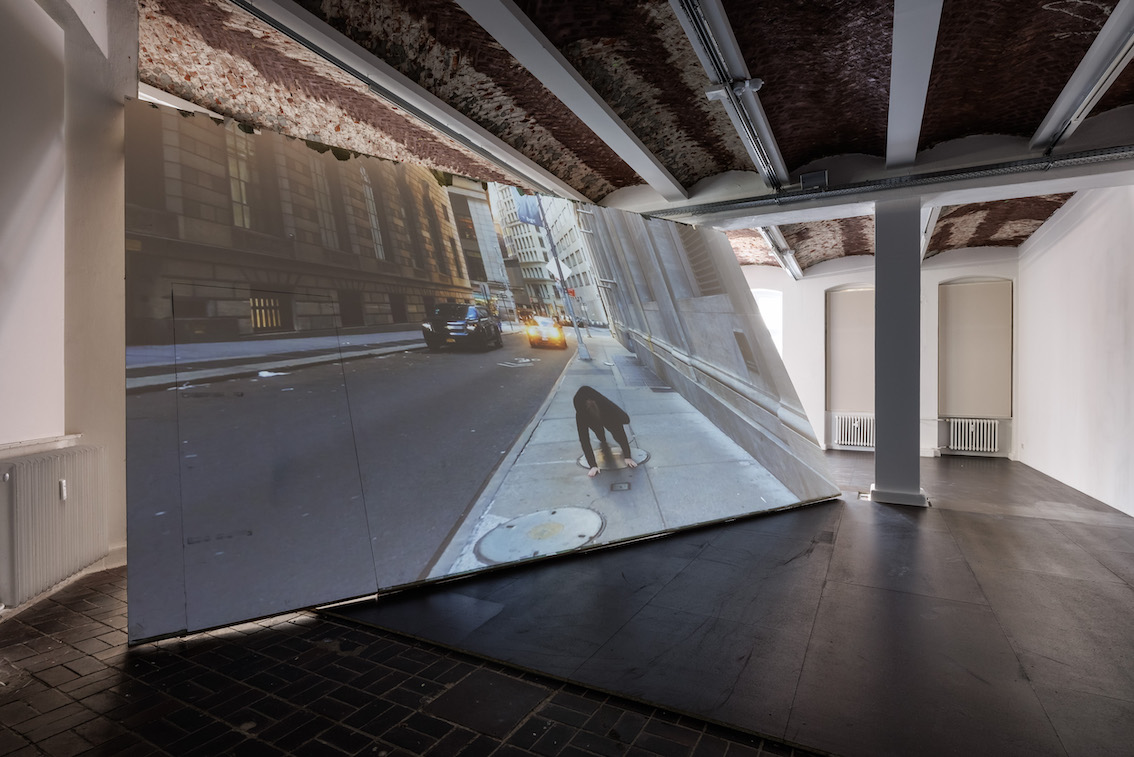
Photo: Klara Lidén, Grounding, video still, 2018. Courtesy the artist, Galerie Neu, Berlin, Sadie Coles HQ, London and Reena Spaulings Fine Art, New York. Installation view of the exhibition Klara Lidén – Kunstwerke at KW Institute for Contemporary Art, Berlin 2026. Photo: Frank Sperling.
Lidén’s interventions do not seek to produce a new and coherent form; rather, they open up a field in which form itself becomes unstable. Space appears here not as a completed whole, but as an ongoing process of dissolution whose boundaries cannot be fixed. The body’s faltering and shifting movements expose the invisible rules that structure spatial order, while revealing that this order never fully closes. While architecture often seeks to stabilize this flux by turning space into ‘’place,’’ producing identity and continuity, unbuilding reverses this process, reopening space to indeterminacy, transience, and possibility.
For this reason, the exhibition proposes a counter-spatiality against the neutralizing tendencies of the exhibition space, one constituted by traces and acts of subtraction. Rather than a completed whole, what emerges is a structure in continuous disintegration, resistant to reconstitution. Lidén’s practice does not reject architecture’s desire to give form outright; instead, it loosens it from within, interrupts it, and opens it toward other possibilities.
The exhibition is on view at KW Institute for Contemporary Art until 10 May.