


The reduced and stirring origin: Lucrecia (Dalt)’s “Congost”
 Lucrecia Dalt
“Congost”
(Pruna Recordings 2009/2010)
In 2014, I attended the wonderful festival for people who don’t like festivals for the fifth time: “Madeiradig” – in the middle of the Atlantic on that once sleepy Portuguese island of flowers, hiking, and retirees, which has since unfortunately become a gentrified stronghold for digital nomads. Tragically and happily at the same time, the festival ended last year. And it was, as my festival ‘neighbour’ and fellow “living inventory” Jens Balzer once said, the ideal mix of noise and wellness.
In 2014, I attended the festival (as in 2017 and 2022) with a fantastic group of pop music students from Paderborn University. In addition to the actual superstar of the festival, the setting, and numerous great hikes, excursions, chill-outs, workshops, talks, and parties, various performances remain unforgettable, but especially the aftershow set by the multi-instrumentalist and transdisciplinary artist Lucrecia Dalt blew my mind, who was unknown to me until then.
Standing on the cliffs of the truly wild Atlantic Ocean (see the photo from 2010 on the harbor promenade in Madeira’s capital Funchal after really violent storms) and listening to mostly electronic and often very experimental pop music is a pure little luxury (probably a big one for some) – and already quite predestined. Or as one student put it at the time: “How f***ing cool is this?”
Amidst this euphoria, Dalt’s solo concert crept in with lots of (effect) devices on the DJ stage behind the festival hotel at the dance rock of Ponta do Sol. Dalt enchanted us—and me. I don’t mean that in a silly, boyish way, even though that was definitely a prejudice some of my female friends had at the time. The proportion of men among the curious crowd rushing towards Dalt, including the desire for recordings and vinyl (which were also available from her suitcase) after the all-too-short show, was clearly evident in everyday experience. Fair enough – we seemed to have fallen head over heels in love with her pop music.
For me, however, there were completely different triggers at work: strangely positive moments of memory and future music. I literally fell into this unique performance, certainly captivated by the wonderful atmosphere described above. For me, Lucrecia Dalt tied in with the somehow mysterious aesthetics of acts from the eighties – such as Wire (in their softer phase), whose Colin Newman with his partner Malka Spigel (from Minimal Compact), or the ungrufty, un-punk version of Tuxedomoon and their incredible album “Holy Wars” from 1985, before Winston Tong disappeared.
Thanks in part to Cologne-based author Oliver Tepel, I was back on the road again, exploring the dazzling cosmos of art-new-no-wave-synth-avant-pop-post-punk Central European labels such as “Les Disques du Crépuscule” and “Crammed Records / Cramboy Records”. At the same time, however, I thought I could hear many shy post-rock moments from the late nineties and early noughties, such as Tarwater, Lali Puna, Múm, and Notwist. Not least because wonderful Gudrun Gut was an early supporter of the Colombian-born artist. To put it short, Lucrecia, within her songs, was uniting my pop musical past, presence and future.
I asked Lucrecia about these references, but she was neither aware of them nor familiar with them at the time. Progressive yesterday, by then. At the same time, Dalt carried a lot of Berlin (see above) and Barcelona club culture from the turn of the millennium with it, whether experienced firsthand or imagined. Entirely in the here and now and in their own right, her sounds and song tracks lingered on the high cliffs of Madeira, yet already hinted at rays and sketches of the future, which were to become even more intense in Dalt’s further work between music, film, theater, performance, and experimentation—right up to the more abstract albums “Anticlines” (2018) and “¡Ay!” (2022).
In addition, Lucrecia Dalt represents for me—and here we arrive at the quarter-century mark, fundamentally on the “Madeiradig”—a kind of performing, melancholic, and somehow very modestly melodious center and intersection of all that is noisy (e.g., Pharmakon), abstract (e.g., Lee Ranaldo), concrete (e.g., Amnesia Scanner), artificial (e.g., Sonic Boom), and also deeply human (e.g., Grouper). These 15 years with Lucrecia Dalt at the center of the festival and the ocean absorbed, drained, and exhausted a lot. They opened up new worlds for me (again) – and Dalt, with her music, also gave me access to the Spanish and Portuguese languages, as well as to appealingly Spanish, Portguguese, and Latin American offbeat pop music beyond the expected: for example, Melenas (including Grauzone’s cover of “Osar Polar”), Nicolás Jaar, Föllakzoid, Lorelle Meets The Obsolete/J.Zunz, Rodrigo Leão, and many more.
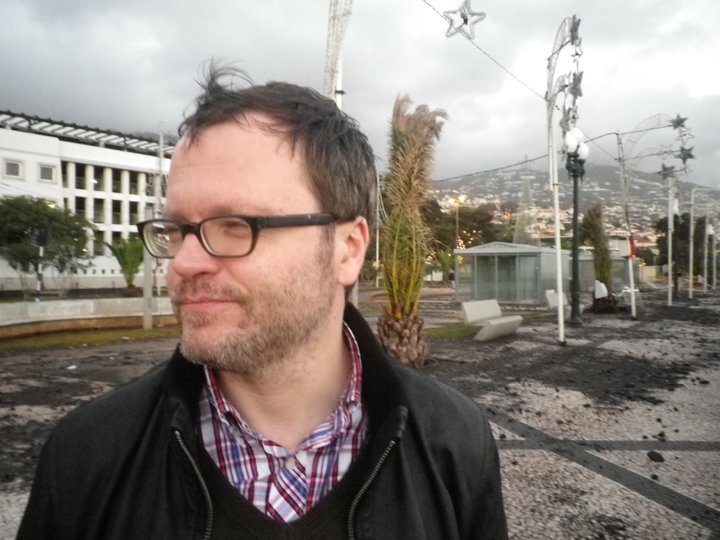
Foto: Madeiradig 2010, Funchal (Photo: Christoph Jacke)
Incidentally, the seminar excursion attempted an interview with Lucrecia at the time – but this was met with well-founded reluctance on all sides and was therefore not successful in terms of publication. Perhaps in other senses, however. So it was both a shame and a blessing.
Actually, Lucrecia initially called herself by her first name on her early second album “Congost”, of which I own two versions (which differ in three songs), without the sir name “Dalt” (at least on one of the versions). Maybe she symbolically had been on search of a full name. Nevertheless, this early album by the Barcelona and Berlin resident inevitably reflects her attitude full of art/new wave, indietronics, post-rock, folk, and songwriting experiments and excursions. Later, she tried out many more abstract styles. She now works with prominent and appropriate guests such as her partner David Sylvian, who embellish the hybrid forms of all her skills and arts – as is currently manifested quite fabulously on the new album “A Danger to Ourselves.” What a story, because David Sylvian’s album “Gone to Earth” from 1986 was the first compact disc I ever bought. What a sound!
For me, “Congost” remains the reduced and rousing origin of her music – listen to ‘Ara’ or “Extraña Colección.” Since then, I have listened to or played her music repeatedly in various mixes, sets, and sessions, allowing myself to fall into this colorful cloud and open up to (my) great love. Because in it—in songs, clouds, love, and me—there lives something so unfathomable, inexplicable, between daydreams and nightmares, between all the sad and beautiful things.
Lucrecia Dalt sets my touching life to music with her delicate yet powerful music, even though I don’t speak her native language. But I think I am truly understanding. I am floating with my love into the next quarter of a century.
P.S.:
Making a selection is extremely difficult. And when it comes to narrowing down the selection, I somehow become listless—the narrower it gets, the more disgruntled I become, a super brutal reduction in complexity, so to speak. And also a bit stupid. How am I supposed to condense my musical worlds so drastically? That’s why I’d like to ‘spontaneously’ mention the last albums by Nikki Sudden, Rowland S. Howard, The Jazz Butcher, Boards of Canada, The Postal Service, Kim Gordon with Sonic Youth, Mazzy Star, Shellac, The Chills, Surrogat, as well as the first albums by Gewalt, HTRK, Messer, Die Nerven, Karies, Die Heiterkeit, Candelilla, Friends of Gas, Burial, Bersarin Quartett, Kim Gordon without Sonic Youth, and so on—and the ever-superb albums by Aldous Harding. It is only from these and many others, some of them forgotten, and Lucrecia Dalt, that the soundtrack of 2020–2025 as I perceive it emerges.