

Macaroni synthesis revisited… on the life, work and philosophy of Yasunao Tone (1935-2025).
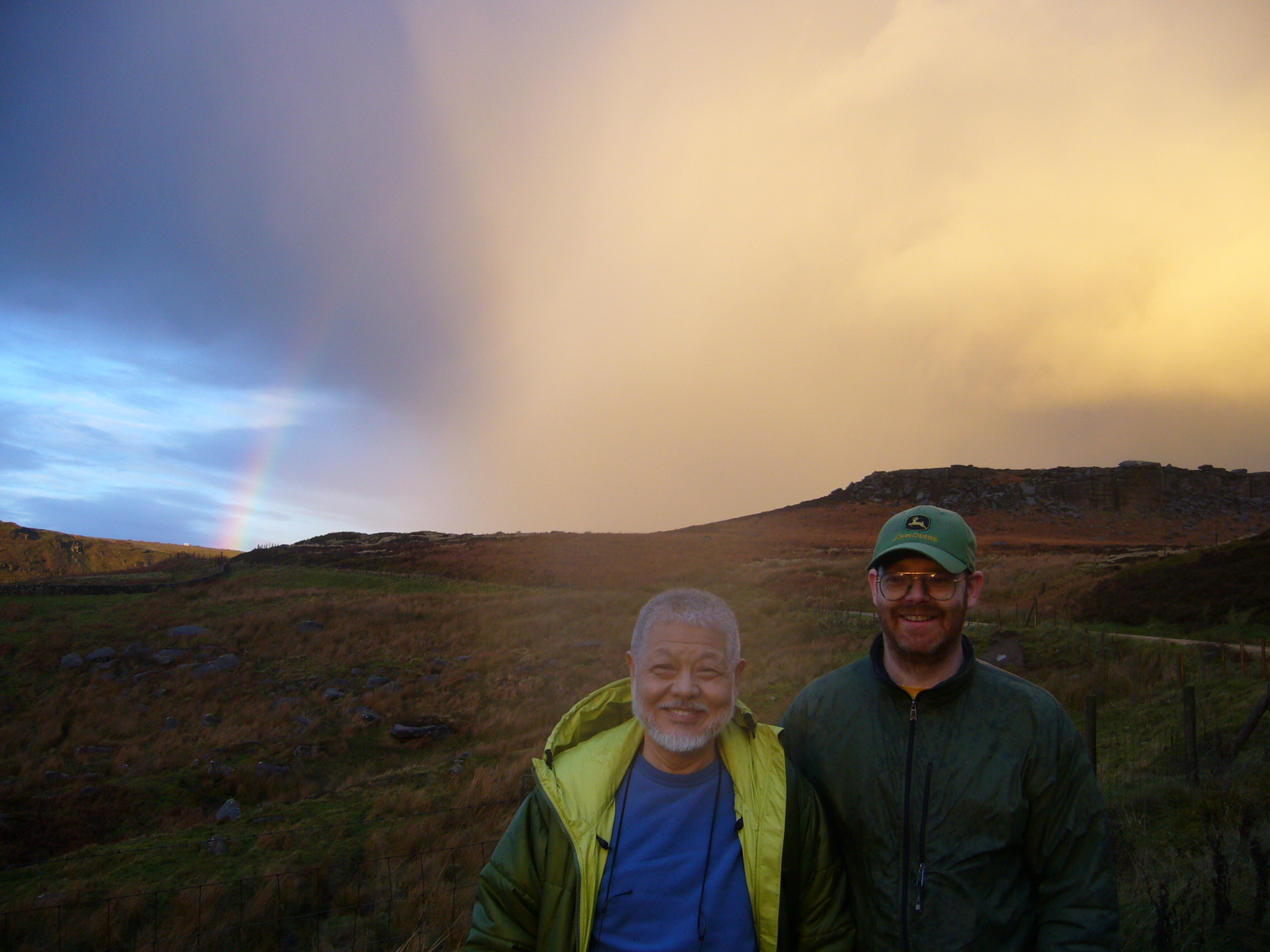
Yasunao Tone & Mark Fell (Photo: Mat Steel)
Macaroni synthesis revisited… on the life, work and philosophy of Yasunao Tone (1935-2025).
Mark Fell, 2026
I was in Milan preparing for a show at The San Fedele Auditorium when I heard of Tone’s passing. It had been years since I last saw him. Our email correspondence had become intermittent, and more or less stopped mid-2024. In those last few weeks of his life, not knowing of his imminent passing, I had been telling myself to get a flight over to New York and spontaneously visit him. But I didn’t. He died the day of my show, and I spent the entire performance thinking of him – what he meant to me and so many of my colleagues and friends. This reflection has taken so long to put into words, partly because I know I cannot do justice to the character of his work, his life, or his massive contribution to contemporary culture.
It feels so strange that now, myself a middle aged guy, I am looking back at Tone’s life, including times before I ever knew him. All those years ago as an aspirational young artist I would have never imagined myself in this role.
Rather than just being a dry biography of Tone’s life, I’ve tried to focus on the bits I know the best – from after the year 2000, the conversations we had, and my observations about his practice and approach.
Tone was born in Tokyo in 1935 and went on to study literature at Chiba University, becoming increasingly interested in avant garde poetry and experimental music. He wrote a graduation thesis on Surrealism.
In 1958 he co-founded Group Ongaku, one of Japan’s earliest improvisational and experimental music collectives, predating European free improvisation scenes such as the UK-based AMM, established by Keith Rowe, Eddie Prévost, and Lou Gare in 1965. The group emphasised unconventional processes: non-hierarchical interaction, the absence of a conductor, and a rejection of fixed harmonic frameworks. Performances frequently incorporated found objects – kitchen utensils, radios, and tape recorders – alongside or in place of traditional instruments. A CD of their work, Music of Group Ongaku, released in 1996, brings together recordings that showcase the group’s wide palette of sound sources, from unusual electronic textures and acoustic materials to traditional instruments. The music is a collision of contrasting elements – erratic sounds, sparse passages, fragile textures, and sudden pauses in energy – across pieces that range from brief works lasting only a few minutes to extended sections of more than 25 minutes. In many respects, Group Ongaku laid important groundwork for later electronic and noise-focused traditions in Japan and beyond. I have a vague recollection of Yasunao telling me that he played saxophone on some of the tracks. I’m now listening back to Metaplasm 1-19 and there it is, perhaps played by Tone, entering at about five and a half minutes: a squealing and squawking, restless and jagged trajectory that would anticipate the character of his later works.
Early in the 1960’s Tone formed an association with the emergent Fluxus movement in New York, and subsequently coined the term “Tokyo Fluxus” to designate a vital segment of the global movement. He also became friendly with Hi-Red Center, a short-lived Japanese avant-garde art collective active in Tokyo from 1963 to 1964. Known for its provocative “events”, Hi-Red Center challenged postwar Japan’s social conformity and the conservative art world.
Tone personally taught one of its members, Genpei Akasegawa, how to compose non-traditional music. When Akasegawa became a defendant in the famed Model 1,000-yen Note Trial, charged with counterfeiting for producing works featuring copies of Japanese notes, Tone served as the artist’s chief strategist. He worked with the defense attorney to organise an impressive list of art-world witnesses, produce trial-related “conceptual works on paper” (such as Invitation to the Trial and Reports on The Trial Proceedings), and helped stage a “courtroom exhibition event” on the first trial date in October 1966. Although Akasegawa was eventually found guilty, Tone went on to focus on art-critical writings, which were compiled as Phases of Contemporary Art: Can Art Be Thought? (1970). Together with the young artist Naoyoshi Hikosaka, he also compiled a massive 400+ page timeline, “Chronology: Five Decades of Contemporary Art, 1916–1968” for the art magazine Bijutsu Techō in 1972.
That same year, after spending six months in San Francisco, Tone moved to New York where he lived with his partner Chie, becoming a central figure in the downtown experimental art scene. When I met Tone many years later, I asked why he had moved to North America. He replied, “to change myself”.
In 1982, Tone premiered his pioneering work “Molecular Music”, consisting of a 16mm film projection depicting images of a brush as it paints calligraphic characters. Light sensors were placed on the screen and connected to custom-built analogue electronics that converted the voltages into synthetic sound. For me, this piece represents an important milestone in Tone’s lifelong interest in exploring the relationships between written language, the act of writing, and sound – and therefore also the nature of language, thought (in its most expansive sense) and being.
This interest is extended in the 1993 work “Musica Iconologos”, which I believe was produced at McGill University’s Electronic Music Studio and Computer Music Lab. The two pieces on the CD release, “Jiao Jiao Fruits” and “Solar Eclipse in October”, are sonifications of Chinese characters.
What is striking about “Molecular Music”, and the later “Musica Iconologos”, is that their sonic character is vastly different to any other contemporaneous works of which I am aware. There are, I think, some sonic similarities with Herbert Brun’s Dust (1976), but in terms of time-structure (shape, change, density, etc) Brun’s work is clearly very different from Tone’s. I wonder how Brun’s formal education as a pianist shaped his approach to structure “as composed”; in contrast to the influence to contemporary philosophy and avant garde literature on Tone’s concern with process, action and emergence. In my opinion, Tone’s brutally jagged shards of electronic sound refuse to build any sort of narrative arc or structure – they simply shape shift at a “molecular” level. And this, I think, is true of what is arguably his most famous work, “Solo for Wounded CD”, released on CD in 1998.
“Solo for Wounded CD” involves the playback of prepared CD-Rs, the surface of which is scored with a knife onto which clear tape is applied. This intervention disrupts the linear playback of the recorded material and foregrounds the CD player’s unsuccessful attempts to maintain linear playback, by focusing on the machine’s error correction system. I watched this performance many times, and observed closely how Tone would very carefully and skilfully tap the side of the CD player to induce these disruptions. Although this work has been the subject of substantial academic discussion, few writers have acknowledged the importance of the specific CD player that Tone used in this work. On one of my many trips to his home he asked me to accompany him on a trip to Queens where a second hand hifi retailer had several of the CD players that Tone used. He bought all five. These were very heavy, and as Tone was my senior I offered to carry them, awkwardly taking them on the subway back to his place on the corner of West Broadway and Canal Street. Upon arriving home he excitedly told Chie that I had carried them all the way. Both Tone and Chie quickly set about unboxing and testing the units, connecting them to old computers and oscilloscopes. It was a very precise operation. I regret not noting the specific model of CD player, but I think the maker was Philips. I also regret not asking Tone to play me an untreated CD-R, as I still often wonder what the original sound was. I suspect it was something from the development of “Musica Iconologos”.
Despite the magnitude of academic writing surrounding this work, I think “Solo for Wounded CD” is perhaps the most misunderstood of Tone’s projects: an allegation that would have delighted him. Nonetheless it is important that we look beyond the rhetoric and buzzwords in order to understand the complexity of the work. Academic analysis of this piece often also mentions the slightly earlier work Systemish by Oval (1994), which similarly foregrounds the sound of a CD skipping. These works were said to herald the emergence of what became known as “glitch” music.
Tone was an avid and capable reader of German phenomenology and French post-structuralism, both of which question popular beliefs about technology as essentially passive tools, as well as challenging romantic descriptions of authorship. His apartment had a large library of works in both Japanese and English. Tone was one of the earliest readers of these theoretical texts, as gleaned from Phases of Contemporary Art, his 1970 book in Japanese. He would immediately pinpoint a specific book or text as we discussed Heidegger, Husserl, Nietzsche, Derrida and the like. Whilst Tone’s understanding of these traditions was exceptionally detailed and nuanced, much of the writing on his work reduced these multifaceted philosophical jigsaw puzzles into overtly simplistic readings of his work. For example, seeing it as some kind of power struggle between the human and the technical in the dominance for the construction of meaning. Similarly, in much of the promotional material around the release of Systemish, passages refer to machines and processes as having authorial dominance in the production of the work, where the role of the artist is reduced. However when we read interviews with Markus Popp (aka Oval) he clearly describes a very careful and considered process of editing together segments of skipping CD in a digital audio workstation, which mirrors a traditionally linear compositional process. In this sense, while Systemish might be read as a modern fable about the attenuation of authorial control, it is certainly not a product of any such attenuation. Furthermore, in my many discussions with Tone, he rejected the belief that humans and technology were somehow in opposition with one another.
At this point in the history of electronic and digital music several distinct projects began to emerge. Although they were strikingly divergent in terms of both aesthetics and methodologies, they seemed to somehow constitute a movement. I mark this period as starting roughly about 1995, and centred on labels including Sähkö, Mille Plateaux, Touch, and Mego (among others). Taken collectively, their catalogue indicated an acute awareness of “popular” forms of electronic music, particularly North American techno (its early innovators including Derrick May, Anthony Shakir, and Underground Resistance to name a few) as well as the earlier and primarily European strand of industrial music (Cabaret Voltaire, Throbbing Gristle, and so on). To some extent this disparate movement also bore a willingness to engage with avant-garde electronic composition and performance. I’m thinking for example of 20th century computer music, and the output of many state funded and academically situated experimental electronic music studios dotted around the world.
In this context, following an article about Tone’s work in Music No. 1 (1997), there was increased interest in him among these circles, particularly among artists affiliated with Mego including Russell Haswell and Florian Hecker. Haswell had purchased Tone’s “Musica Iconologos” (circa 1993/4); and in 1998, while working as a curator at PS1 in New York, Haswell made contact with Tone via Gary McCraw at Music Magazine.
It was around this time that I first met Tone. Anna Ramos and Roc Jiménez de Cisneros, of the record label Alku, had given me a copy of a mini CD-R, Tone’s Wounded Man’Yo #38-9. And in 2001, as a music co-curator along with Mat Steel at the Lovebytes digital arts festival in Sheffield, we invited Tone to present “Molecular Music” and “Solo For Wounded CD”. I think this was his first performance in Europe for several decades, and further cemented his importance to our generation of artists. Without claiming any responsibility for his recognition within this emergent community, I feel lucky to have been able to contribute to it. In parallel to this, he was recognised at ARS Electronica with a Golden Nica in Digital Musics.
At this point Tone became a central figure in that younger and emergent family of artists, as well as a recognised historical precursor to our practices. I think it’s fair to say that he successfully migrated from his earlier embedding in Fluxus, to scenes around festivals including Sonar, Transmediale, Unsound and the like. Back then, when I spoke to him about his involvement with Fluxus, he replied that he felt more closely connected to his newer audiences and his younger contemporaries.
The following year I was working as a researcher in computer science at Loughborough University with the pioneering British artist and computer scientist Ernest Edmonds on a project exploring technological and aesthetic co-evolution. We invited Tone as a resident artist where we prototyped a new work. Reminiscent of “Molecular Music”, it used an interactive white board to translate calligraphic writing into synthetic sound. I remember we had a meeting about the use of granular synthesis as a means of producing sound, whereby a sound file is chopped into a number of small “grains” which can be reordered to produce new textural materials. I will never forget the proud grin on Tone’s face, anticipating the pleasure in what he was about to say: “I prefer ‘macaroni synthesis’ because it has a form” – macaroni being composed of grains formed into a given geometric structure. This joyous fusing of mischief, irony and criticality was typical of Tone. The Loughborough project marked the beginning of around 15 or so years of our close working relationship; his partner Chie jokingly referred to me as “the British connection”, a title I accepted with honour. In 2004, Tony Myatt invited us to perform at the opening of the Music Research Centre at University of York (UK) where we collaborated on two new works: the first a counterpart to “Molecular Music” using digital synthesis; the second, “Sonographia” for graphics tablet and digital synthesis. These were the only projects that we co-authored.
In 2007, Mat Steel and I once again brought Tone back to the Lovebytes festival, commissioning him to make a new work for 4 screen projection, graphics tablet and real-time multichannel synthetic sound. The result was a 3 hour performance in the Sheffield Central Library. The piece’s title “495,63” referred to Dewey classification of subjects used in libraries, and specifically to “Japanese language dictionaries (dictionaries and bilingual dictionaries)”.
My work with Tone took a very unlikely combination of roles: as a curator I was able to commission works from him, while simultaneously working as a technical developer to support him in the realisation of those works. So I had a unique and unusual multi-perspective access to his process, enabling me to see how detailed technical issues were tangled up with conceptual and aesthetic concerns. For example, in the development of “495,63” Tone requested that the sound made by longer strokes should be played over speaker 1, whereas shorter strokes would make sound in speaker 8. This seemed sensible enough, but there is no way of knowing the length of a stroke until it is completed, and hence no way of knowing in advance which speaker it should emanate from. I suggested to Tone that the length of the stroke should determine the spatial placement of the following sound. In this way it broke the pattern of long sounds always emanating from speaker 1, and short sounds emanating from speaker 8, yet it also had a structural logic whereby this temporal displacement of one step created complexity. This technical issue therefore informed what could be seen as a conceptual element of the work where structural deferral becomes a fundamental feature in the construction of its meaning. However, I think Tone might agree with me here, that the technical, aesthetic and conceptual aspects of work are intrinsically inseparable – or, that our means of analysis has insufficient critical resolution to untangle them.
In 2009, I was again working as a researcher with Tony Myatt again at the University of York on a project called “New Aesthetics In Computer Music”. We invited Tone as a resident artist, where we worked on Tone’s “MP3 Deviations”, with then PhD student Pete Worth being the main software developer, working along with myself, Tony and Tone. The following is an extract of an email from Tone to me, where he first raises the suggestion of MP3 deviation as a possible area to explore:
I thought it will be interesting to see after all the change from the mp3 original to error induced sound with pitch shift and a short channel exchange, timbre alteration, then add considerable length of pulse generation would be interesting. If result is satisfactory. So, we will experiment and I like to see the maximum possibility. – Email Exchange 2009.
This sort of technical specification was typical of Tone. Consequently, for each of his projects I would spend hours trying to decipher what he actually meant. It was a great relief when, at his memorial at Artists Space in New York, Dave Meschter explained how he also spent hours puzzling over exactly what Tone wanted, when he was asked to develop a flute-to-computer speech system for the Commodore 64 in the 1980s. It was a system I later helped Tone revive around 2005. Now some 20 years later, I listen to Meschter’s account, and somehow a circle of temporally displaced shared experience is completed.
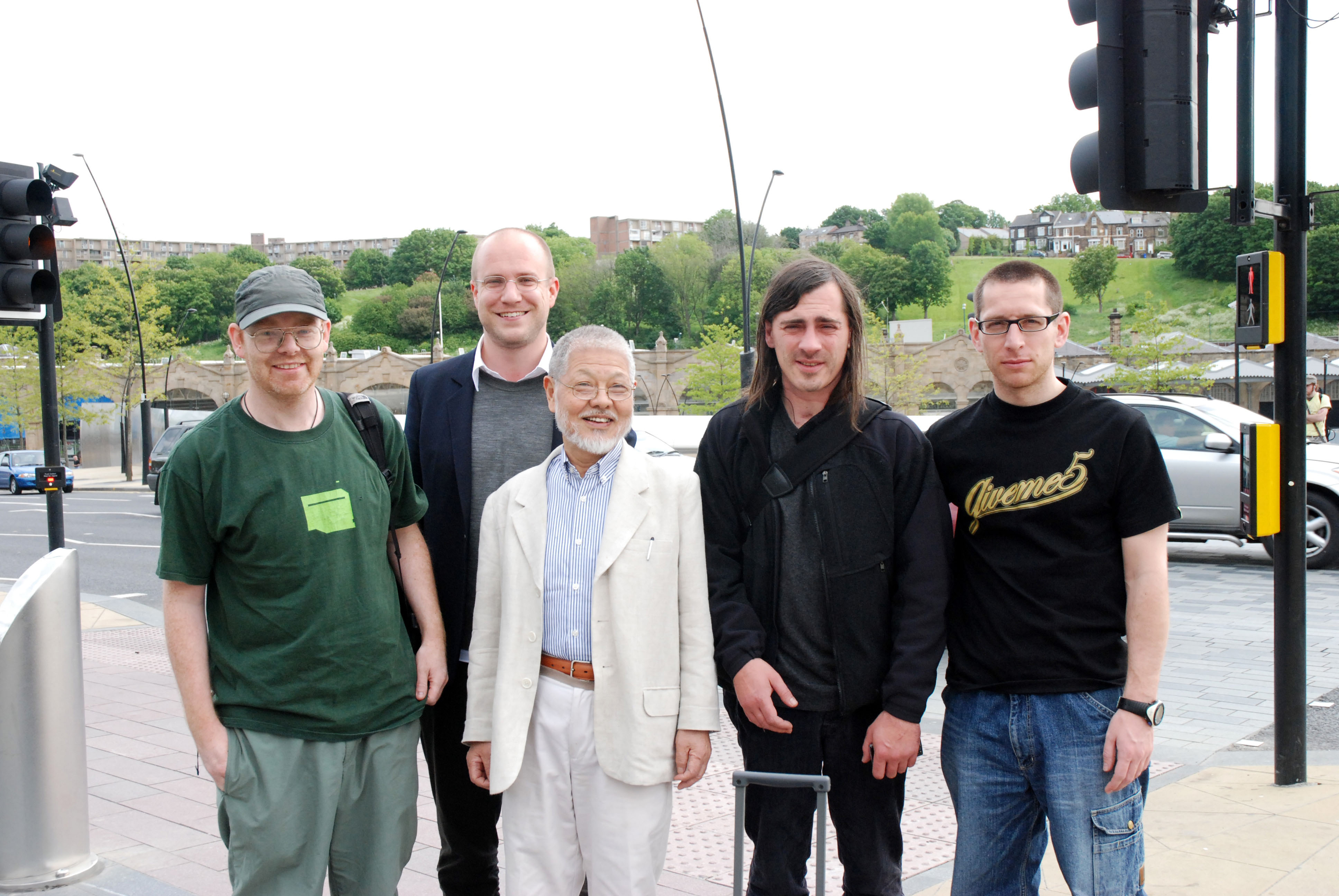
Mark Fell, Florian Hecker, Yasunao Tone,Russel Haswell, Mat Steel (Photo: Aoki Takamasa)
After so many years of working with him I became a sort of “Tone-whisperer”, and around 2015 I was invited to work on the development team for “AI Deviations”. Again led by Tony Myatt but this time at The University of Surrey (UK). My role was as a kind of go-between, helping the programmer Paul Modler (from Staatliche Hochschule für Gestaltung Karlsruhe) form a clearer understanding of Tone’s intentions. But Tone seemed to deliberately throw out decoy statements. It was Tone’s characteristic fusion of mischief, irony and criticality continually at play. Here I realised the greater significance of this methodology: it gave room for the unanticipated to emerge. In one of our conversations Tone once referred to a concern for “the field beyond intentionality”. In this sense our role as developers was not so much to understand Tone’s intention, but to fill in its deliberate gaps. I asked him why he had an interest in systems as the basis of his practice, he answered “to get to a place that I could not imagine”. For me, this statement correlates with the reason he gave for moving from Japan to North America “to change myself”. I saw how this need to explore outside the bounds of one’s habits ran throughout his work and life.
Throughout my time with Tone I was fascinated by how he understood his practice, because such an understanding might help me deal with other questions that had haunted me since finding myself, aged 13 or 14, in this accursed role as an artist. In particular, how we can re-describe, rethink or undo the alleged divide between creative and technological processes. My aim was not to find some hidden truth of his work, but rather to use his approach as a kind of lever to dislodge an unwanted and unhelpful set of assumptions. In doing so I think I got close to Tone’s underlying attitude, which seemed to say there are no final answers, only a constant questioning.
In November 2025 I was invited by Christophe Charles to present a guest lecture at Musashino Art University (MAU) in Tokyo. It felt fitting that I introduce a younger generation of Japanese students and future cultural workers to Tone’s approach, legacy and importance. The title of my lecture was “Molecular aesthetics, performance, procedure and emergence … and other stuff I learned from Yasunao Tone (1935-2025)”. Here I attempted to draw a diagram of the relationship between the aesthetically familiar, the unfamiliar, and a zone of unique confusion between the two: this is where Tone’s focus would be. His means of opening it were anti-expression, procedural systems, technical intervention, and intellectual shape shifting. Later on, after years of discussion, debate and work with him, I became aware that ultimately Tone rejected any singular reading of his work. It was as if he saw our thoughts and theories as a snow globe, and his job (our job) was to perpetually shake it: to never let those molecular flakes settle, instead becoming mesmerised by their perpetual turbulence. This is my enduring picture of Tone, and my way of honouring the memory of my teacher and dear friend.
I would like to thank Thomas Venker for persisting in his requests that I write this text; Reiko Tomii for checking and expanding on my account of Tone’s history in Japan; Russell Haswell; and Terre Thaemlitz.
Please order your copies of the kaput print magazine directly from Wolke’s website.
Bookshops and online retailers can find more information on Wolke’s worldwide distribution here.