

Sera Kalo “Vulnerability and surprise. That’s what I’m looking for. Always.“
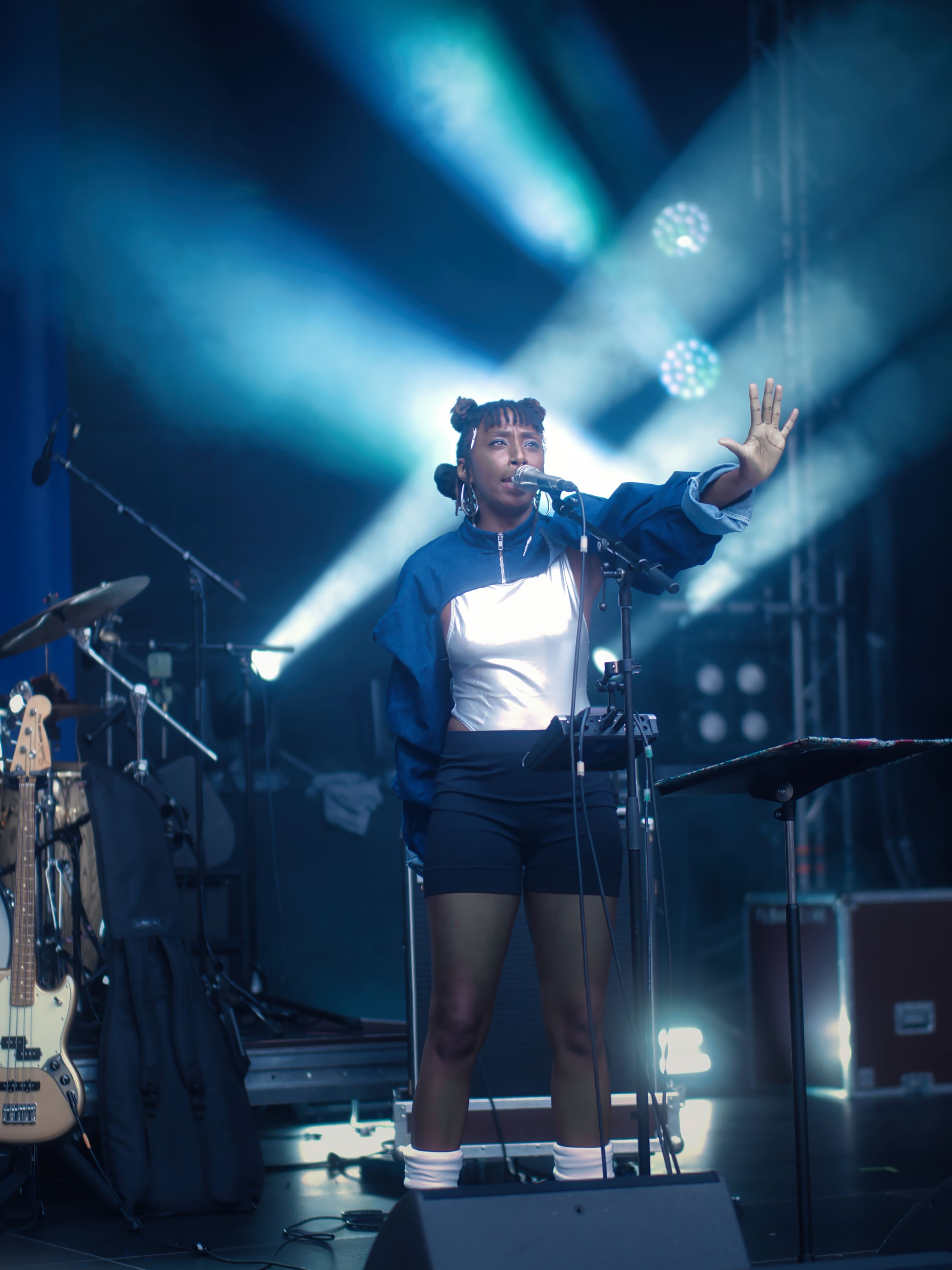
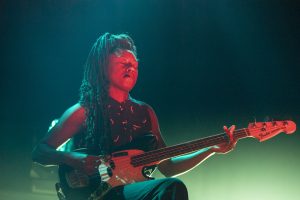
Sera Kalo (Photo: Chris Binns)
Sera Kalo has little interest in simple preservation. What she proposes instead is a productive friction: between histories and futures, between her own sound and those of past and present colleagues, between the seductive and the unruly.
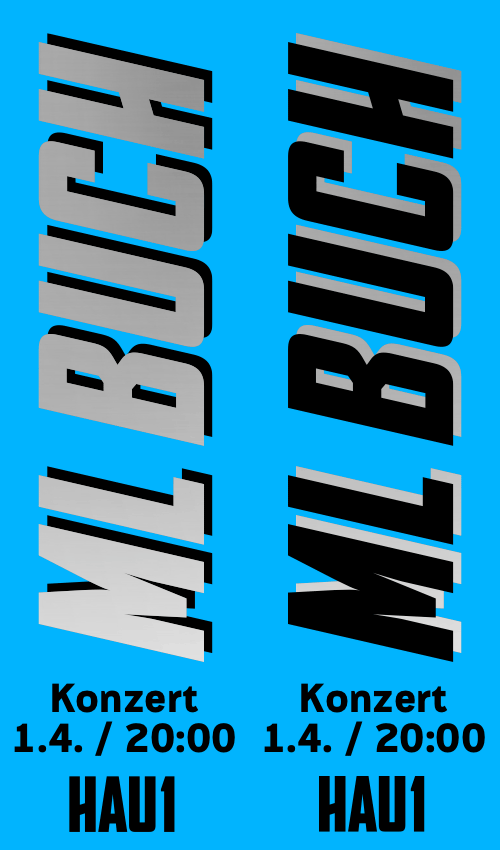
On February 23 at HAU Hebbel am Ufer / HAU1, the Caribbean–US American singer and composer presents her latest album, “eX.II – JAZZ IS PUNK” for the first time live, a gently embracing and yet also radically open form of jazz built from layered vocal constellations, modular synth structures, microtonal deviations, and deliberate ruptures.
Kalo’s sound world folds Afro-diasporic traditions into broken beat, avant-soul, spoken word, noise, and experimental electronics—not as fusion, but as ongoing negotiation. “My sound shifts from soulful and sensual to raw and experimental,” Kalo says, “blending jazz, spoken word, noise & electronics.” At the center is her voice, treated as a living archive. Each performance rearranges fragments of diasporic experience, biography, and imagination, refusing a definitive version. This approach earned Kalo the 2025 German Jazz Prize in the category Vocal—an acknowledgment of a practice that understands virtuosity not as control, but as permeability. Listening to Kalo means listening to a voice that absorbs, fractures, and reconstitutes itself.
The context for the evening at HAU1 is deliberately expanded by the presence of Sonic Interventions, a Berlin-based diasporic-futurist ensemble whose immersive live rituals operate at the intersection of rhythm, community, and speculation. Drawing on traditional African and Latin American rhythmic knowledge while channeling hiphop, trap, and house, their performances function as temporary zones of collective intensity—spaces where improvisation becomes social practice and music shades into ritual and political gesture. Awarded the 2025 German Jazz Prize as Newcomer of the Year, Sonic Interventions mirror the ethos that also drives Kalo’s work: an insistence on music as a site of transformation.
I met Sera Kalo in a café in Kreuzberg on a freezing late-January morning. The Berlin streets were so icy that people slipped and fell like dominoes – glady not we.
Kaput – Magazin für Insolvenz & Pop: Sera, may I ask from what kind of family background you are coming? Are your parents music lovers?
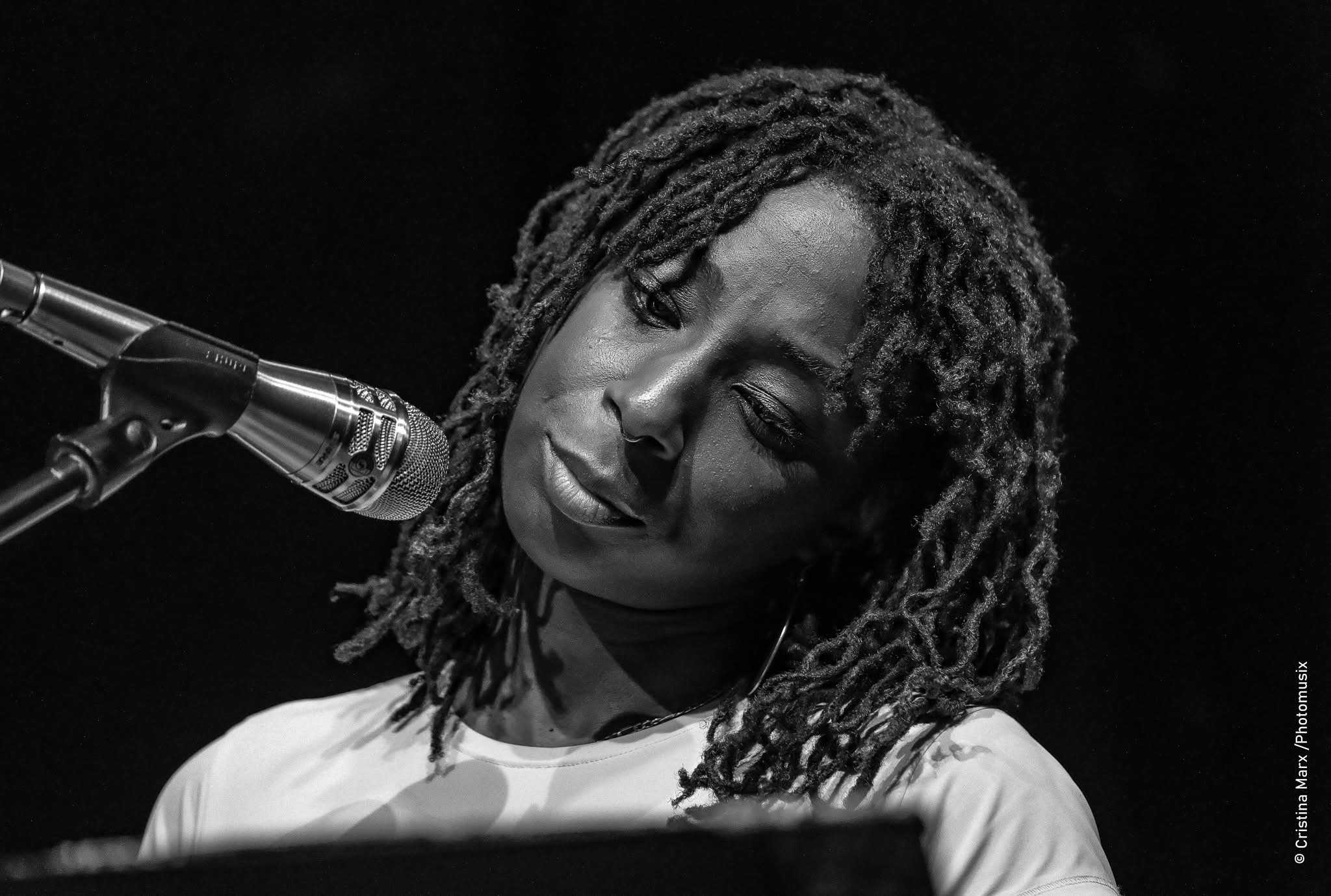
Sera Kalo (Photo: Cristina Marx)
Sera Kalo: My parents love music, but they’re not musicians. They have non-musical professional careers. With that said, my dad is an avid music listener and my mom loves to sing, so the house was filled with music all the time.
Music has always been that space for me—ever since I was a kid. That was always the context where I could best express myself. I think it was something I did instinctively; I didn’t start to reflect on it or realize it until I was a young adult, around my teens.
Where are you from originally?
Sera Kalo: I was born and raised in Connecticut, then I went to college in New York and lived there for a while. After that, I came to Germany.
Why so?
Sera Kalo: Love made me come to Germany. And I was also pretty sure that I didn’t want to stay in the U.S. My parents come from a different country, and I grew up hearing stories about other places. It made me curious. I knew that when I finished college, I wanted to explore. I happened to be in love at the time, and it was just the best opportunity.
You arrived around 2008 or 2009. Looking back, the jump from the United States to Germany is often framed as an artistic pilgrimage, but I’m interested in the structural scaffolding. The German jazz scene is often cited as being very supportive in terms of funding.
Sera Kalo: I’m aware that being a musician in the U.S. is probably a lot more difficult than it is here. There are things like funding and insurance—basic things that are really hard to come by in the U.S. I’m not sure if I would have become a full-time professional musician as quickly if I were in the U.S. It might have taken more time. I haven’t played there much recently. I had a tour there a long time ago with one of my first projects, but since then, I’ve been focused here. Organizing a tour in the U.S. now seems extremely difficult, especially since most of my band is not American. But I hope I get the opportunity eventually; I’d love to play for my friends and family again.
Did they engage you to follow up a career in music?
Sera Kalo: My parents supported all of my interests. When they noticed I had an interest in music, they made sure I could get lessons and participate in school activities that encouraged music education. When it came to being a professional, I can’t say they were 100% enthusiastic, but they provided the tools I needed to try. They also said over and over again, “Make sure you have a Plan B.” I know that was coming from a good, rational place, but it also planted a little seed of doubt. I was always torn between music and my other interests. It took a while before I decided to really listen to my inner voice and dedicate myself solely to music.
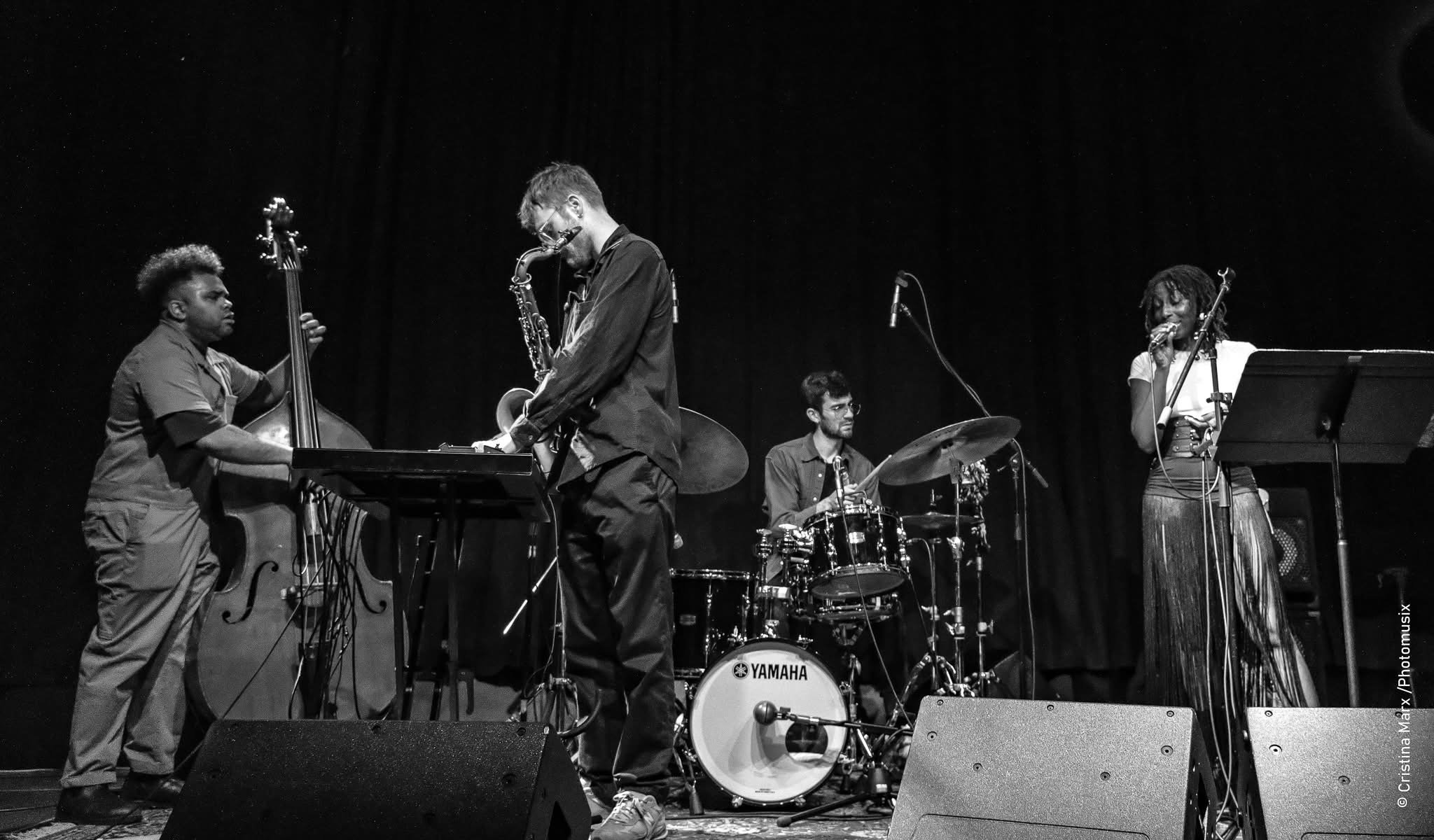
Sera Kalo (Photo: Cristina Marx)
I’ve noticed a trend in experimental electronic music where everyone has started singing, I guess besides artistic reasons also to reach a wider audience. But often, they aren’t “singer-singers,” and the vocal feels disconnected. How do you view the voice as an instrument versus a tool for articulation?
Sera Kalo: It depends on how the voice is being used. You don’t have to be a professional singer to use your voice in a musical way. When I’m listening to music, I usually give it a lot of chances before I say I don’t like it. I listen to all the different parts and interpret them in different ways. If I don’t enjoy the aesthetics of a voice, I ask myself, “What is this voice saying?” I focus on the lyrics. Instead of the technique, I listen for the emotion they’re trying to express or how it mixes with the overall production. Sometimes it saves the song, sometimes it doesn’t. But I listen very carefully.
Of course your album title “eX.II – JAZZ IS PUNK” triggers some questions in me. Can you lay out in short what you connect with each of these words: Jazz and Punk.?
Sera Kalo: When I think of Punk, I think of resilience, resistance, authenticity, and rawness. And for Jazz, I actually think the same thing. Both genres come from social movements. I try to tune into those movements as they were before they became a specific aesthetic or a definition that could be marketed. When I put them together, I’m thinking about what they meant for the community, for society, and for the individuals who found their identities in those labels. It’s a spirit, an energy, and a perspective on how one moves in the world. Sonically, it sounds jazzy or punky depending on the instrumentation, but it sounds like whatever it needs to sound like to get the right point and vibration across.
That suggests a very political baseline to your work. Is that a choice, or a necessity of your identity?
Sera Kalo: By default, not by choice. It’s a vibe, an energy, and an experience. I’m trying to make it a transformative experience. There’s enough space for the music to be interpreted however the individual needs so they can feel something and hopefully grow in a positive way. I chose my references—artists like Moor Mother, Shabaka Hutchings, and Makaya McCraven—because as a genre-fluid or cross-genre artist, I think we have the responsibility of helping people understand our context.
Often, we are doing something very different from everyone else. You might be in tune with others doing the same thing, but on a larger scale, you seem like the pink elephant in the room. I look for artists who share a similar essence and who have managed to make a name for themselves internationally. I hope that helps make sense of what I’m doing for those who are new to my music.
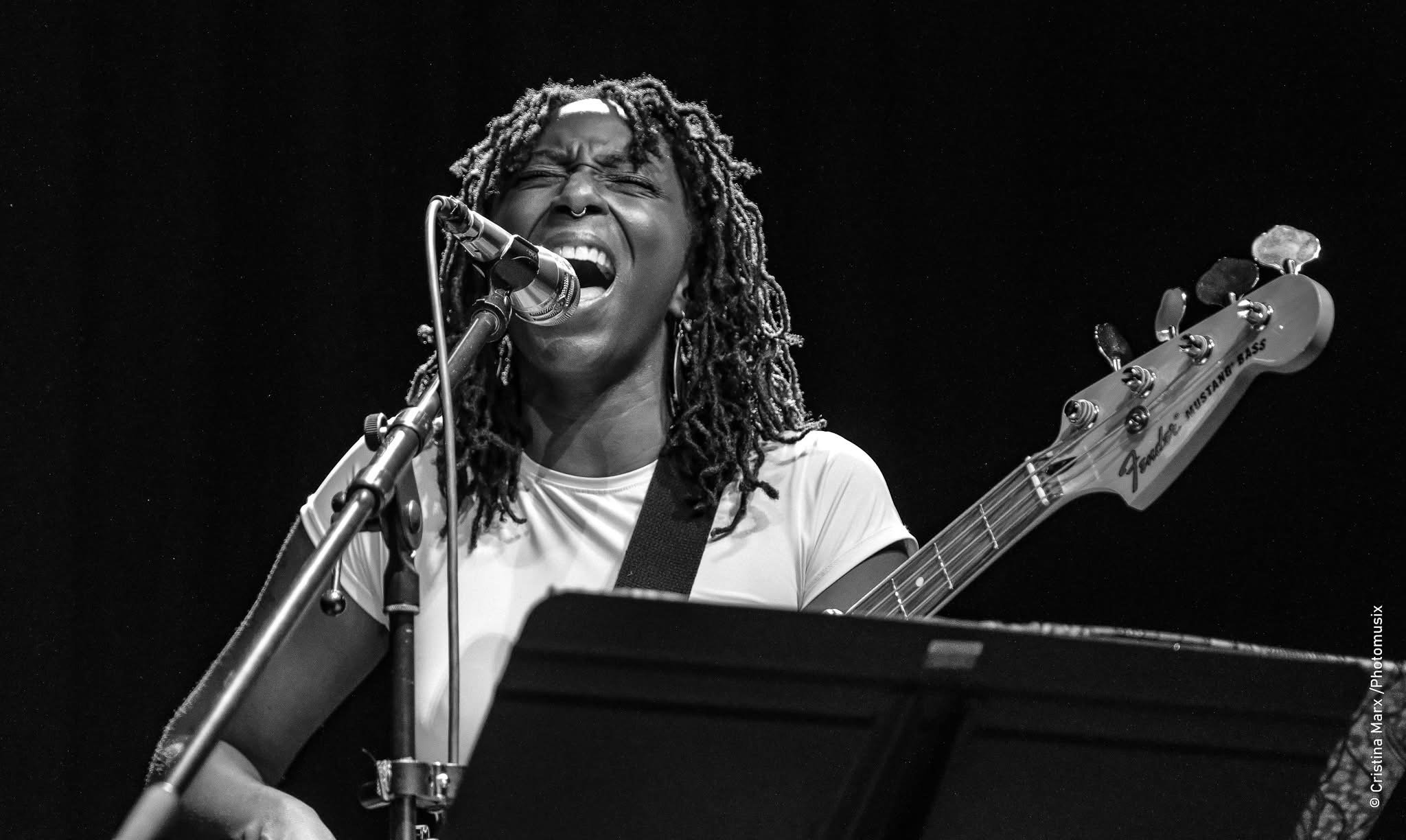
Sera Kalo (Photo: Cristina Marx)
You’ve described your voice as an archive of diasporic experience. What does this refer to? Language, trauma, pleasure, refusal? Can you lay that out a bit more?
Sera Kalo: I think it holds a bit of all those things—language, trauma, pleasure, refusal. It holds the intangible aspects of humanity and culture that allow for survival. These are traditions passed down through generations until they feel instinctive, but they originated from someone who had to, for example, learn strategies to survive, to feel joy, or to self-soothe. I tap into those things when I’m improvising. It’s a mix—it can be good things, but it can also be transgenerational trauma. Some people call it anxiety; others call it a heightened sensitivity that allows you to protect yourself and be ready for surprises. Those are the things I’m acknowledging.
How important is living in Germany for this process?
Sera Kalo: Living in Germany makes a huge difference in that archive. It influences my sound and how I articulate myself. It’s a different kind of existence to live in Germany. The experience of being Black in Germany is obviously different than in the U.S. or the UK. A lot of that is acknowledged in my lyrics, and I allow that influence to come into the music. My experiences here definitely affect how I interpret my sound. That’s why I can’t sound exactly like the people I reference, even if I relate to their essence. Aesthetically, it’s going to be different because it’s a different lived experience.
When you reference artists like Moor Mother, Shabaka Hutchings, Makaya McCraven, or Aja Monet, are you pointing to a general affinity—or to very specific shared strategies? You know what I mean: political intention, rhythmic logic, the use of voice as structure, or something else entirely? And do you feel you are in an active artistic dialogue with these figures?
Sera Kalo: No, not at all. When I started doing this music, it was very instinctive. At that point, I didn’t even know who many of those people were. I was creating this music and feeling into it, but I also felt insecure because I didn’t see any mirrors around me. I felt like I was on a lonely island. I had to do research to see who else was doing something with a similar essence. I went to the Womex music conference in Manchester and realized there was a similar movement happening in the UK and the U.S.
I appreciate how this movement in jazz is happening in parallel. I’m not sure if people are influencing one another in the moment, or if they are just influenced by the same societal shifts that push them toward making a statement. Usually, the research comes after, if I feel I need it. It’s very instinctive. I go with how I’m feeling, which is why I refuse to be boxed in. I’m moving through the different chapters of who I am, and that can reflect many different styles. I just go with it and eventually it makes sense.
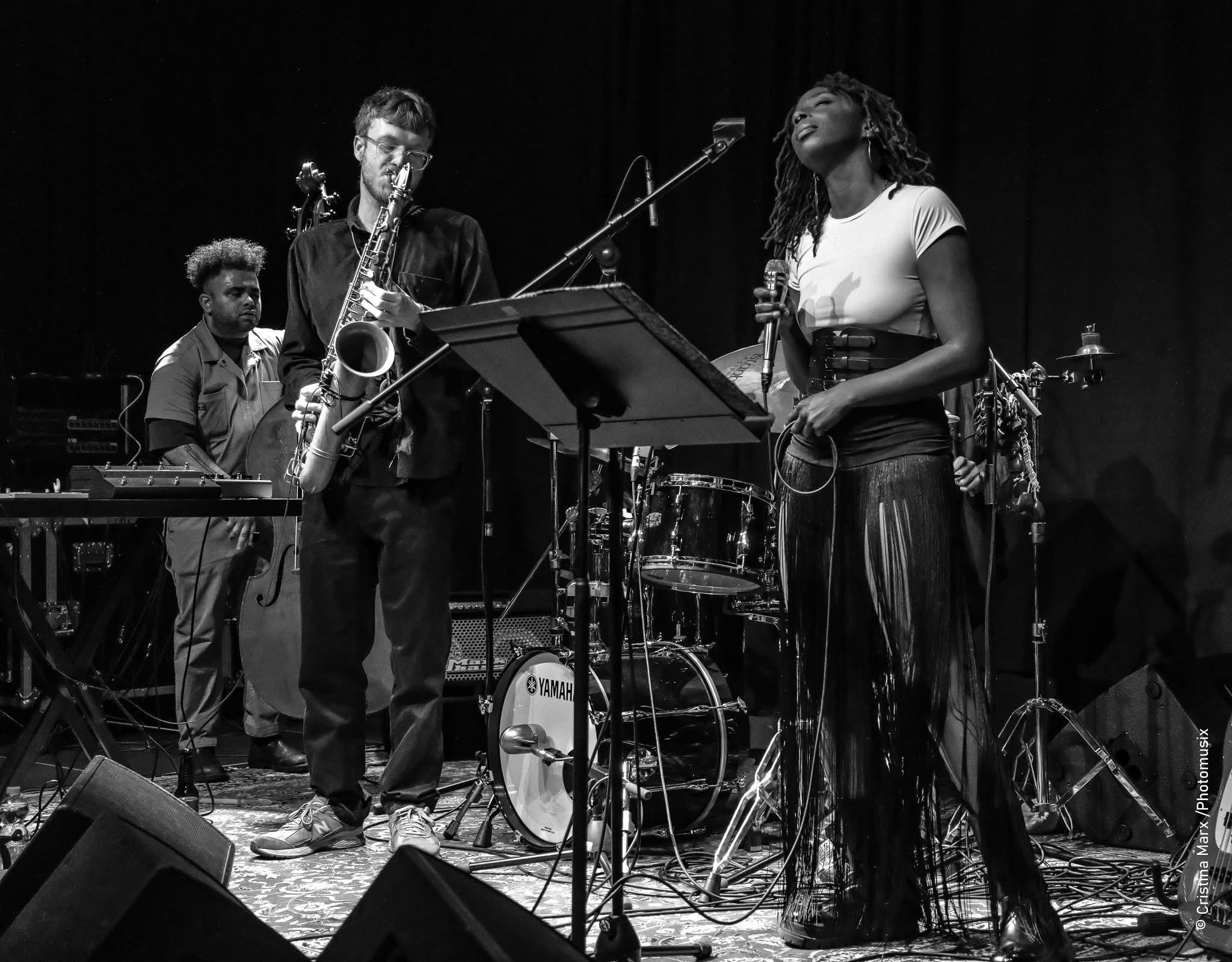
Sera Kalo (Photo: Cristina Marx)
How does that translate to your working process? Do you feel more as a composer or sound (re)searcher through improvisation?
Sera Kalo: I have a classical background, so I appreciate a well-structured piece of music—nice sheets and everything. But I’ve also felt a desire to move away from that. What I did with the album… it was more about creating frameworks. There are fixed elements that act as anchors, but in between, there is the freedom to allow the sound and the moment to move as they should. It is definitely important who I involve. I have to like them! I have to like their musical language, I have to like them as people, and we have to communicate well.
I have a lot of fragmented ideas that I go back to. I had a “writing explosion” in 2015. I still have a lot of material sitting there, and every once in a while, I’ll listen to see if anything pops out. I never get rid of it because I know it’s all worth something. It’s an open field. Sometimes it’s a melody, a lyric, a rhythm, or a bassline.
What does that mean for the band constellation? Are you the boss? And how does that feel?
Sera Kalo: For now, yeah, I’m the boss. It’s not an easy task at all. It’s a lot of responsibility, and sometimes it’s difficult to keep the focus purely on the music. I handle the artistic, structural, and financial responsibilities. Structurally, financially, managerially—being a band manager as well. It’s a lot. I have two main projects with four people each, so that’s eight people. And I do most of the non-music stuff myself. I don’t have a fixed structure for my day. I take it as it comes. You learn that the more you care about making your music sustainable, the more you realize it takes around-the-clock work. It’s nonstop work that I hope to eventually get some help with, but right now, it’s my job.
Does the bureaucracy ever drown out the creativity? Does the music become the “reward” for the labor, or is it a separate entity?
Sera Kalo: I have that feeling sometimes. Sometimes the workload is so heavy that I’m too tired to create. I have to take a break from everything to get the energy back. Doing what I do isn’t just my profession; it feels like it helps me survive on a spiritual level. It’s a necessity. I can’t stop doing it. For me, the rewards are people listening to my music, feeling inspired, getting an album, or receiving a nice review. When I’m performing and creating, that’s more of a celebration.
As stated: Your work feels less like influence-tracking and more like parallel evolution. Do you think of yourself as part of a scene—or as operating within a rather self constructed environment?
Sera Kalo: It’s a bit of both, but not as a strategy. More as a necessity. When your music lives between worlds, you start to notice where there’s room to breathe. For me, the jazz scene has generally (and hesitantly) been more welcoming of that in-between space than something like pure pop.
At the same time, jazz itself isn’t a unified scene. It’s got many small ecosystems. I don’t feel fully at home in any single one of them, and that’s actually shaped how I work. I end up curating my own environment. Just seeking out people who are open, curious, and inspiring, and building contexts where we can collaborate without needing to fit a fixed idea of genre. Just let it flow.
Is improvisation, for you, a way of accessing memory in a free but still somehow planted way —or a method for interrupting it, breaking its patterns totally?
Sera Kalo: Yes. When I’m channeling memory, it becomes a foundation rather than a script. It’s hard to build a house without a solid foundation, and in the same way it’s difficult to imagine a future without understanding the past.
And what does that mean for the process of forming the fragments of improvisation into songs and their reproduction?
Sera Kalo: It means that my process is continuous and bound to change and growth.
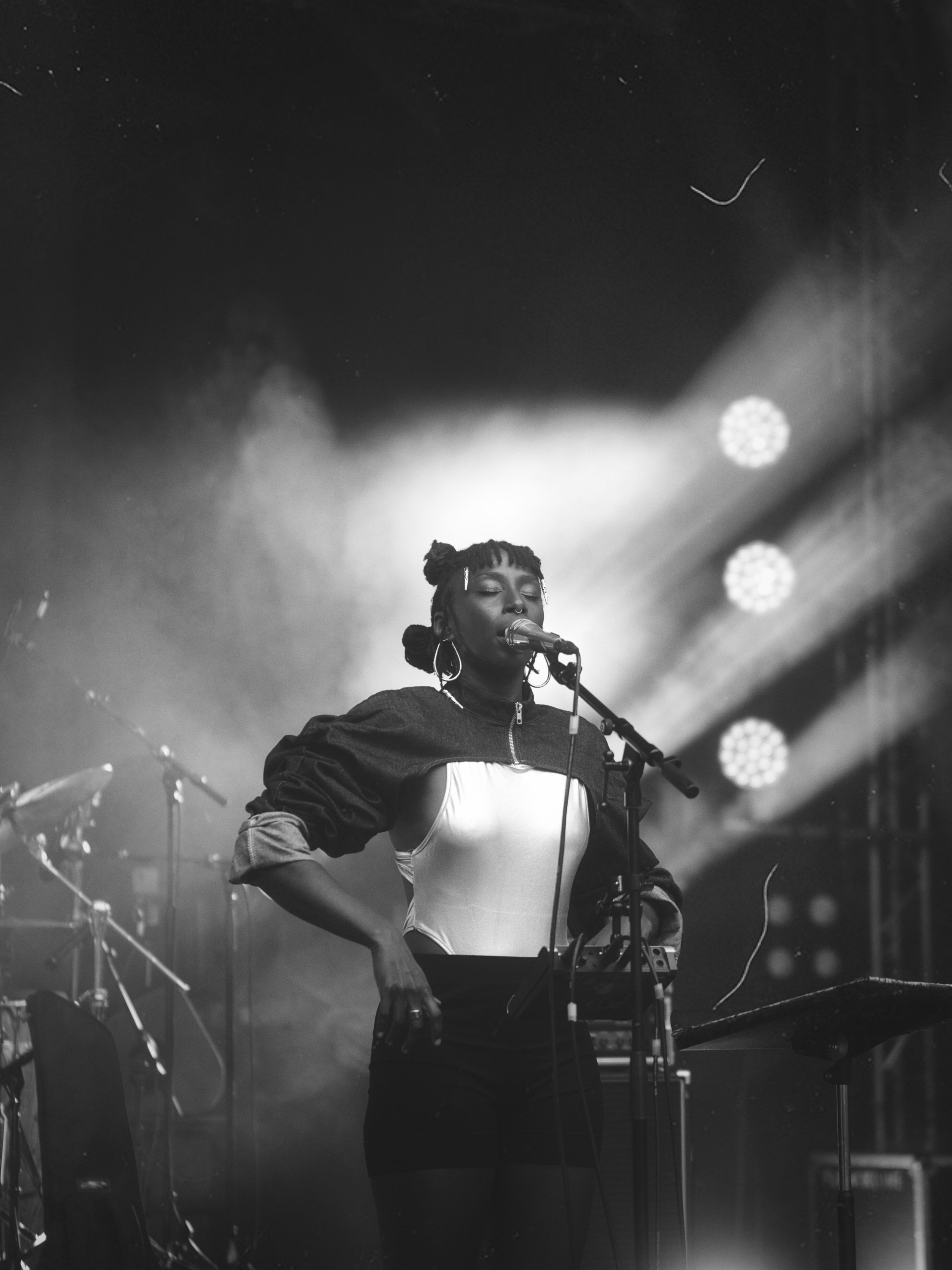
Sera Kalo (Photo: Chris Binns)
Who—or what—are you pushing against with this record? Jazz orthodoxy, market expectations, inherited aesthetics, your own previous work?
Sera Kalo: I’m not pushing against a particular tradition or expectation. I’m pushing toward a broader sense of inclusion. With this record (and maybe also the one before it), I question how much creativity the industry can really hold and how seriously it takes authenticity. When boundaries are so constricting, we lose entire possibilities of what music can be and do.
Berlin has its own dense history of punk, jazz, and electronic radicalism. How much does place—its infrastructure, its ghosts, its current politics—shape this album?
Sera Kalo: Definitely. I’m super open. I go to concerts and stay curious. Berlin has definitely influenced my use of electronics. Before coming here, I was proud to be a purely “acoustic” artist. After hearing the different contexts of electronic music in Berlin, I started to appreciate it and slowly incorporate it. I’m excited about playing places like HAU because I love big stages! I love having space on stage to move around. My movements aren’t choreographed; I’m just moving.
How do I have to imagine your stage presence?
Sera Kalo: I have my moods when it comes to interacting with the crowd. Sometimes I don’t talk at all; sometimes I tell a lot of stories. I never really know what I’m going to do until I’m there. I think it’s usually helpful for people to have a personal connection to the artist. Even when I don’t feel like talking, I enjoy relating to people. Before we are musicians, we’re human. It’s good to connect on that level.
Your music balances modular synths, microtonal shifts, and layered vocals, yet it never collapses into – again, let´s use a punk-ish wording – chaos.
What holds it together: rhythm, breath, intuition, discipline. When dealing with micro-tonal shifts or experimental structures, do you find you need to be more theoretical, or do you still lead with the “feel”?
Sera Kalo: I listen a lot. I try to feel into things before I get theoretical. I only look at the theory later if I need to communicate it or if I want to reproduce a specific sound. I think everything has some kind of sense to it, even the most random things.
How much of “eX.II” is about losing control—and how much about deciding where control is no longer useful?
Sera Kalo: I thought about this, these questions of control… if I like being in control in the context of music. I want to say yes to that, but control isn’t a term I fully relate to in this context. I’m not trying to lose it or regain it. I’m trying to strip things back. Improvisation, for me, is a way of getting closer to an unfiltered self not losing control. Also, to me feeling free doesn’t equate to losing control. And when I make choices, they’re not acts of control but of ownership. I’m defining my own musical language, setting my own standards, and refusing the need to conform to someone else’s framework. It feels like reclaiming sound in a way.
I think I worked really hard to get to this point. I like to have control over my sound, but at the same time, I love collaborating and incorporating other perspectives. I’m here to grow, and I don’t let my desire for ownership minimize that growth.
Is public “failure” or experimentation something you embrace, or do you prefer to have the vision fully realized before the audience sees it?
Sera Kalo: I don’t really think about the risk; I have ideas and I execute them. They become a body of work, and then I present them. Because my albums are so different from one another, it makes the “music business” side difficult. They ask, “Who is she?” It’s hard for the industry to embrace multi-faceted artists. My first DIY release was soul-jazz-pop-rock. The next was heavy neo-soul and hip-hop, which got a lot of attention.
Now I’ve come out with something completely different again. I’m happy I’ve gotten good feedback, but my legacy is a diverse one, not a single path. I hope that through my consistency, people will eventually make sense of who I am. My fans understand it, but on a business level, it might seem scary. Tradition and familiarity are definitely favored. We know this algorithmically. Especially in Germany, it seems to take a few years for people to catch on to something that happened elsewhere five or ten years ago. It’s not easy to be a trailblazer. That’s why I take the responsibility of creating my own context. I’ll create my own community, my own concepts, and my own bands so I can get the work out there.
I find the “mistakes” or the shifts in direction are the most beautiful parts of an artist’s trajectory. But you’re right—the industry wants a predictable product.
Let’s go back to the beginning of that trajectory. What was the very first music that made you feel you had to create your own?
Sera Kalo: It was someone on television playing classical piano. I remember it clearly—I was seven. My mother was braiding my hair, and we were watching a classical concert. The camera zoomed in on the pianist’s fingers moving so fast, and I thought it looked cool and sounded beautiful. I bothered my parents for a year until they got me an upright piano for my eighth birthday. That was the spark.
But in terms of wanting to write original material, four specific songs come to mind: “Almost Doesn’t Count” by Brandy, “What If God Was One Of Us” by Joan Osborne, “Redemption Song” by Bob Marley, and “Under the Bridge” by Red Hot Chili Peppers. If you listen to those, they are all very moody, intense songs. Those made me want to express myself musically. They have a certain weight to them that I’m still chasing.
Winning the Deutsche Jazzpreis / German Jazz Prize for Vocal places you inside an institutional framing, while your music resists institutional framing.
Did that recognition alter how you see your work—or how others now approach it?
Sera Kalo: The recognition didn’t change my relationship to the work, but it did shift its reception. Suddenly, people seemed more willing to listen before deciding whether it belonged. While Jazz Is Punk is often framed through resistance, my interest lies more in transformation than opposition. Total refusal would mean disappearing, and I don’t believe that’s where change happens. I want to push institutions toward deeper responsibility, sustainability, truth, and the ability to learn from their own contradictions. I do that best through my voice in music.
Do you have voice role models? Musically?
Sera Kalo: I have many role models. This question is the toughest of them all because it always feels unfair to name a few. But for today, I will say the vulnerability of Nina Simone, the free flowing spirituality of John Coltrane, and the powerful poise of Skin from Skunk Anansie.
Can you say what it is that you search for in music?
Sera Kalo: I search for moments that bring me peace. I say that without binding peace to a particular sound aesthetic.
Which other artists and/or record is your happy place? The sound you lean on when you need it the most?
Sera Kalo: Soca music. It’s music from the Caribbean—originally Trinidad—and I have Caribbean roots. My parents played a lot of Calypso and Soca during family gatherings, so it always brings a happy mood. There’s a group from Dominica called The Midnight Groovers that makes me extremely happy. Also, the album “Tiki Hotel” by the saxophonist Johannes Enders. I heard he produced it in a hotel room, and that whole album just puts me in a great mood.
If you had to boil down what you are searching for when you listen to new music, or when you are creating your own, what are the primary elements?**
Sera Kalo: Vulnerability and surprise. That’s what I’m looking for. Always.