



Stephan Mathieu: “Cutting hair, playing drums, computers, Early music, mastering. Ultimately, it all fits together and defines me as a person. Keep learning every day; slow growth is good growth.”

Stephan Mathieu (Photo: Richard Mathieu für Neverdaless Photo & Film / www.neverdaless.de / IG: @neverdaless__ )
EIt’s a Saturday in March, the best time of the afternoon. The whistles have been blown on the 3:30 Bundesliga matches. Time to dim the lights and train our attention on a jagged line on the monitor—more topography than clearly legible image, a digital mountain range at first only decipherable by an adept: Stephan Mathieu.
We’re ensconced at Kapute Szene, our new art/music salon, where a series of concerts, talks, exhibitions, and whatever else we damn please has been taking place on an irregularly regular basis since late 2025. Today’s guest: Stephan Mathieu. A name that for some time now could be found gracing the back covers of many of Kaput’s most cherished records.
Mathieu’s musical biography begins with his time as a drummer in Berlin’s improv music scene and leads, via a distinguished career as an artist in his own right (with releases on labels such as 12k, Die Schachtel, and his own Schwebung imprint), to his current profession as a mastering engineer. His mastering work is internationally known and covers a broad range of genres, with clients including labels like Shelter Press, RVNG Intl., Crammed Discs, Blank Forms, Editions Mego, and Week-End Records, as well as musicians as diverse as Grouper, Kali Malone, Keiji Haino, Hayden Pedigo, KMRU, Jonny Nash, Merzbow, and Ellen Arkbro.
The fact that he now lives in Bonn feels like a quietly contrarian move. In place of the myth of the big city, he opted for the acoustically perfect refuge. Our plan is to talk not only about technology, but also about the more philosophical aspects of his work—the moments in his practice when the act of making music is transformed into one of forming sound.
Kapute Szene and Stephan Mathieu thank Kii Audio, who were so kind to rent us one of their amazing Kii Three systems for free for the happening.
Translation by Everett Mason.
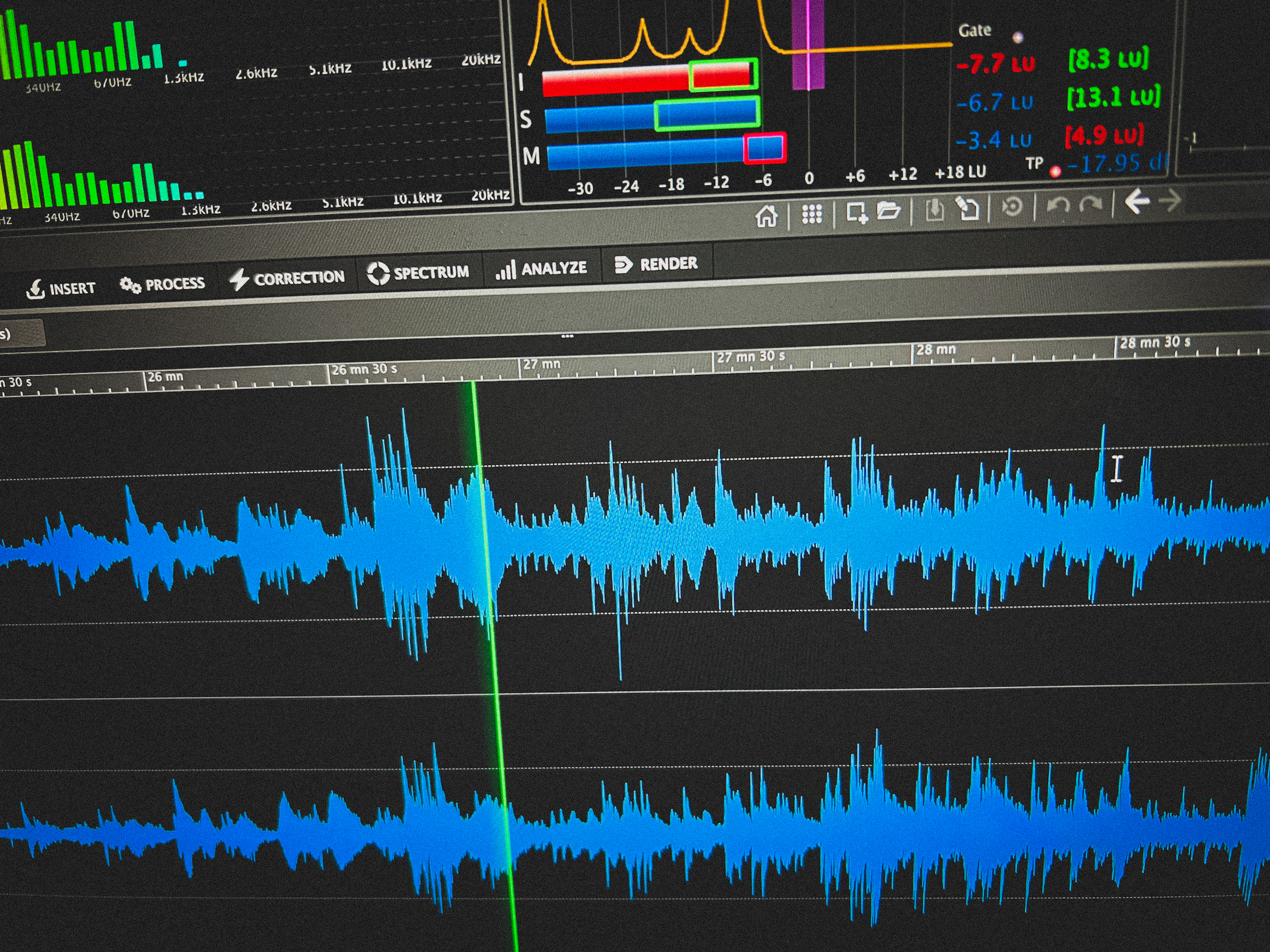
(Photo: Stephan Mathieu)
Stephan, I’m looking at this waveform of music on your screen, and, first off, I’m just wondering what you see in it that we don’t. Is it already telling you things when you read it, like a doctor reading a cardiogram?
Stephan Mathieu: Yeh, there’s something to that. When I start a new project, a waveform is the first thing I see. It’s telling me about the volume levels and the progression of a piece over time. What I can tell from it right away is whether the piece has natural dynamics. If a piece has been compressed too heavily just to make it louder, you can see that immediately. The quieter elements have been excessively boosted. Simply put, the waveform ends up looking more like a block than a varying, zig-zagging line. When I receive new material, I open it up on my laptop and look at what the sound file looks like before I even listen to it for the first time. That already gives me an initial indication of the state of the production. From the waveform, I can see if there are peaks and valleys—that is, a natural relation between loud and quiet—rather than just being more or less the same volume throughout. Without quiet, there is no loud; in other words, without dynamics, a track can’t really bang when it’s supposed to. There’s no punch. How the track actually sounds, I only find out in the next step. I listen to it first through the laptop speakers because that provides a good initial reference for the quality of a mix before I listen to it in a more focused way in the studio.
WWhat does good sound mean for you, in general terms?
Stephan Mathieu: Details, balanced timbres, and a healthy dynamic range that’s fitting for the track and brings its point across. That I can hear details and that the elements in a mix have a nice contour to them, so that you almost want to touch them. I was originally a drummer, then I worked with computers and historical instruments for a long time. After always helping friends with their productions, in 2013 I started mastering more frequently—that is, making their tracks ready for release. Since 2017, I’ve been focusing exclusively on that. Mastering has always fascinated me. Through my own productions, I learned how much a track can blossom when it’s mastered by someone who knows how to handle the material well. It basically sounds much more transparent and precise afterward, which conveys the content and intention a lot better.
So, you used to give your stuff to other people and then at a certain point started doing it yourself?
Stephan Mathieu: I’m originally from Saarbrücken, but I spent the ‘90s in Berlin. When I moved back to Saarbrücken, I met Henner Dondorf, who ran Hard Wax there as a branch of the Berlin store. At the time, Henner was also a collector and seller of vintage studio equipment and a real luminary in that world. He also has what you might call a “golden ear.” When he heard my first piece of computer music, he offered to master it for me. I was already familiar with mastering from a few sessions with my improv projects back in the ‘90s. Back then, a mastering engineer was, for us—people on a budget—, someone with a computer and a CD burner, which in 1992 was still very rare and as expensive as a mid-range car. Mastering an album took maybe 30 minutes and mainly involved balancing the volume levels between the individual tracks as well as setting the pauses, index points, and CD tags. It was really kind of clerical work. In the ‘60s and ‘70s, mastering hardly meant anything more than that. The final takes for an album were spliced together from various tapes to create the master tape, which was then cut 1:1 onto vinyl. The splicing of the master tapes was usually done by studio trainees, as a kind of manual exercise.
My first experience with Henner, a few years after this, was completely different. He listened to the tracks with me, asked questions, and then put each one through these fantastic-sounding EQs from his collection. I immediately got the impression that what he was doing was like sculpting: a careful stripping away of material leaving the clear contours of the whole intact. I found it really fascinating—a real “aha” moment—and over the course of our sessions together I ultimately learned a lot about sound and listening to and evaluating sound. And from what resulted, it was clear that I never wanted to hear my original tracks again, because they had been so drastically transformed by the mastering process and now sounded so much better than I could have ever imagined. Henner, coming at them as an outsider, recognized the potential of my mixes and also had the skills to clearly bring out what had been hidden.
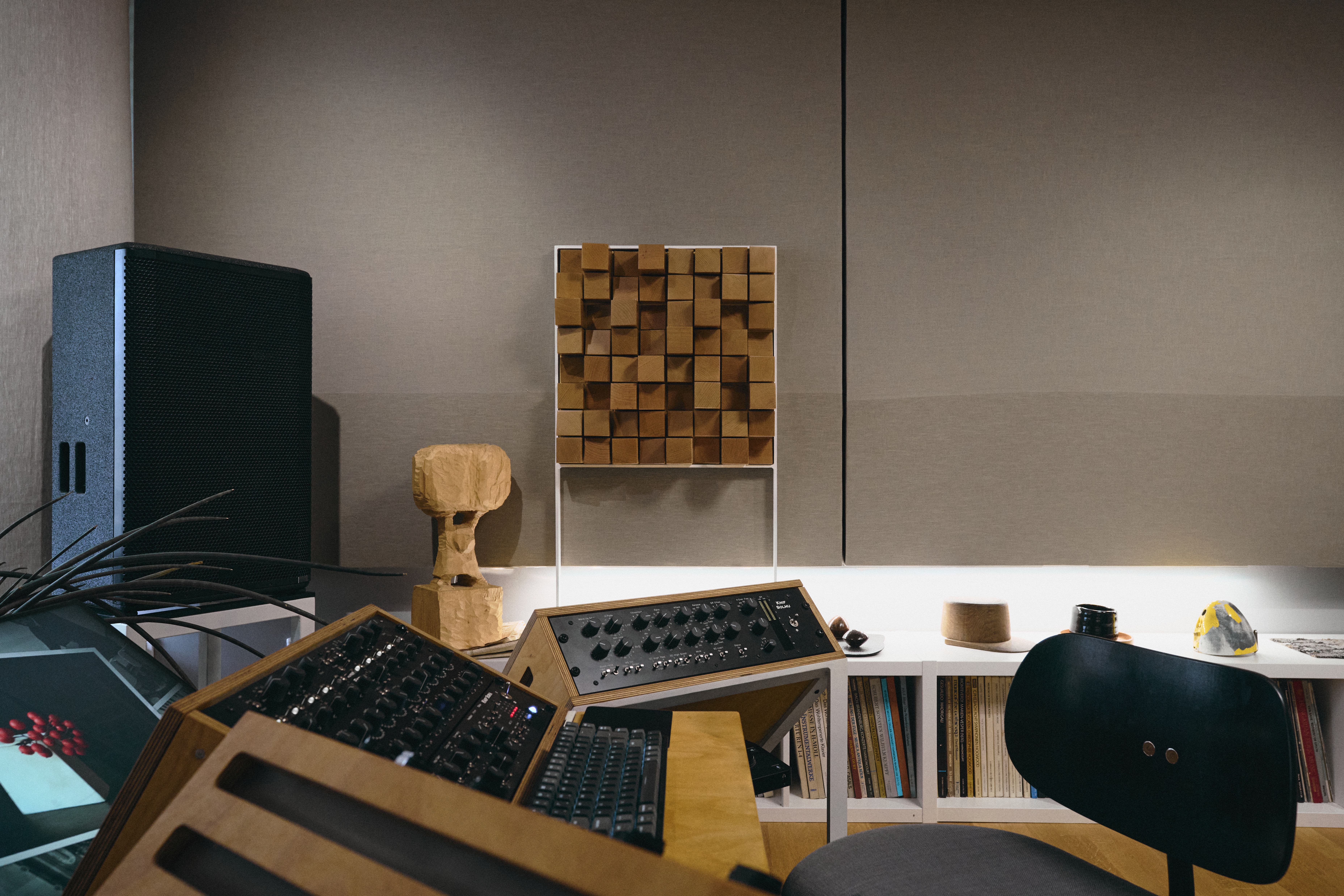
Studio Schwebung (Photo: Richard Mathieu für Neverdaless Photo & Film / www.neverdaless.de / IG: @neverdaless__ )
For people who don’t produce themselves, this is often confusing. Someone produces the music with their own equipment, and then someone else comes along who takes it to a new level using similar tools. How do you explain these different roles?
Stephan Mathieu: Mastering as its own art form only emerged, or, rather, only became important, in the late ‘80s or mid-‘90s, as more and more people were able to produce at home. First with 4-track tape decks, then with computers. Artists no longer went to a studio with great-sounding consoles for recording and mixing, where people in white coats had already set up specially chosen microphones. Instead, they produced using their own, usually very modest equipment in an environment that was often acoustically suboptimal—the typical bedroom producer scenario.
As an artist, under such conditions, you don’t hear nearly everything that’s in the music; instead, you’re hearing what the room and your equipment are making of it. It might sound good there, but your music should be able to be taken out of your room and still work well. Producing independently has enormous advantages, but compared to doing it the old-school way in a studio there’s often the lack of an outside person who can bring so much specialized knowledge and experience to bear. Since YouTube this has changed again, although now it’s a question of sifting through this vast offering of dos and don’ts to find what works for you personally. As in all fields, you come across an endless number of tips and opinions, many of which are simply wrong. Because of all this some people prefer to find the right mastering engineer for the final polish, using their time for the creative part instead of endlessly browsing then just saying “I’m done!” at a certain point. Sometimes I suggest to my clients that they send me their tracks when they’re unsure about them or get stuck. That said, for me it’s important that they remain solely responsible for their artistic vision. So, while I stay out of the creative process, I might mention that I could already get really good results with the material as it is.
A good mastering studio has as its basis a room that is, acoustically speaking, perfectly optimized. Ideally, such a room doesn’t sound “good,” rather, it sounds like nothing at all, because that’s the only way you can hear exactly what’s coming out of the speakers and what’s actually contained in a track. Then the monitors are important, because they’re your window to sound. They also shouldn’t have any character of their own, but should be able to reproduce precisely what’s there across the entire frequency range. In your room, you can then immediately hear if something sounds too boomy or too thin, or if the highs are grating or something else is getting buried. From there, you can make decisions that benefit the material.
In the golden age of the big recording studios, all this wasn’t really necessary because the recordings were already excellent to begin with. Today, tracks are often worked on in great detail to make them sound really good. When an artist has already spent endless hours working on a mix, they need someone who can say, impartially, “This is great, but here and here, the whole thing could use a little more shape.”
But doesn’t that also mean that the artist takes the first step, and you then make something different out of it?
Stephan Mathieu: Mastering is about ensuring that, in the end, the intent of a piece comes across very clearly. I work on very different projects, both in purely stylistic terms and qualitatively. Some need just 5% to come across perfectly; to achieve that in other cases you almost have to turn the whole thing upside down. Over the course of a month’s work, the reality is usually somewhere between these two extremes. I work almost exclusively on albums, and there’s no standard approach that fits every project. My work involves going really in-depth into the music and seeing what’s still missing to make it ready-to-go, including the flow of the album sequencing and the volume balance between individual tracks. Compilations are a special challenge, since various tracks by very different artists need to work well together. The master approved by the artist is then the final product that is released into the world, goes into digital distribution, and is pressed onto vinyl. Mastering is also a kind of final quality control. The equivalent in the film context would be color grading: the film is essentially finished, but the colors get another fine-tuning in a specialized studio so the grass looks truly natural and not like some neon-green stuff in an Easter basket.
Does the distinction between vinyl and digital play a major role in your daily work?
Stephan Mathieu: I always master with vinyl in mind—that is, with the specific requirements of that medium. There are several physical limits when cutting vinyl. For example, having extreme peaks in the high-frequency range can be risky for the cutting stylus. So those levels have to be right so the cutting engineer can transfer the master to vinyl without having to make further changes. Interestingly, the range is the same as the range our ears are sensitive to. The cutting stylus and our ears function quite similarly here. That’s why I usually master in a way that works for vinyl, even if vinyl isn’t necessarily an option. It’s very rare that I create separate masters for digital and vinyl. Working this way has become a solid foundation for me because it forces you to get the most out of the situation within physical limits. I certainly don’t always follow the rules, but some of them definitely make sense.
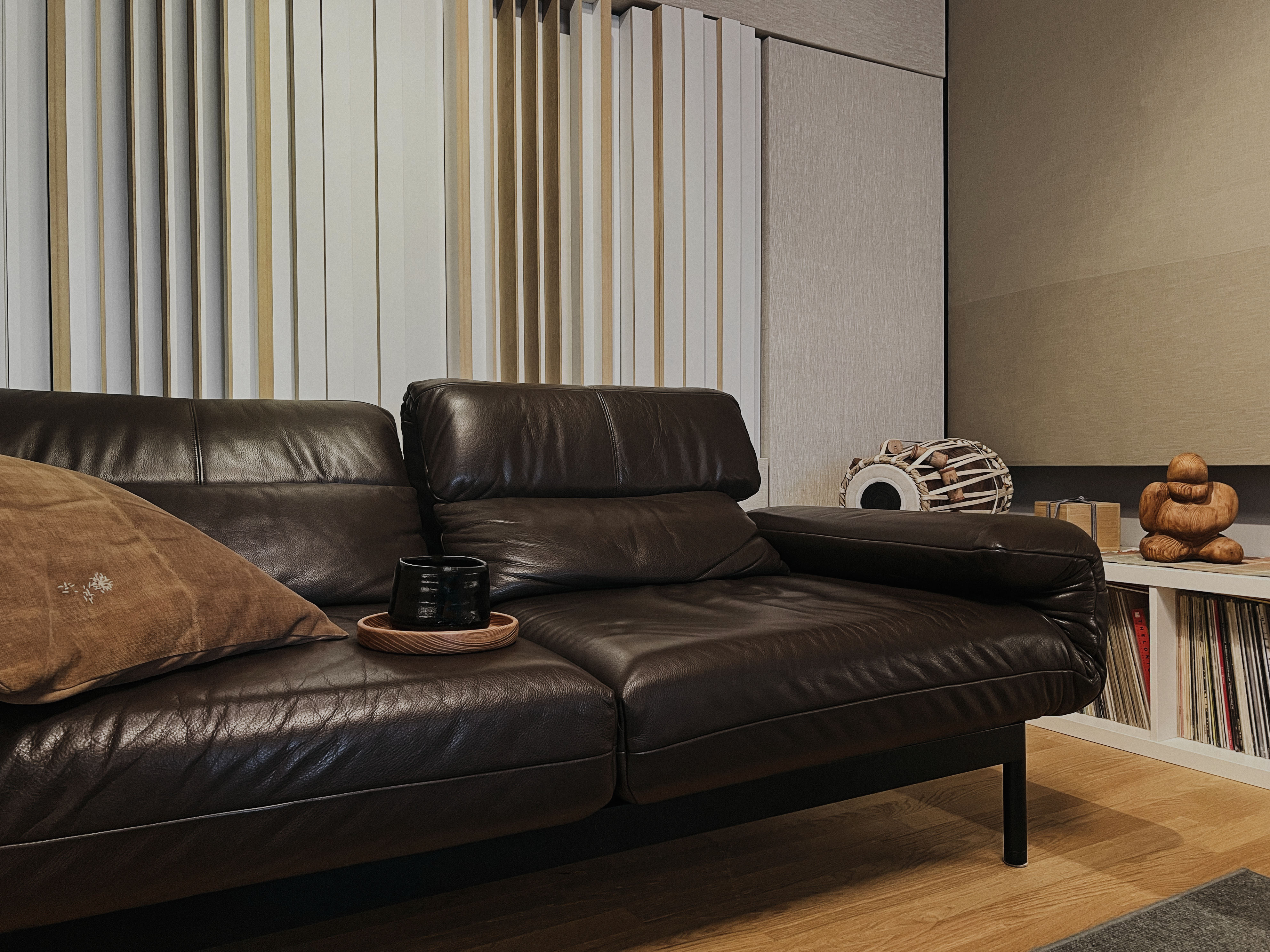
Studio Schwebung (Photo: Richard Mathieu für Neverdaless Photo & Film / www.neverdaless.de / IG: @neverdaless__ )
We pause briefly to listen to an example. Mathieu plays a remix by Will Long (also known as Celer) of a track by Frank & Tony. The difference between the raw mix and Mathieu’s master is striking: the space opens up, the sounds find their place, and a subtle boominess disappears.
Stephan Mathieu: This is the original, Will’s final mix, …and this is the master that was ultimately released. To me, the bass drum was too resonant; it had lacked real punch and was overshadowing the other elements in the mix too much. I’ve done a lot of work for Will—the house and jungle tracks, and especially his Celer project, which I’ve followed since the beginning. He has very little interest in delivering a perfect product himself. I see him first and foremost as an artist who creates his own beings, often rather imperfect ones. He works with vintage, quite limited or obscure equipment and then tells me, “Please do your thing.” Will’s work is an interesting example, since I never want to alter his tracks or polish them too much; instead, I like to preserve a certain spontaneous, almost unfinished character that is part of his work and makes it so special.
But what does the dialogue look like with other artists? Do some of them come to you with lists and special requests?
Stephan Mathieu: It really varies. Some artists send me notes for individual tracks, but many send their material more or less without comment and trust me. Some projects are finished after three or four emails. Peter Rehberg’s way of communicating was legendary in this respect: “Here are the mixes for EMEGO304, double LP and digital.” … “This is approved, send invoice.” In other cases, though, there might be 25 emails: “It sounds a bit shrill in the car, but great at home…” Then I make adjustments until it works for everyone. In some cases, I’ll capture the tracks again from scratch.
I work analogue, but I always receive my projects as digital files. If necessary, I’ll clean up a project a bit beforehand with a digital EQ and then send it to my console. It consists of a kind of tube preamp, which I use to shape the width and depth of the stereo field and add harmonics, a more surgical EQ, a second EQ for color, and a compressor that can further influence the tonality. That mix gets sent from the console back to the computer and captured there. That mix is then my print, which I send to the artists to listen to. If adjustments are necessary, I’ll make minor changes in the digital file. If they’re bigger changes, I capture the track again completely from scratch using the analogue chain. Often, it ends up with us going with the print after all—the one I made based on my first listening impression. But these options were a necessary step to get us there.
The signal flow at Studio Schwebung:
Wavelab playback → Merging Anubis DAC → Knif Sora → Knif Eksa → Terry CEQ → Knif Solmu → Anubis ADC → Wavelab capture
By the way, the CEQ manual is pure poetry!
You’ve done work for renowned labels like RVNG Intl. and Editions Mego. Do these labels have their own sound aesthetic that you’re expected to help shape?
Stephan Mathieu: In a way, yes, but the music usually already embodies that aesthetic on its own—that’s precisely why the label sought it out in the first place. Most labels usually give the artists free rein. There are exceptions where the label handles all communication, but most of the time the artists have the final say. I sometimes give my artists tips like “Try this next time” or “Record your next project in 24-bit/96 kHz.” Some people I’ve worked with for a long time have gotten better at producing as a result, have bought better monitoring equipment, or simply developed a better sense or more interest in certain details—a similar evolution that I also went through at a certain point.
When did you first start developing your ear? Has good sound always been important to you?
Stephan Mathieu: Yeh, that goes back to my parents. My mother worked in a record store in the ‘60s, and my father was a huge hi-fi enthusiast. At first we had a Braun system, but in the early ‘70s he drove from Saarbrücken to Trier because he could listen to a Bang & Olufsen system there. We always had great sound at home; and hi-fi was more of a priority in the ‘70s anyway. When I was a kid, my parents listened to all the classics of the time: The Kinks, the Beach Boys, the Carpenters, the Ventures. Later, my father got into electronic music, like Tomita and Jean-Michel Jarre, and then brought Kraftwerk’s Trans Europa Express into the house. Whenever there was something new on the system, he’d say, “Come sit down and listen to this.” A friend of my parents had an electronics store with a record department that went out of business. The record section got stored in our basement, and I’d just stand there all day flipping through LPs. The owner told me to take whatever interested me, since everything was going under the hammer anyway. When I showed him my selection of 20–30 LPs, he said, “But check this out…,” and by the age of nine, I had my own collection of 200 records. At 16, I bought my first really good stereo system.
You went to Berlin at 22 to work in the improv scene. Were you self-taught at this point?
Stephan Mathieu:Yes, I’m self-taught in everything I do. I lived in Berlin from 1990 to ’98. When our first daughter was on the way, I moved back to Saarbrücken. At that time, I wanted to get completely away from the improv scene and away from Berlin. This is when I started working on the computer, originally to do live processing of my drum kit. Once I had my own computer, I left the drums behind and went through a pretty steep learning curve with the software. The fact that I could make music on my own with a computer, without a band, was very liberating at first. I then had a job for a couple years as a technician in a traditional studio for electronic music nearby in France, where I was able to set up a high-end computer-centered studio where I could teach and also work on my own projects. Over the years I produced around 40 albums, and I was always present when these recordings were getting mastered.
What made you decide to move away from producing your own music?
Stephan Mathieu: For me, there have always been long phases where I devoted myself completely to one thing until something else began to interest me more. Cutting hair, playing drums, computers, Early music, mastering. Ultimately, it all fits together and defines me as a person. Keep learning every day; slow growth is good growth.
In 2013, I was part of a small tour with a big budget and endless requests for further bookings. I wanted to use the income to set up a mastering studio. The tour was halted for artistic reasons, and in the end, the booking agent cheated me out of my fees. It took five years to resolve the matter. This really destroyed all the fun of performing and collaborating for me. After that experience, it was clear to me I had to do something else. I then retreated entirely into studio work for a few years and focused on saving up for the mastering studio.
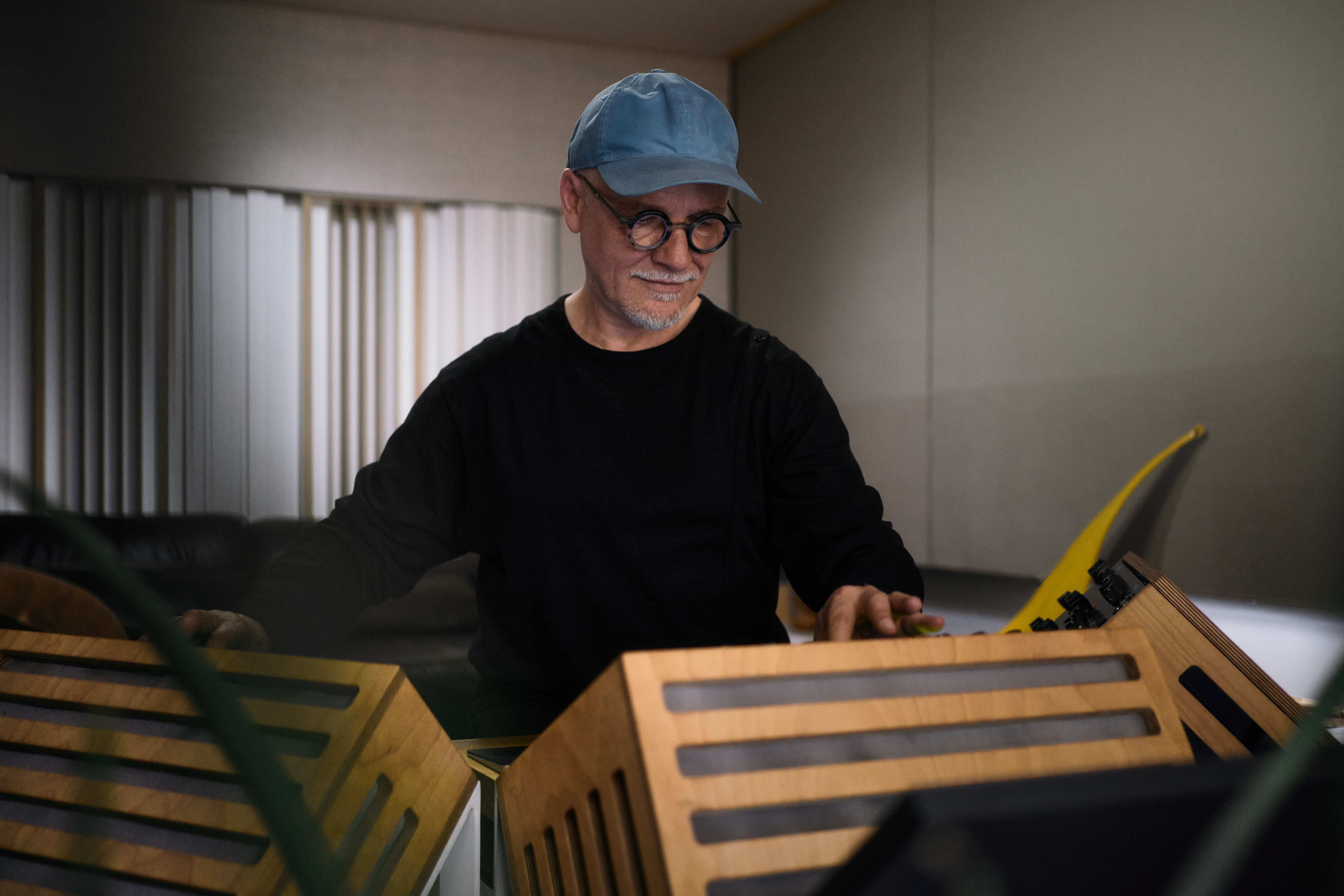
Stephan Mathieu (Photo: Richard Mathieu für Neverdaless Photo & Film / www.neverdaless.de / IG: @neverdaless__ )
You mentioned that your own catalogue is no longer available at all. Not making your own music is one thing, but actively taking it down it is almost like an act of distancing.
Stephan Mathieu: Withholding my music from the business was a conscious decision. I wanted it to disappear from the market. It still exists, of course, with the people who bought it at the time. I never wanted my music to be on streaming services, so I didn’t have a contract with a digital distributor either. The whole lossy mp3, “everything, all the time” thing was never for me from the start, since at the time I was interested in my music sounding good. I always wanted my work to exist in the best possible quality. Closing the Bandcamp store was then a logical step for me, one that had to do with personal autonomy. In the streaming world, music becomes a drop in the sea of data. So instead, I started making 4-hour pieces. By keeping my music out of all this, I’m also protecting it somewhat from this kind of devaluation. The developments that have taken place over the last 20 years are just mind-boggling, and I wish more artists would refuse to be part of this horror show.
Could you talk about your clients?
Stephan Mathieu: At first, I worked for friends, colleagues, and people who liked my own music. Word got around, and the projects I was able to work on kept the momentum going. Then, at some point, new clients came along who had no idea that I used to make music myself: “I saw your name on five of my list of the best albums from last year—would you do my music too?” I don’t specialize in specific genres and will take on just about any project. For me, mastering is always about cleaning up and shaping frequencies. It doesn’t matter to me whether it’s jazz, electroacoustic, jungle, or chamber music. I’ve always been interested in a very broad spectrum of music. The variety that comes with working this way is what makes it so exciting and special for me. I’m really very happy with my job, with the fact that I get to work on fantastic projects every day. As a mastering engineer, I’m an invisible helper who makes sure others shine brighter.
Is there such a thing as a signature sound in the context of mastering? Would you be able to identify the work of your colleagues
Stephan Mathieu: Yes, absolutely, there is. I worked with Henner Dondorf for so long because he was so good at dealing with my music. I often buy albums mastered by certain of my colleagues because they almost always sound fantastic. For me, it’s definitely a selling point when I see that Heba Kadry, Josh Bonati, or Giuseppe Ielasi mastered something. That’s why I’m always glad when there are detailed production credits. What’s the point of writing “Mastered from the original reels” on it but not mentioning anywhere who did it? Your buddy with a cracked version of Ozone? Good engineers do their very best to make a release sound great. I always like to know who did it, and I often reach out to express my respect. It makes the world feel a little smaller.
What does a typical workday look like for you? Eight hours straight?
Stephan Mathieu: I sometimes work longer than 8 hours, but never straight through. My new studio, which I finished last year, takes up a good portion of our apartment. Since it’s just a few feet from the kitchen and the bedroom, I often start early—ideally around seven when my daughter leaves the house. I check emails and then can work with focus until eleven or twelve. Then I take care of other things and get back to working in the afternoon or evening. Working analogue also means that tracks are captured in real time. If a track is 35 minutes long, I’ve got some time to clean up in the kitchen. That, by the way, is a favorite tip of mine: listen to a master while doing something else in another room. If under those circumstances the music doesn’t intrude, it’s already sounding pretty good and balanced. Working from home gives me the flexibility I need, since often I’m dealing with clients across multiple time zones simultaneously.
What do you see as the advantages of working with physical gear?
Stephan Mathieu: : I’ve made my own music either entirely in-the-box or recorded acoustic material with computers and then edited it with software. For a long time, I wasn’t interested in hardware processing at all, partly because my software could do things that are impossible with hardware. I deliberately worked with very limited resources: Pro Tools Free, Tom Erbe’s Soundhack, Akira Rabelais’ Argeïphontes Lyre, and a handful of plugins. I really went deep into those tools; they were my instruments, and I learned to play them. At some point, Soundhack became so outdated that I had to keep a vintage computer on hand just to continue working with the software.
But for mastering it was completely different. My albums were processed using legendary vintage equipment—EQs where a single move could make a difference as stark as night and day. That’s when things really come to life, and there’s also a tactile connection you have with the gear that can create magic. It’s obvious to me that, for some years now, you can create fantastic masters exclusively with software. In this sense, when it comes to sound, having expensive hardware has become more of just a cliché. Still, it was important to me to work with hardware, even though what felt like 8 years’ worth of income went into my console. The upside of having to wait so long was that, after so much planning and designing, I knew exactly what gear I really needed and what would have been just excessive nerdiness.
My room and my gear are an instrument I can play. I can make really fast decisions, practically in real time. As a former drummer, I designed the racks so I could arrange my gear ergonomically, just like my drum kit. This means I don’t have to move out of the sweet spot of my monitors, and I know more or less by feel where to reach to adjust the highs, mids, or bass. The racks are acoustically invisible, so they don’t interfere with the sound and don’t cause reflections of certain frequencies.
But capturing a track or a new mix of a track also means manually adjusting 200 knobs and switches before I can get started. So, much like someone doing a take on an instrument, I have to “play” the track from scratch, because with hardware there’s no automatic recall, as is the norm in software. I write down the settings for my gear for each track so I can recreate them if necessary.
The first masters I did took days because I was still having to explore and learn. Henner sometimes worked on my albums for weeks and then gave me seven versions of a track to compare. That drove me crazy. In my work, I’m going after efficiency, which is easier for me with my own gear. I like to approach the processing phase of a project with as live an approach as possible. When a new project comes in, I listen to it and ideally start working on it right away with that fresh impression intact. As an artist, you’ve already listened to the tracks 170 times and now you have to let them go. I then have the advantage of hearing them for the first time and know right away in my room if and where I can get more out of them.
There are also difficult collaborations. You told me about a situation where you’d already had an endless series of emails over what were just two test tracks.
Stephan Mathieu: Yes, but that was a pretty unique case. An artist for whom I had already mastered a fairly successful album had a new project two years later that I was supposed to master for him. After two weeks of back-and-forth with endless emails, I realized: this isn’t working. He insisted on his approach, arguing that since I had all this great gear, he surely shouldn’t have to tweak his mix with plugins first. To me, that’s nonsense—because while you can certainly do fantastic work with plugins, it would also mean that I’m finishing his work for him. That’s just not what mastering is—I’m not a co-producer. For my work, I always need the final mix that an artist stands behind and from which I can clearly see the direction we’re heading in. At some point, the client became verbally aggressive, so I cut things off and recommended he go to a colleague who’d done the cutting for his last album and charges by the hour. I’m very dedicated and, when necessary, try to find solutions. But in this case, the chemistry just wasn’t there at all.

Studio Schwebung (Photo: Richard Mathieu für Neverdaless Photo & Film / www.neverdaless.de / IG: @neverdaless__ )
What about your pricing? Do you charge by the minute?
Stephan Mathieu:Many studios have a fixed price per track or work on an hourly rate. Since I often work on very long tracks, it still makes the most sense for me to calculate based on the duration of an album plus the number of tracks. Generally, it’s important to me that my work stays affordable and that the pricing is transparent and fair for both sides. In my international network, there are people who charge less, but there are also studios that charge three times as much. I’m comfortable with my prices and don’t raise them just because I’ve got a lot of projects going on. My pricelists are a guideline. If someone is releasing their album entirely on their own or the budget is tight overall, I’m flexible. In my mid-50s, I’ve reached a point financially where I no longer have to throw my hands up in despair when something breaks down on the car. That feels good. Since my partner and I enjoy working and work a lot, a good apartment with enough space was important to us. A home as an office as a home. We rarely go out and, instead of taking vacations, tend to take the occasional short trip. So far it’s working out well.
Qobuz Playlist
A playlist of reference tracks that Stephan is revisiting frequently “to know how audio can sound.”
Last year I was on a panel where they played frequencies that people of certain age groups could no longer hear. Is there a biological limit to your job?
Stephan Mathieu:Bernie Grundman, one of the legendary mastering engineers, is now 83 and is still doing fantastic work. Another example is Kevin Shields of My Bloody Valentine. By his own account, he can’t hear everything said in a conversation anymore, but he can still judge his mixes perfectly, and he also knows exactly how they’re supposed to sound. Susan Rogers, Prince’s former sound engineer and now an academic in the fields of music cognition and psychoacoustics, says that musicians have much more trained hearing than laypeople, often even better than some audio professionals. She compares them to athletes, in this case whose every auditory muscle is optimally trained. That’s probably where my experience as a musician comes in handy. I can sometimes judge the subtleties of a mix better than the person who produced the track, even if their ears are 30 years younger than mine. It’s a training process I unconsciously began 40 years ago. Mastering is also about knowing which things to focus on. They’re usually completely different things than what you’re working on as an artist during mixing. I’m coming with a different perspective.
I usually work at a moderate volume level, around 74 dB. The classic thing to do in the recording studio is to crank it up, but I prefer a calibrated listening volume so I can immediately tell if a new project is too loud or too quiet. When I really want to let it rip, I’ll turn it up, so it’s like the band is playing right in my room.
That brings us to the topic of remastering. These days, you constantly see remasters of albums that are barely 20 years old. Is that just a money-making scheme?
Stephan Mathieu: The last 20 years have been an interesting period. Albums from the era between 2000 and 2015—the peak of the Loudness Wars—were often mastered to be extremely loud. Especially pop and chart material in the broadest sense, which then dragged everything else along with it, even classical music or jazz. In my room, I can’t turn it down low enough—it still just blares out at you. These days, many artists aren’t going along with this anymore, and so I’m sure there’ll be a whole wave of remasters on the way, because especially with streaming, you can clearly hear whether a ridiculously loud track is automatically being turned down 7 dB by the platform, or whether something sounds really good and dynamic. If a mix has punch, it comes through without needing to be distorted by a limiter. Then, as a listener, you can turn it up yourself, and if you want it to be really loud on a good system, a well-made track will still be enjoyable without hurting your ears.
Albums are often remastered to make them sound more contemporary. That sometimes makes sense, since the recordings either never sounded that great to begin with or were mixed to strongly reflect the demands of their time. Today in the rental car, “Drive” by The Cars was playing. A great song, but it sounds extremely ’80s radio—that is, overly bright. I’d actually like to hear it sounding a bit more earthy. On the other hand, Phil Collins’ Face Value and Hello, I Must Be Going! were released as remasters in 2016—two albums I loved as a kid and that had a huge influence on me as a drummer. The originals still sound great, but the remasters are just horribly loud, which has practically ruined the tracks.
The opposite is true, for example, of the 2015 reissue of A Tribe Called Quest’s People’s Instinctive Travels. That one was remastered by Bob Power, who engineered the 1990 original, and now sounds more transparent and richer than the original. Fortunately, there are countless great examples of very well-done reissues.
For the overly loud productions from the 2000s, a new master from the unprocessed original mixes therefore makes perfect sense to give the music more room to breathe. You can restore the dynamics that were sacrificed to the volume craze back then, so that they don’t fall so far behind other good productions in streaming, which is what is currently happening.
Is there such a thing as the perfect record for you? Sonically and musically?
Stephan Mathieu: Yes: Columbia 14425-D, a 10” shellac from 1929 featuring two tracks by Blind Willie Johnson. I like it when the form serves the content, and I’m always interested in going back to the roots, that is, going back to where things started and to how they sounded back then. At some point, I started collecting and restoring mechanical-acoustic gramophones and set out in search of specific records from the ’20s and early ’30s. “Keep Your Lamp Trimmed and Burning” was the first treasure I found in the U.S. When I played the record at home on an HMV 102 gramophone, I was really moved. It sounded as if Blind Willie and his wife Willie B. [Harris] were sitting on the other side of the needle. Or, as a friend once put it, as if you could see Adam and Eve in paradise.
Let’s watch a short film that my friend Cedrick Eymenier shot in my studio a few years ago. It has no dialogue—it’s a kind of portrait of my work. At the time, I was working on a reissue of Costin Miereanu’s music.
Thank you very much for this conversation, Stephan!
Piano – Miroir
Cedrick Eymenier, 2022
The interview has been edited to clarify some ambiguities in the transcript.