

Tyshawn Sorey “I’ve got this!”
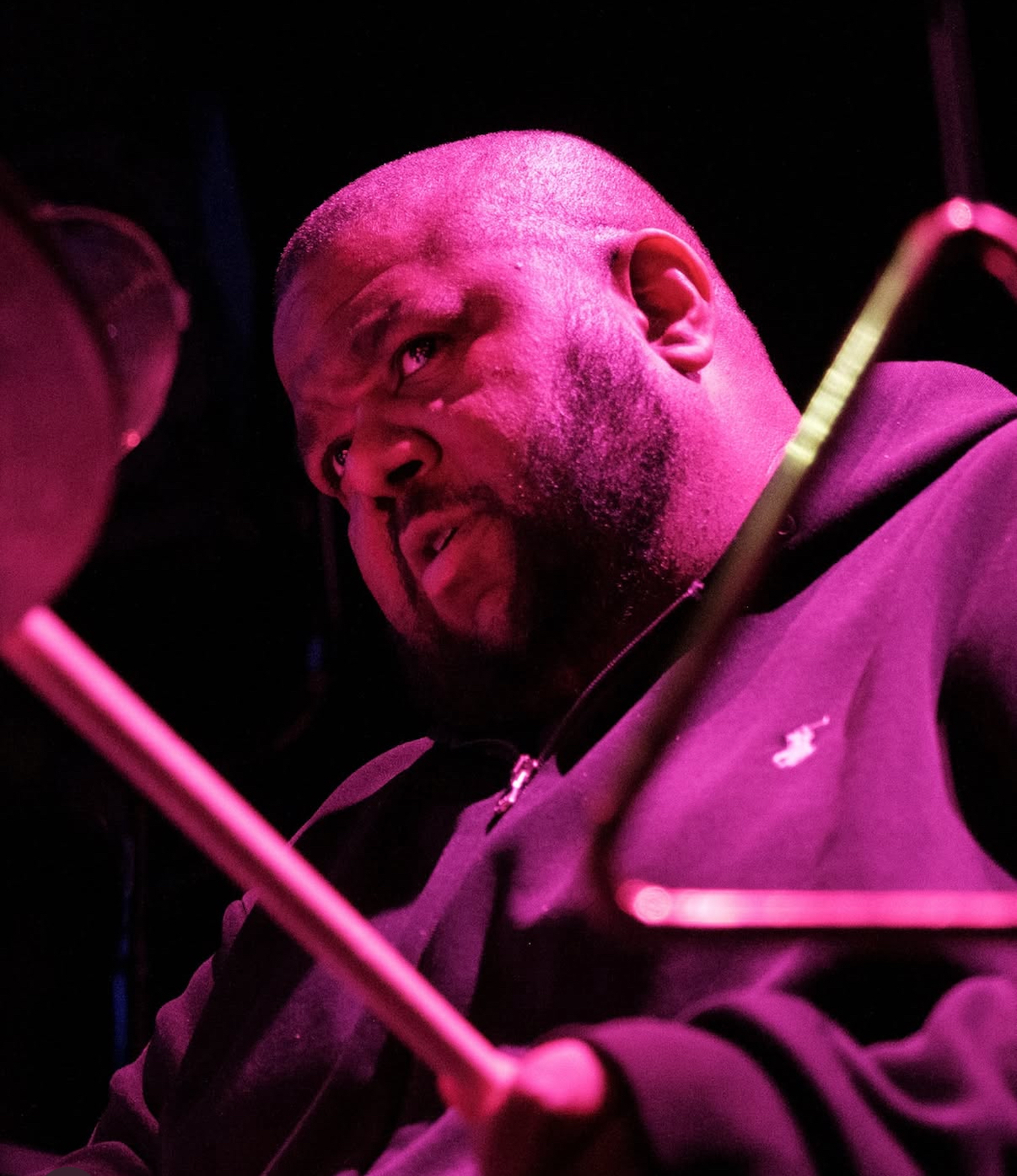
Tyshawn Sorey (Photo: Niclas Weber for Monheim Triennale)
Tyshawn Sorey is one of those rare artists who collapses the usual partitions between worlds: contemporary composition and free improvisation, jazz tradition and avant-garde experiment, extreme stillness and explosive momentum. Across the past year, I’ve witnessed his art in six distinct performances—four times at the Big Ears Festival in Knoxville, three at the Monheim Triennale—each appearance reframing what “seeing” Sorey actually means. In Knoxville, the range was staggering: the meditative vastness of “Monochromatic Light (Afterlife)” inside St. John’s Cathedral, all deep resonance and Rothko-like gradations of tone; the fiercely polyrhythmic time travel of his quartett with King Britt, Melz and Meshell Ndegeocello; the tensile interplay of his own trio; and Fieldwork’s diamond-cut density alongside Vijay Iyer and Steve Lehman.
By the time Monheim came, Sorey was under the weather—yet still, his drumming inside Peter Evans’ two “Being & Becoming + Voices” performancs and his first-time pairing with Darius Jones radiated the same fierce intentionality, an approach where every hit, pause, and sustained tone feels earned. Out of respect for his health, we postponed our conversation until two weeks later, catching up via Zoom while he was in Darmstadt for the Ferienkurse, where he returned as a faculty member.
The accolades are plenty—Pulitzer Prize in 2024 for “Adagio (for Wadada Leo Smith)”, MacArthur Fellowship, commissions from leading ensembles—but what strikes me most is the way Sorey uses virtuosity not as display but as invitation: to listen differently, to inhabit the space between composition and improvisation without anxiety over which side you’re on.
This fall, Germany will experience that very special Sorey power again, first at Ruhrtriennale and one day later at the yearly Jazzweek gathering in Cologne, both performances with his trio.
You’re in Darmstadt for the Ferienkurse. Is this your first time participating?
Tyshwan Sorey: This is my second time here.
So you already have some history with the festival. How are you experiencing it this time?
Tyshwan Sorey: I love it here; it’s incredible. I’m serving as one of the composition tutors and also leading a large ensemble course called autoschediasms—which is essentially a spontaneous composition ensemble with a large group of nearly thirty musicians. That’s what I’m doing as part of the program here.
It is a truly great program. I find it exciting to see composers and performers of color here, and it’s wonderful to just see a much more diverse body of people around.
As said, this is my second time, and my first visit in 2023 was fantastic and very successful. Fortunately, that year I was able to be part of several panels, including one that centered on the music of Anthony Braxton. Another panel I was on was hosted by the ethnomusicologist Harold Kisaydu, who is based in Hamburg. He and George Lewis collaborated on a book together, it’s a really important piece of literature. The panel and the book are both titled “Composing While Black”. George Lewis and Harold Kisaydu hosted the panel, so it was a very important one for me to serve on. I also delivered a lecture and was a composition teacher that year as well.
Being here in both 2023 and 2025 has been an exciting opportunity each time. I hope to come back for future installments because this is one of the most important historic institutions for contemporary music, from its beginnings in the late 1940s until now. It’s an honor for me to be part of such a wonderful cohort of composers, performers, students, teachers, and researchers. The climate is intellectually stimulating on every level. People here are really open-minded to new concepts and ideas surrounding music—not only musical ideas but also socio-musical ones, like having a more diverse pool of performers doing really interesting work.
From my understanding, and as you’ve just pointed out, it’s not simply teaching in the sense of you disseminating information. It’s a reciprocal process, a dialogue with the students as well as the other teachers, artists, and composers.
Tyshwan Sorey: Yes. It’s a hotbed of intellectual stimulation, I’ll put it that way.
It seems that passing on your experience to the next generation is an important part of your life—engaging in dialogue with younger artists and enabling them. Do you feel that this act of communication and mentorship is as important for an artist as working on the art itself?
Tyshwan Sorey: Absolutely. I see a lot of that happening here in this program and elsewhere. Even in America, many more people are understanding the importance of inclusion and of artistically and intellectually taking care of each other, of doing things for the greater good of the community of music makers. It’s really nice to see that at important institutions like Darmstadt, or even at academic institutions like the University of Pennsylvania where I teach.
I encourage this kind of dialogue and this way of thinking, not only as it relates to music but also to other forms. This perspective is vital in music studies and across the board—in the study of music and in understanding its relation to the world.

Especially in times of tougher political circumstances around the globe, it seems we as culturally active people have a duty to keep dialogues going. You’ve been with us in Monheim for the Monheim Triennale, now you’re in Darmstadt, and you’ve spoken about both the European tradition and your happy recognition of people of color being part of the system here. This all feels like part of a responsibility for us to understand that what we do is also political, but on a deeply human level of interaction.
Tyshwan Sorey: Right. Absolutely.
I’m also interested of course in your reflections about your time in Monheim. How did you experience the festival? You were a bit ill, but you managed all your performances.
Tyshwan Sorey: Yes.
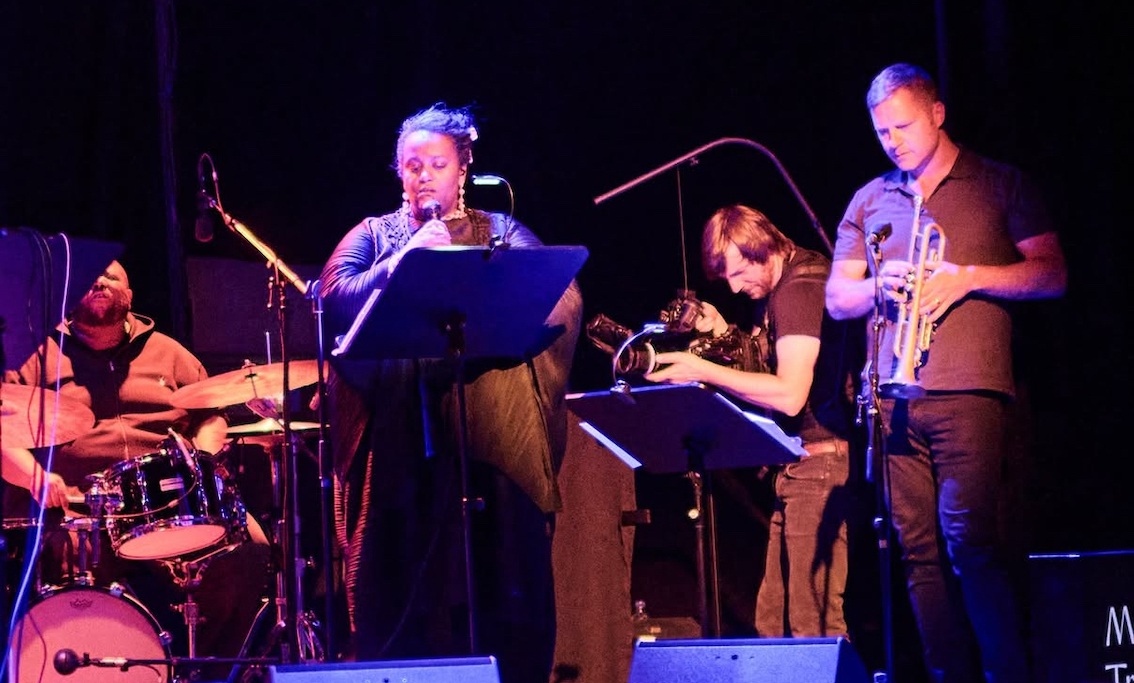
Peter Evans: “Being & Becoming” / Peter Evans: trumpet, composition – Joel Ross: vibraphone, drums, synthesiser – Nick Jozwiak: double bass, synthesiser – Tyshawn Sorey: drums – Alice Teyssier: vocals, flute – Mazz Swift: vocals, violin – Sofia Jernberg: vocals. (Photo: Niclas Weber for Monheim Triennale)
Did you find time to check out other things? Did you feel you got the same inspirational momentum from that festival as you do from Darmstadt?
Tyshwan Sorey: Yes, absolutely. I felt that way even though I was unfortunately bedridden for much of my time in Monheim. As you know, I was extremely sick with a very bad flu. I was in bed for over 24 hours and could barely make it to anything. So, I had to save just enough energy to make it through the concerts I had to perform.
The concert with Peter Evans, as you saw, is a very demanding book of music. And to also do the duo concert with Darius Jones, I just needed to save as much energy as possible. Despite being sick, I wanted to put one hundred percent into each of those projects. I jokingly told Darius, “Well, if I die here, I’m going to die knowing that I put everything into the music,” because I was not going to cancel a concert. I just decided to conserve as much energy as I could to get it done.
The day I arrived, I was okay, and right on I met some forward-thinking artists, some wonderful, hopefully future collaborators. It is indeed a forward-thinking festival. What I loved about it is that it’s not a jazz festival. There are so many jazz festivals around nowadays, so it was refreshing to see a festival that was inclusive of this idea of post-genre music, to put it that way.
In many ways, Darmstadt is similar. In Monheim, I got to meet musicians from all different kinds of backgrounds who are doing all sorts of interesting things. I was able to see and hear some of their music online, which was how I got to know about some of the artists who came.
I will say that Monheim is very much the same as Darmstadt with regards to the diversity of musical form, thought, and ideas, and also in terms of the people who are making this music. You have trans-African musicians, trans-African-American musicians, trans-European artists… and when I use the word “trans,” I don’t mean it in a gendered sense, but in the sense of crossing—of coming from these different continents and places. It was really great to see all kinds of artists making vitally important music that is fresh for today, who all share the idea that we are indeed in a post-genre era, where no one type of music is quote-unquote “important” over another.
There’s no presupposed idea of who is supposed to play what kind of music. Everybody is doing the best they can, regardless of what genre or box the music might fit into. For a festival like Monheim Triennale—and I feel this way about Darmstadt today—we don’t really have boxes anymore, which is a nice thing.
It was good to be a part of both experiences. So, a succinct answer to your question is that yes, indeed, I think the climate is very much the same in Monheim as it is in Darmstadt.
And it’s not just about the boxes, but also the hierarchies. Not that they are deconstructed entirely—of course, there’s huge respect for what all the artists have achieved, and some are farther on their path than others. But what we wanted to create at the festival, and what the artists enable, is a space where everyone meets at eye level.
That’s important to me, coming from a DIY punk and hardcore background where the idea was to get off the high stage and communicate. It’s great to see how older artists will jump in with a twenty-year-old without a problem, or how they work with even younger students in school projects. The hierarchy is clear, but you don’t make them feel it. You just let them know, “I have experience, and if you come here, there’s something for you to take.”
Tyshwan Sorey: Absolutely. While hierarchies are inherently present within these institutions, it’s always good to recognize that they are there and then move on from them, to not dwell on them. We don’t try to talk down to people, especially not to younger collaborators and students. I think it is our job as older-generation musicians to inspire them and to let them know that they, too, have a voice and something to contribute. They are inherently creative, and all that is left is to express that in a form that allows for it.
Places like Monheim and Darmstadt very strongly encourage that kind of artistic ideal. Because of it, the mind remains more open, more fertile, and more receptive to information. No one person can know every single thing there is to know about music. There’s always something else to learn, whether it’s from a younger artist’s creation or from scholarship that is becoming more available through new technologies, books, and other resources. We have so much information out there now, and we’re at an advantage where we can take it all in and hopefully change things for the better, musically and artistically.
I was also lucky to be in Knoxville this spring for the Big Ears Festival and see you perform in several different constellations that were quite far apart stylistically. You had your trio, the King Britt project—and then the large-scale “Monochromatic Light (Afterlife)” performance in the church.
This brings up two questions. Artistically, what do you take from one project to the other? And also, do some of these projects function differently for you? The church composition, for instance, must have put a lot of pressure on your shoulders as the director of such a large, collaborative work. Are there other outfits where you feel you can just let loose and play, where one feels easy and the other hard, and you need both?
Tyshwan Sorey: I suppose it just comes down to experience. With the King Britt project, my trio, and even Fieldwork—which was at the end of my residency at Big Ears—I felt, yes, I’m totally allowed to let loose and just do my thing on the drums. I like having the ability to do that while also showing my compositional side, because I think both of these things inform each other. My composition practice and my performance practice inspire each other in different ways.
I’m also thinking of my duet with the great composer and percussionist Adam Rudolph. Hardly anyone talked about it during the festival, but for me, it was one of the highlights. We are both composers, we both think compositionally, and we have ways of playing together that exist within the lineage of percussion music and new music. But we are also looking to do it in a way that incorporates percussion music from all spheres, not just the contemporary classical realm. That is another situation where I feel I can be as much of myself as possible.
Because composition and performance inform each other, I feel like I’m one hundred percent myself all the time. It’s just that the mediums are different, and the way I express myself is very different for each approach. But it’s always nice to both play and conduct, or to listen to my own music be performed in these settings, as a way to remind myself that all I’m doing is the best I can do, whether I’m on stage or not. And hopefully, people will enjoy the work for what it is.
That’s often the blind spot when people talk about improvisation: that for the artists themselves, in the best-case scenario, there are many surprising moments. There’s nothing wrong with bringing a finished composition to the stage where you know exactly what you want, but with improvisation, I’m sure you have moments where you think, “Wow, how did that happen?” The magic is that music can be planned, but it can also lead you.
Tyshwan Sorey: Definitely. I feel that way. For example, what was great about King Britt’s project in particular was that it was the first time I had played with any of those people. I’ve known King for five or six years now; we’ve been collaborating for a long time. But that situation was a fresh environment where I was playing with Meshell Ndegeocello for the first time, even though we had talked in the past about doing things together. Playing with her, I think, brought some things out of me that I probably would have never otherwise done with another bass player.
I would say the same thing for Melz, the guitarist. I had never even really heard her before we played at Big Ears. Playing with those musicians, I found they had such an openness to what I was doing, and that openness was shared. I felt it towards them as well. I guess we managed to make a music together that felt most honest and unique, and that really brought out elements of ourselves that we never would have expected. That was an incredible opportunity, and I hope we get to repeat that experience. Of all the shows at Big Ears, that one stood out the most to me because there were a lot of firsts in that situation, which I really value. Sometimes you never know what to expect until you’re actually in the act of creating.
When you’re in the act of creating, you are one hundred percent in tune with whatever is happening on stage. If you’re not, then what you do doesn’t make any difference. I want to do something that challenges both myself and the musicians around me, and I want them to challenge me and make me discover things about myself that maybe I hadn’t explored much in other bands. It’s always about learning. As I often say, any day that I learn something is a really good day.
I imagine you as a very, very curious teenager. Is the curiosity you have for music today coming from the same corners of your mind and body, or is it a different state of curiosity now?
Tyshwan Sorey: It might be a different state of curiosity, insofar as I’m curious about learning more information. I’m interested in having more opportunities to learn what other people are doing and how to take my own music in directions I haven’t yet taken it. It’s different in that regard. But in terms of my curiosity remaining what it always has been—my curiosity will always continue because I have a curious mind. I’m a person who tries to think beyond the present moment when it comes to music-making. I like to be in the moment at all times, but I also like to think about taking the next step in a project or a composition.
I see all of this as part of a continuum of development. And development, I would say, is the law of progression. One has to develop in order to make a body of work that is meaningful. To do the same thing over and over again and not be curious about anything else—I think that’s a deadening thing for an artist’s development. So I’m always interested in learning and in having situations, musical and otherwise, that challenge me and present me with new ideas to explore.
So that also means you actively search for different things in music. Is that a planned process, or does it happen more in a natural flow?
Tyshwan Sorey: It happens more in a natural flow. Given that I function both outside of academia in the world of making music and within academia, I’m interested in every aspect of it. I don’t think one is necessarily superior to the other. I’m a person who likes to think I can learn from any of these fields.
I mentioned music studies earlier—ethnomusicology, musicology, anthropology, and a number of other things. All of these are of high importance for me in terms of what I’m looking to learn and how I can apply it to my own practice, whether it’s curating concerts, presenting my own music, writing compositions, or participating as a sideman in projects where I feel challenged. That will forever be part of the natural flow of things as I continue to live out my life in music.
That fits with the fact that you were already quite an established live musician when you decided to step back and go study with Anthony Braxton and Alvin Lucier. Many people would have just stayed on the established train. It seems risky to make a cut like that and go somewhere else.
Tyshwan Sorey: For me, the guiding principle has always been that I have a vision—my own vision when it comes to making music. It wasn’t that I felt my vision was being hindered by the other artists I’ve had the fortunate chance to work with. People like Steve Coleman, Dave Douglas, and many others were of great importance for my development. But I also felt that if I have a vision, it really needs to take priority at a certain point. That’s why I made the break that
I did, going back to study and taking a sabbatical from myself to further my own vision.
I guess I just got tired… I didn’t want to be pigeonholed as just a drummer, or as a drummer in somebody else’s ensemble. I thought then, and still do, that there is much more to accomplish if one wants to pursue a vision that expands beyond merely being a side person. Anybody can do that. I have my own vision. I want to be a composer, and I want to present my own music in public, with my own bands, in America and abroad. I had never really had the chance to do that very much. The only times I got to present my music were basically in New York, and that was it. I was limited because I was so busy with commitments to other musicians that I couldn’t advance my own work in the way I wanted to.
That’s why it was necessary for me to make that break and to just say, “Look, it was a pleasure working with all of these bands, but I have my own vision that I need to pursue.” I do like to perform, but my focus since then has mostly been composition. It’s been great to be able to do that and still maintain an ability to play and participate in projects that I feel can benefit my vision as a composer and performer, the Tyshwan Sorey group being one of them. I want to be in groups with like-minded people, rather than just making a gig to make a gig. I’m not interested in just playing gigs. I want to learn something and fulfill my vision while doing so.
It’s beautiful how you describe being in a moment where you are still learning, while at the same time you are adding a body of work to the continuum of music. What do you consider the first work where you thought to yourself, “Now I’ve achieved something. I’ve made something that is part of this larger continuum”?
Tyshwan Sorey: I would point to two pieces in particular. One is my “Permutations for Solo Piano”, which was recorded on my first album, “Thet Not”, from 2007.
The other would be the “Seven Pieces for Trombone Quartet”, also from that same record. Those two pieces, although aesthetically and stylistically very different, kind of sealed the deal for me in terms of what I wanted to do and the vision I wanted to pursue as a composer of notated music, where both notation and spontaneous composition can function within the same framework.
Those two pieces for sure were the highlights for me. They were an assurance to keep going in the field of composition and to pursue different concepts I wanted to explore. So really, 2007, with those two pieces and my first record as an artist—those things set the tone for what I would develop going forward.
Did that feel like just a great moment, or did you also think, “Wow, now the pressure really starts, because I’ve set my own bar there and have to follow up”?
Tyshwan Sorey: No, I felt like, “I’ve got this!” I felt I was in a good place. I just wanted to continue doing it, and the pressure was on to continue. The thing I have to remember is that consistency breeds success. I have to be consistent with what I’m doing. I can’t just write these pieces and then call it a day. I have to continue developing and learning if I want to be successful—and by successful, I mean according to my own definition of success.
I’m not in this to become rich. I’m in it to express myself and my life experiences, and to offer that to humanity and to people who will hopefully enjoy it. That is the sole reason I’m doing this, and I have no choice in the matter, because the real reward is in the work itself. When I put that album out, I said, “Okay, this is my statement. If people don’t like it, they don’t have to listen, but I’m going to keep going with my own vision.” And now, almost twenty years later, we’re still breaking new ground. So I’m very happy about that. I do feel pressure sometimes in terms of deadlines, but that’s a different kind of pressure.
The conceptual artist Lawrence Weiner always said that the only reason for making money was to have the time to work on what he wanted to work on. Money gave him the freedom to be the artist he wanted to be, which also meant having breaks and not constantly touring. That’s a health aspect, too. Is it easy to stay healthy and find rest while following your musical dreams, or is it a constant struggle?
Tyshwan Sorey: It’s something I have to demand, to put it that way. I have to almost force the issue to give myself time for self-care and to make sure I have enough time to work on my music without going on a bunch of tours. It’s good that I have a manager and an assistant who help me with these things, because I am by nature a workaholic. But the danger of that is not taking enough time for yourself. Rest is an important part of an artist’s work; it’s as essential to progression as the work itself.
Because I’m in very high demand, I sometimes have to say no to things. I know well in advance what writing projects I have to finish by a certain time. If people are asking me to do things within a time frame when I need to do a lot of writing or research, sometimes I have to say, “Look, we have to wait for a year from now, or six months from now,” when there is a free period. I do have to block out periods for myself where I can take a break from performing and only focus on composition. That’s happening more and more now because, as I said, I’m not getting any younger. And the fact is, there will always be gigs, but my vision has to remain the priority, and that includes rest. Otherwise, I won’t be able to make it through.
How should we imagine your time frames for composing? Do you work on one piece at a time, or do you have several in progress that you finish in concentrated periods?
Tyshwan Sorey: It’s more both. I work from composition to composition; I don’t like to work on pieces simultaneously. But I also know the deadlines for them, so I typically work in order of deadline.
Do you need a deadline?
Tyshwan Sorey: I do need deadlines. Otherwise, it’s hard to finish things on time. Deadlines are good for inspiration, in a way. It’s like playing an improvised solo: you know the amount of time you have to say what you need to say, and you have to do it in a way that makes coherent, logical sense and that the audience can enjoy. I see composition and deadlines in the same way. The deadline helps ensure that I’m consistent with how much time I’m putting in to get the work done.
When I think of composers, I have two images in my mind. One is someone sitting at a piano, working things out. The other is someone walking in a forest when an idea suddenly hits. Is your process a mix of those?
Tyshwan Sorey: No, it’s definitely a mix of those things. Absolutely. I have a notebook that I carry with me in which I take a lot of notes and write down ideass
Regarding your composition “Monochromatic Light (Afterlife)”, which we saw in Knoxville: how much discussion do the musicians need? They are all at a level where they can play anything from paper, but there are always unwritten things. Is a lot of talking involved?
Tyshwan Sorey: Not necessarily. There’s a lot of rehearsal involved because of the detail and the interpretive things we discuss, but the musicians are so great that we don’t have to discuss too much. I basically just hand them the score and they perform it. We’ve had that music now for three years; the piece is about three years old, and the same featured musicians have performed it since its world premiere. So we no longer discuss things within the music.
When I first handed them the score, of course, we talked about some things and addressed concerns in the piece, be they interpretive or notational. But we’ve been playing the piece for three years and it’s been fine-tuned. Now, every time we come together, it’s a unique experience. The piece is never played the same way twice. There is an improvisatory element to it, but largely what they’re doing is reinterpreting the score each time.
It was beautiful to see that your musicians on stage were also visibly touched by the performance.
Tyshwan Sorey: Right. I would say so. It’s a very demanding work—not only physically demanding, where you’re focusing for almost an hour and a half, but also in the mood the piece intones, the emotions it sets in motion. There’s the political and social consciousness in its interpretation, the semi-autobiographical nature of being in a world with so much chaos, and how the music is hopefully about healing.
All these different things are of high importance because music isn’t separate from that. It’s not separate from the ability to heal people in times of unrest, like what we’re dealing with now. “Monochromatic Light (Afterlife)” was written at the height of COVID, at the height of so many injustices done to people all over the world. And there’s still a lot of injustice being done today. Hopefully, this piece of music can at least give some sign of hope to anyone who is willing to sit down and experience something that, yes, is reflective of pain and trauma, but is also reflective of hopefully bringing some kind of peace to one’s self, so they can carry that out into the world.
To come back to the beginning of our conversation, that for me is the most important socio-political aspect of what we all do. People from all over the world meet and present their narratives, and others can take so much from it, even without words. Culture naturally ignores borders, even as we experience too many of them every day.
As a final question, I’m always curious: are most of your friends within the music community, or do you also have friends who have nothing to do with it?
Tyshwan Sorey: No, many of my friends all have to do with music. A great deal of them. I’d say about ninety to ninety-five percent of my friends are engaged in some way in the arts. It’s not necessarily just music—there are painters, visual artists, filmmakers. But mostly all of my friends have something to do with the arts in general, and their musical tastes are very sophisticated, which is something I tend to gravitate towards.
Do you still have contact with old school friends?
Tyshwan Sorey: Hardly. I didn’t really have many friends growing up in school.
You were a loner then?
Tyshwan Sorey: Yes, very much a loner. I kept to myself a lot of the time, which was probably for the best. I don’t know if I would be making music on the level I am today if I hadn’t taken it so seriously and put in the time to truly pursue it. As for old school friends, I can count on two hands how many of those I maintain contact with, but there are not very many at all.
Tyshawn, thanks so much for your time.
Tyshwan Sorey: It’s my pleasure.