

Etran de L’Aïr “To us, the desert is freedom. It is our home”
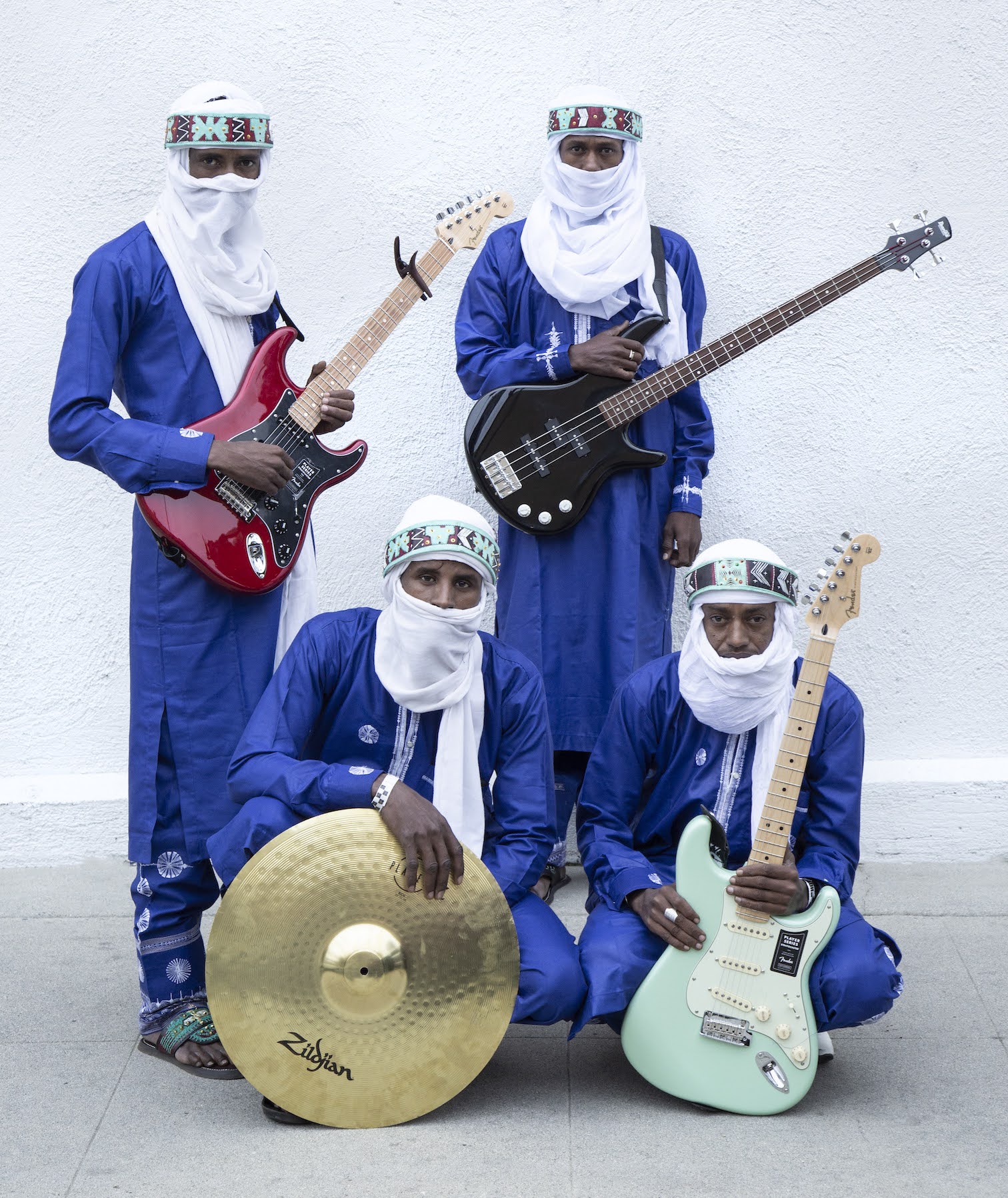
Etran de L’Aïr (Photo: Larry Hirshowitz)
Hailing from Agadez, Niger, Etran de L’Aïr have emerged as one of the most compelling voices in contemporary Saharan guitar music. Active since the 1990s, the group’s sound is deeply rooted in Tuareg traditions while reflecting the urban reality of Agadez’s growing musical scene.
Etran embody a festive, community-oriented aesthetic: their interlocking guitar lines and rhythmic propulsion echo both celebration and endurance. Their live performances are raw, direct, and immersive—eschewing showmanship in favor of a hypnotic drive shaped by local weddings and outdoor parties.
In Berlin, their presence is more than musical—it is a political and cultural bridge, offering insight into the complex dynamics of postcolonial identity, regional autonomy, and global circulation. Etran de L’Aïr remind us that innovation often emerges from the periphery, not despite it, but because of it.
This interview was conducted by email during the current US tour of the band. They answer as a collective with one voice.
You named yourselves after the Aïr, a triangular massif located in northern Niger, within the Sahara. The name literally means “Stars of the Aïr region.” What do you feel when you look up at the sky and see those stars?
Etran de L’Aïr: We used to play at night, so for us the stars bring back memories of playing at night under the stars.
I’ve never been to Niger — and I imagine that’s true for most Kaput readers as well. Could you give us an idea of what life is like in your home neighborhood of Abalane, in Agadez?
We are with our friends and family, we play a lot of music, we have the Sahara, life is good there.
What do you love most about your home country?
The Sahara, straight away.
Are there also things you dislike — and would feel comfortable talking about?
We have no worries there. We’re at ease, we’re at home, we do what we want, work on our music. We’re free.
The stars aren’t just a beautiful experience or a source of light — they’re also your orientation system. They guide you. They speak to you. Is that right?
At the time, yes, the tuaregs did use stars as a means of orientation in the desert. There used to be guides who knew their way around very well, reading the stars, but now it is less popular to navigate the Sahara by looking at the stars.
What do the stars tell you?
They bring back beautiful memories.
What is the primary emotional state that the desert evokes in you?
To us, the desert is freedom. It is our home.
Your band — made up of brothers and cousins — has quite a legacy. You originally formed in 1995, led by Aghaly Migi, and played at local ceremonies. Back then, did you ever imagine that people outside of Africa would take such an interest in your music?
It’s something we’ve built over time. Music is a universal language and we have now started to build a good base. If we keep going like this, our music will continue to expand and reach new people.
How do you personally explain the international success of Etran de L’Aïr?
Mostly the energy of the music. But what has made the music known across continents, in practice, is our friends, the people we’ve met along the way, and Chris. It’s all thanks to Sahel Sounds.
Do you play a lot across Africa as well, or is your international success mainly centered in Europe and beyond?
Yes, of course. We play a lot in Niger, but have also played in Togo for instance. We played our first festival in Africa in 2018 in Uganda. It was for Nyege Nyege.
You release your music through Sahel Sounds. Your debut album, “No.1,” came out in 2018 — 23 years after the band first formed. With that in mind: what role do recordings or “artifacts” play in your artistic life? Are they essential to you, or are they more like a nice addition — while the real experience of Etran de L’Aïr happens live?
While we value playing live a lot, the recordings are still important. They are a way for us to share our music. People can listen to it and physically hold the record in their hands. This is great advertising as well, and a source of income.
After “No.1”, you released “Agadez” in 2022 and 100% Sahara Guitar in 2024 — following a release rhythm that feels quite familiar to Western audiences. What’s your songwriting process like? Do you constantly explore new material while touring and playing live, or do you block out studio time and write new songs together there?
When we’re in Agadez, we work every week from Sunday to Thursday, with a break on Wednesday. We improvise, exchange ideas. Above all, we rehearse a lot. Sometimes we also work on the road when we have days off, but there often is no time. And we don’t have the right equipment to effectively write music on tour.
Where do you usually record?
We record at home in Agadez. We did, however, record our last album “100% Sahara Guitar” in a studio in the United States. The next one we are also planning to record in a studio, in Algeria.
How did it happen that your live album was recorded — of all places — in Seattle?
We spent two days in the studio. Chris from Sahel Sounds knew someone there and we were on tour on the continent already. So it was very practical to do it there.
Right now, you’re on tour in the U.S. As I write these questions, your tour is just kicking off — tonight in Brooklyn, at the Music Hall of Williamsburg, one of the city’s best venues. You’ll be visiting 20 cities before the tour ends in Los Angeles. What is your American audience like?
Very good, dynamic, they have energy, they dance. The audience is very nice.
Looking at the schedule, that also means a lot of driving — long hours between cities. Of course, Africa is just as big, if not bigger, than North America, but since you often play in your home region, I wonder: does the idea of traveling so far for a single concert feel strange to you?
Now that we’ve travelled a lot, we’re used to it. But it’s still very intense and tiring.
Can I ask what kind of music you listen to in the van while traveling?
We listen to a wide range of music, mostly from the African continent: Tinariwen, Ali Farka Touré etc.
Any games you play on the road?
Yes, we do sometimes. When we have a very long journey we play Ludo.
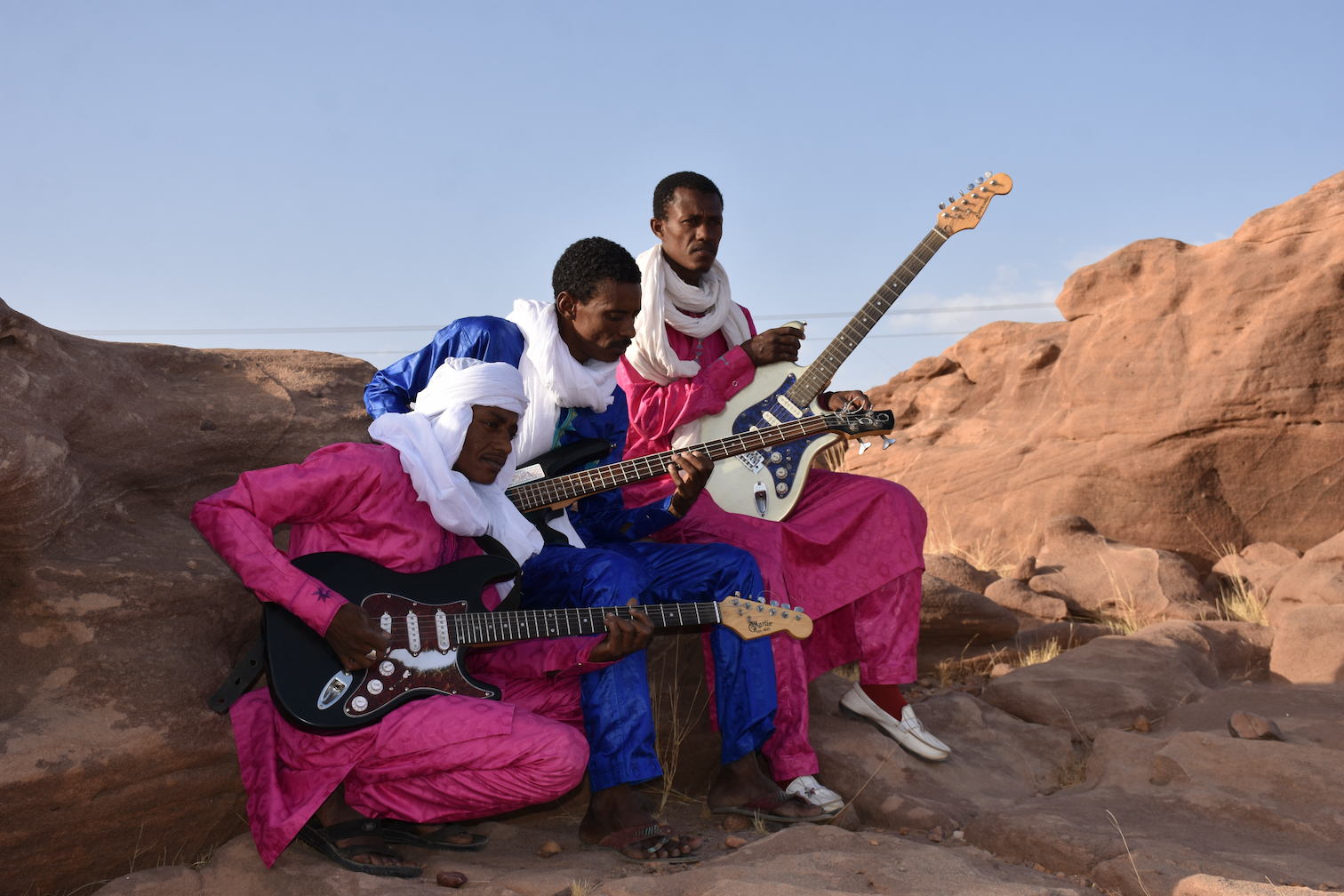
Etran de L’Aïr (Photo: Abdoulmoumouni Hamid)
Do you stay in touch with people back home while touring? Checking in with family, keeping up with social or political news?
Yes always. We keep in touch through whatsapp. We message, but also keep in touch by calling regularly.
I heard that you cook for yourselves while on tour — is that true?
Yes, if you work hard you need really good food! So we prefer to make our own meals. We prepare dishes from back home in Niger. We’re used to it and we want to stay healthy. It’s important to make sure you eat healthy when you’re on tour.
Is it about saving money, or is it more that you can’t quite get used to the food in the U.S.?
We prefer to cook for ourselves to eat healthier than otherwise we would here. The food in the States isn’t bad, but we like to eat well like we do at home.
You’ve been on the road together for a while now. How do you experience the dynamic of touring as a collective?
We’re always together. We’re brothers after all, we were born in the same house, we grew up together and we spend a lot of time together at home too. That’s good, we share ideas, we talk, it inspires us.
It’s not easy to talk politics right now — especially coming from Africa, where many countries are currently on the U.S. administration’s “red list.” So let me ask it like this: are you proud to represent your continent in the States?
Yes, it’s very important. We represent our country, our region.
Music has always been — and will always be — a healing force. But not everyone sees it that way. When you perform for international audiences, do you feel that your music immediately works as a shared language? Or does it take time for people to connect?
The audience understands, they often start dancing directly.
You sing in Tamasheq, a Berber macro-language spoken by nomadic communities across Niger, Mali, Algeria, and Burkina Faso. That said, your international audience likely doesn’t understand the lyrics — or at least not easily.
Most of our recent song lyrics are translated into French and then into English. For 100% Sahara Guitar, our lyrics are inside the sleeve! They are in the youtube descriptions as well. That way, people can see and understand what we want to share.
What kinds of stories do you want to share with your audience?
We sing about friendship, love, the shared experience of life and, above all, peace.
Does your music change depending on where you’re playing — and who you’re playing for?
We play the same music we play in Agadez. It brings us joy.

Etran de L’Aïr (Photo: Larry Hirshowitz)
You’re known for your energetic dance moves. Even though people could just sit and listen to your music, there’s an immediate urge to stand up and move. Are there specific dance styles or aesthetics that feel especially natural or fitting for Etran de L’Aïr?
We dance like we dance in Agadez, we play the same music we play in Agadez. The dancing style depends on the music genre. Regarding Tende music for instance, the dance is very different. We wouldn’t dance to our music in the same way we would to Tende music. But yes, we like to dance on stage to be with the crowd and express our joy.
Your latest album is named after your hometown, Agadez — which we spoke about at the beginning of this interview. Now that the band has been around for nearly 30 years, how have you experienced the changes in your hometown during that time?
It has changed a lot thanks to touring around the world. People are happy too, because we’ve gone out into the world in the name of Niger. We share our music with European and American audiences. We come with our clothes, our music and we share our culture. People in Agadez are aware of this and very proud of it.
Last question: This will not be your first Berlin concert. What do you connect with the city?
It is great, the people are very nice.
_________________________________
Etran de L’Aïr perform on August 7th at Humboldt Forum as part of DURCHLÜFTEN festival.
__________________________________________________________________
 This article is brought to you as part of the EM GUIDE project – an initiative dedicated to empowering independent music magazines and strengthen the underground music scene in Europe. Read more about the project at emgui.de
Funded by the European Union. Views and opinions expressed are however those of the author(s) only and do not necessarily reflect those of the European Union or the European Education and Culture Executive Agency (EACEA). Neither the European Union nor EACEA can be held responsible for them.
Kaput is a proud member of the EM GUIDE network.