


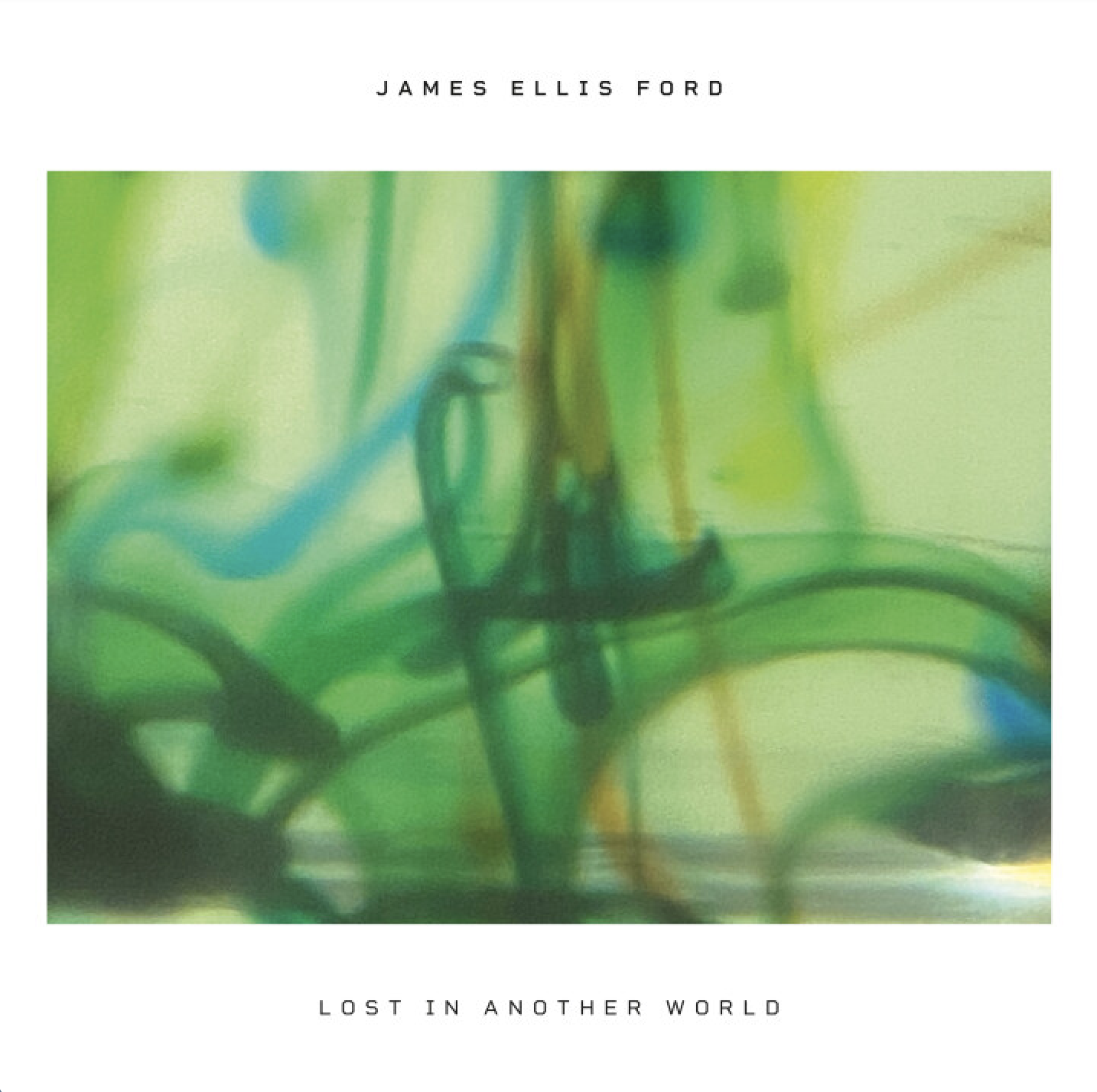
James Ellis Ford “Lost In Another World”
 James Ellis Ford
“Lost In Another World”
(Domino Records)
Right from “Overtones”, the first track, I think: “Great! Someone is paying tribute to Ryuichi Sakamoto / Yellow Magic Orchestra!”. You might even detect a less tense version of Japan’s final album (Tin Drum) as a trace. Although the electronic orientation is maintained, it occasionally departs from ’80s sounds, branching into various directions as the album unfolds.
The more one immerses oneself in James Ellis Ford’s second solo work after The Hum – Ford being known from Simian Mobile Disco and as producer for Foals, Arctic Monkeys, Gorillaz, among others – the clearer it becomes that the pop-leaning music is accompanied by lyrics with real weight. Lines like “now I’m losing my hair” (“This Will Also Be A Memory Soon”) or “and I’m not sure if this poison doesn’t make it worse” (“Parallel Dimension”) suggest the circumstances of chemotherapy. This automatically charges the entire album with enormous significance.

James Ellis Ford (Photo: Dan Wilton)
Ford circles the subject without foregrounding it. The lyrics possess a descriptive and sometimes subjunctive (“as if”) quality that maintains a measured distance. Yet the album remains deeply moving throughout. The lyrics reveal a perception altered by illness, reduced to basic yet existential insights, emphasising that experience of the world is only possible through one’s own existence. The result is not grandiosity but rather humility toward things and toward one’s own music. By making an album about illness, Ford in a sense rises above it. The songs depict sickness as something external to the subject, giving the album a transcendent power. Physical aspects are present but translated into the sphere of art.
Many song titles play with transience (one, “Homesick For Another World”, references the excellent author Ottessa Moshfegh). Uncertainty about one’s fate manifests in a musical language often suspended in midair. The music does not impose itself, but neither does it hide. Lo-fi is not Ford’s thing. Many tracks feature a continuous sequencer conveying continuity.

James Ellis Ford (Photo: Dan Wilton)
Much moves in mid-tempo, avoiding extremes, making the songs feel balanced despite the themes. Music as consolation for oneself. Because of the soulful, mostly gentle electronic setting, the album’s underlying narrative acquires a dignified aura. Whereas Ford once represented forward-driving rave sound in Simian Mobile Disco, he now relies on subtle structures. Dabs replace hatchings.
This turn toward impressionistic sound design connects to the influences mentioned earlier. On a more abstract level, the idea of allowing something external to intervene can also express not being identical with oneself, or with the illness. The productive otherness of Sakamoto and Japan lends many tracks an unfamiliar sheen.
Lost In Another World is an album that compellingly invokes music’s healing potential, its ability to project us into alternative realities and leave apparent fixities behind.