

Ali Kazma: “We make all of these things, but we don’t see this beauty”
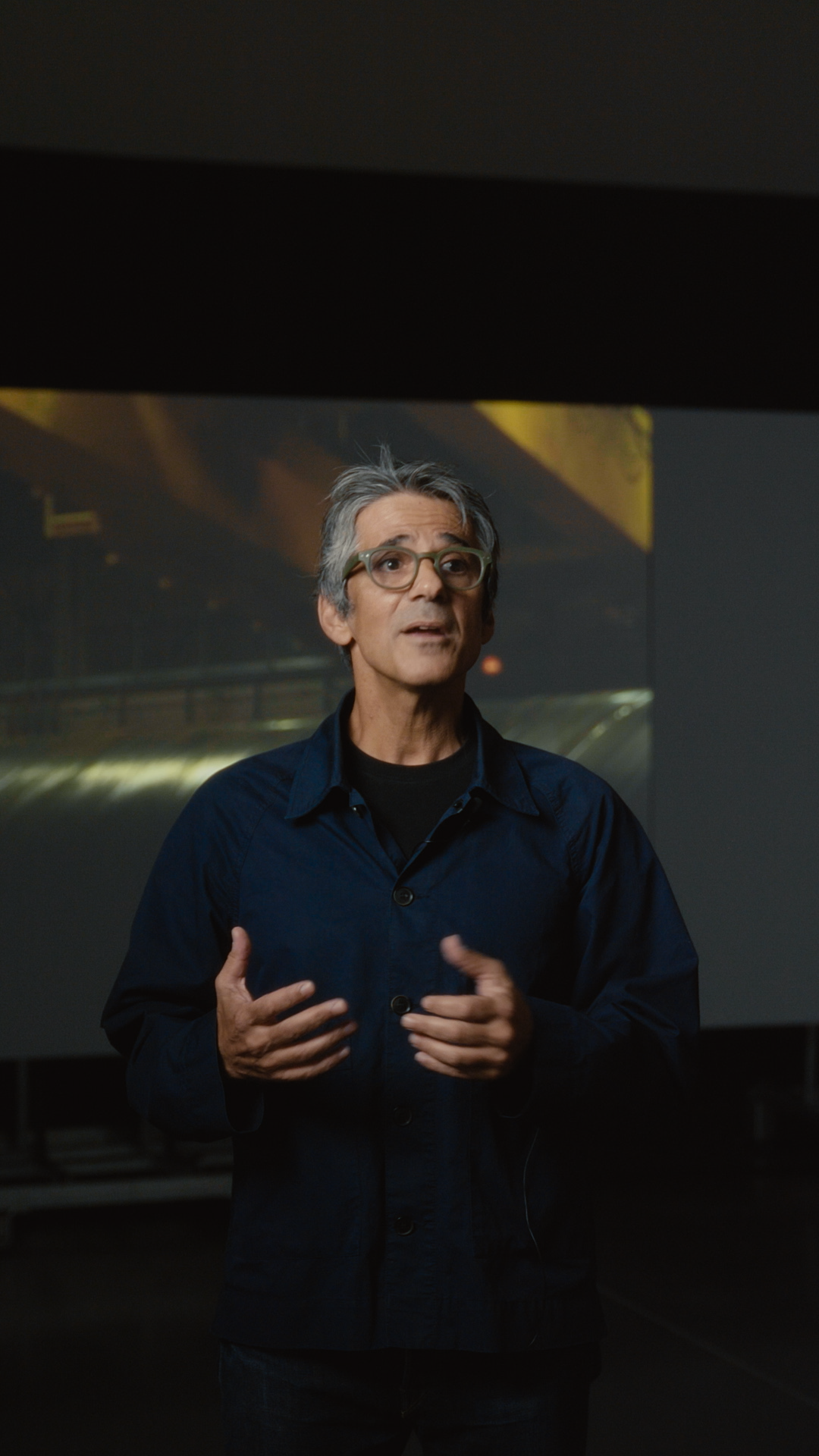
Ali Kazma (Videostill: Roman Szczesny)
At the center of Ali Kazma’s work “Subterranean”, filmed roughly a decade ago in a vast factory in Türkiye, are pipes destined for a thousand-kilometer gas pipeline carrying energy from Azerbaijan through Türkiye and on toward Europe. Enormous steel cylinders, large enough for a person to walk through, their surfaces bearing the traces of heat, pressure and force. Soon they will be buried underground, disappearing from view while continuing to shape the lives of those above.
The work emerged from a period when Kazma felt that cultural things, valuable things, perhaps simply anything worth preserving, needed to retreat from authoritarianism, mediocrity and technological scrutiny.
Across some 75 works, Ali Kazma has observed the ways in which people construct objects, spaces, artworks, literature and even themselves through work. The act of making becomes a way of looking at the systems surrounding it.
There is something patient about Kazma’s films. They resist the urge to explain too quickly. Machines, gestures and materials are given time to reveal what they might mean, without being forced into a single narrative. In “Subterranean”, the pipes are at once industrial objects, images of geopolitical power and strangely poetic bodies waiting for a future that will make them invisible.
Shortly before the opening of INDUSTRIAL: Silk Roads 3000 in Dortmund, Thomas Venker and Linus Volkmann spoke with Ali Kazma about post-Gezi Türkiye, abandoned mining towns, energy politics, poetic images and the patience required to let things become clear.
Let’s start with the work we can see here. “Subterranean” was made about ten years ago. Can you tell us about it and how it relates to your wider practice?
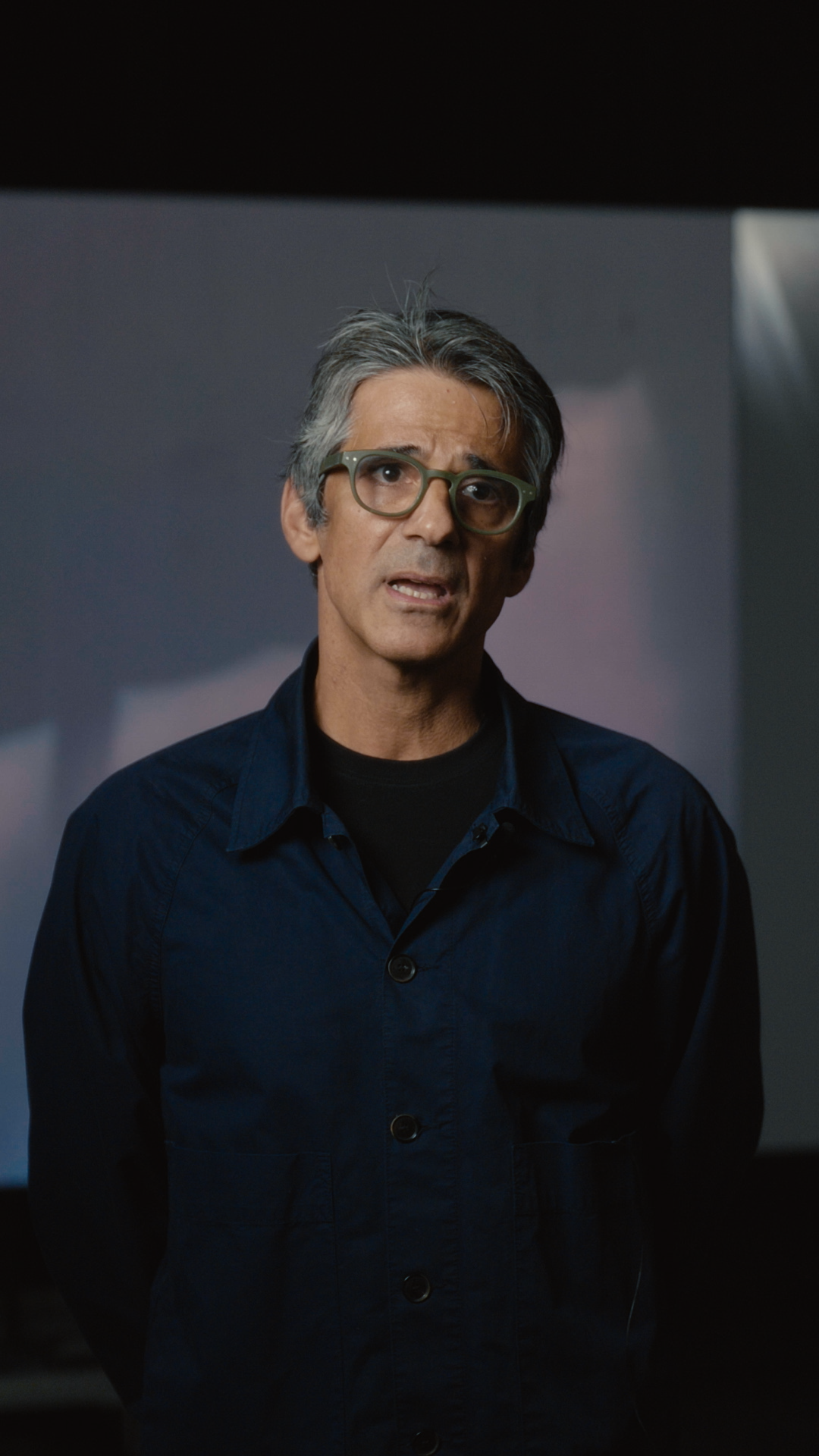
Ali Kazma (Videostill: Roman Szczesny)
Ali Kazma: My work in general is about the way we construct the world and create the objects we live with. It’s about how we build spaces, how we build our art pieces, how we create literature. All of these things are within my work.
My work is about how we construct the world and how the world, in return, constructs us. It’s about how we touch the world and shape the world—our living environments, our objects, our artworks, our literature, our stories. I follow the processes through which all of these things are produced.
There are moments when I’m more interested in certain things than in others. Ten years ago, it was a moment when I felt the world was going to pieces and that all good things had to hide themselves. Cultural things, things that we value, things that we want to protect, needed to be underground. They needed to stay away from the gaze of the mediocre, the gaze of the authoritarian, the gaze of technology.
So I was doing a lot of works connected to things that are underground. I was working with mines. I made two works about mines, one in Svalbard and one in Chile. And, of course, this work is literally called “Subterranean”—underground. So it came out of that moment.
I was very interested in this work because all of these big pipes that you see being built in this huge factory in Türkiye are actually used to bring gas from Asia to Europe. As you can see, they remind me of whales. They are really big objects with scars on their skins. You can put them underground and you don’t see them, but they’re actually working all the time, bringing energy back and forth between different countries.
When I made the work, of course, much of the gas being consumed in Europe was coming from Russia. Now there are other, obvious problems with that because of the war. Through Türkiye, they were building this huge thousand-kilometer pipeline that brings gas from Azerbaijan. These are the pipes being used for that.
All of these ideas—hiding, not being seen, being affected by things you don’t see, hiding from the gaze—were on my mind. In 2017, I also made an exhibition at Jeu de Paume in Paris called “Subterranean”. This work comes from that era.
What happened around 2015 and 2016 that made you feel so pessimistic?
Ali Kazma: I had felt for a very long time that the world was going to pieces because of too many things: neoliberal economies, wars, general stupidity, the mediocrity of our culture, the consumption of nature, the consumption of everything, and basically the loss of any kind of ideals to build toward, or goals for a human society that we could actually work on.
But personally, 2015 and 2016 were difficult years for us in Türkiye. After the Gezi protests, the government became even harsher. At that moment, for us, it was a time to preserve, to try to keep what you had. So I was thinking along those lines.
I never thought about it only in terms of Türkiye, Germany or the US. I felt it was a global phenomenon that was coming to different parts of the world at different moments. But in my life, it arrived around that time.
It felt as though this might be a period in our history when we had to try to preserve things by hiding them, like treasures, so that they didn’t become targets. That was the reason, I think. I think.
Is that negative perspective on the world also connected to your interest in people at work—to looking closely at their processes and going right up to what they’re doing? Other works in the exhibition take a more macroscopic view and talk about things at large, whereas your camera often approaches very particular acts of making.
Ali Kazma: I have made 75 works, and some of them look at the world in the way you describe. So no, that’s not the reason. The reason is that I’m very interested in making things. I’m interested in the qualities that we, as human beings, bring forth when we make things, when we touch things, when we change things.
I believe that, when done in the right way, these activities bring out good qualities in us. They teach us patience. They teach us a narrative form. They teach us how to think. They teach us to respect the material. They teach us values that are almost the opposite of a culture of consumption.
I’m interested in people who touch the world and who, in turn, are touched by the world, and who develop their lives through this give-and-take. I work with a lot of people and a lot of groups, a lot of architects, a lot of people in dance, who have a positive relationship with the world.
In my work, you never see people consuming things. You never see people gazing into the distance in minor keys, sentimentalizing. No, you see people touching the world. You see people changing the world and, hopefully, changing themselves as well—most of the time for the better.
It’s interesting that you mention what you don’t show. You also don’t use sound and other elements to—
Ali Kazma: I use sound, but not music. Not music.
Right—not to manipulate. That’s what I wanted to say.
Ali Kazma: Exactly. Very good. Yes.
But the work is still not simply documentary. It can be poetic, beautiful and touching. How do you construct that creative and artistic process without using music to direct the viewer?
Ali Kazma: I’m writing with images, right? Filmmaking is, in a way, writing with images. I’ve been making images since the late 1980s and early 1990s. I’ve been looking through a viewfinder, and I’ve been seeing how the world looks through a viewfinder. I’ve learned how to look through it, how to see things and how to reflect them onto the screen.
You know Cézanne, the French painter. There is a writer, Robert Walser, who wrote about Cézanne. He said that the things Cézanne painted on the canvas looked back at him in a way that communicated that they were happy to have been painted like that. They became eloquent. They spoke to him and said: “We like what you did with us.”
I really like Robert Walser’s approach to Cézanne’s work. When you’re looking at the world, there is a way to paint, photograph or film objects, people and spaces that is true to those objects, people or spaces. It gives them the necessary room and doesn’t constrain them too much, but it also frames them within the context of their existence so that they become eloquent and speak about what they are.
I think this is my search: to find the right distance, to find the right image to talk about what I’m talking about, to give these objects, these people, these hands, these fires and these steel tools the ability to express themselves.
I’m not going to call this search poetic, but since you did, I’m happy to hear it. I think this continuous and concentrated effort to try to see things for what they are—this activity—is already poetic. Nothing is what it is without resonating with other things. You can only talk about a space when it resonates with other spaces, other things. So I think the activity itself is already poetic.
Through long exposure to this activity, I think many of my images can be considered poetic in the way they speak to one another and say something more than just the image itself.

The exhibition is called “INDUSTRIAL: Silk Roads 3000”. The industrial aspect is immediately visible in “Subterranean”. What is your connection to the other part of the title, the Silk Roads?
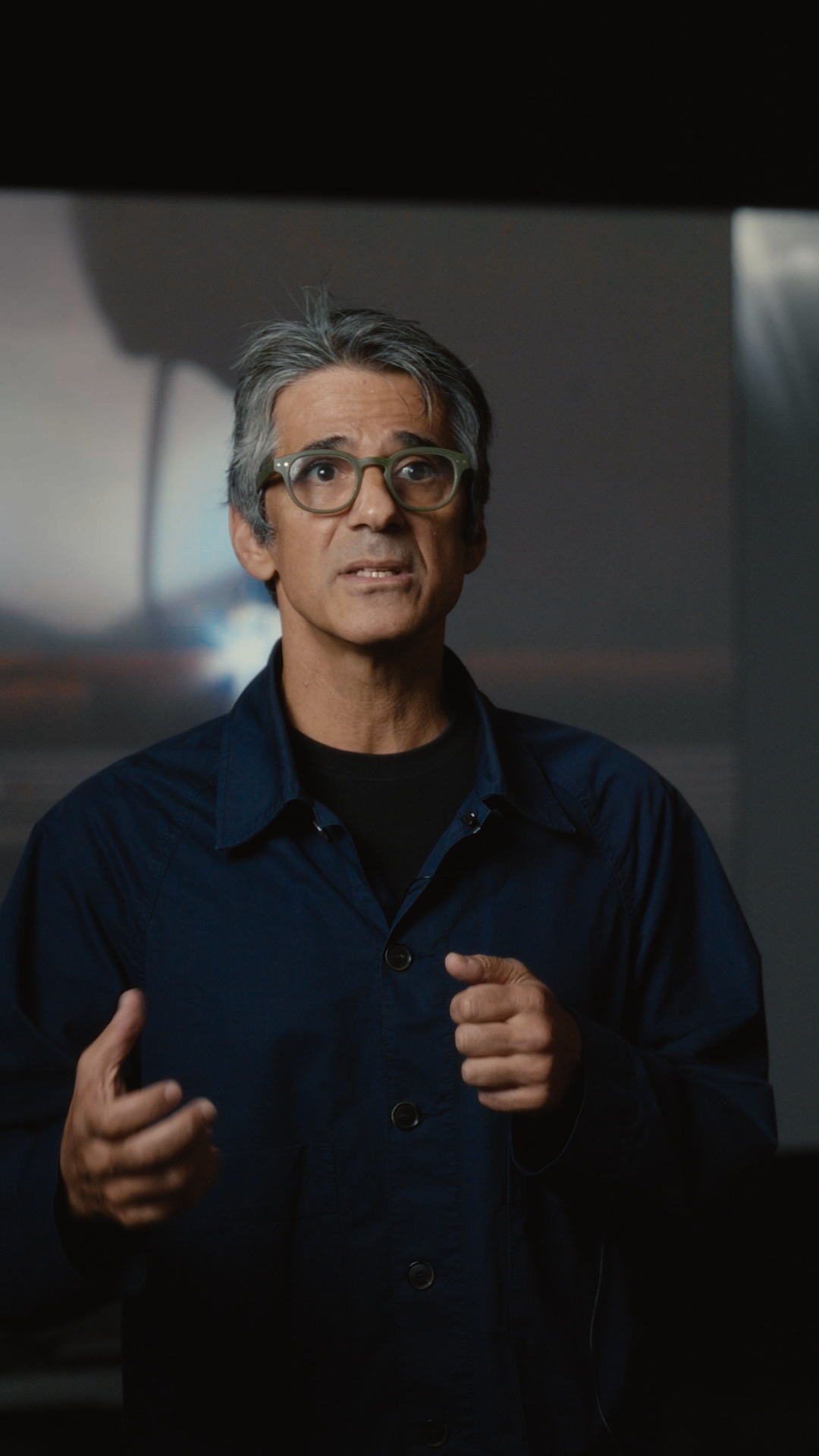
Ali Kazma (Videostill: Roman Szczesny)
Ali Kazma: I think that’s a question better directed at the curators, because they are the conceptual builders of this exhibition. To tell you the truth, I came here five minutes ago and I’m still looking at the works. Maybe I can tell you more later.
I think they were interested in looking at the historical phenomenon of the Silk Roads and asking what happened to it today. What are we talking about now? What kinds of activities are going on in this geography? Is it the flow of goods? Is it the flow of images? Is it the flow of artistic activities? What is it?
In that regard, my work fits the symbolic gesture, but it also fits because it really is about a pipeline from east to west. So I think the work fits in a few ways. Regarding the other people’s works, I have to see them better.
Looking at these pipelines while we speak, it’s difficult not to think about the political implications they now carry. When we see or hear about pipelines, we immediately think about attacks on pipelines and about energy dependencies. What does that changed context do to your work? Are those associations something you want the viewer to bring to it?
Ali Kazma: I always try to stay away from daily politics, but I’m a political person, as we all are. Everything we do is political. But when you’re too close to events, both in terms of time and distance, you can’t necessarily see them.
Maybe this links to what I was trying to say about finding the right distance from things so they can express themselves. History can also express itself through a little bit of distance.
For me, the idea is that gas is transported from A to B, used to manufacture certain things at B, sold back to C and then to D, and all of this is the network we live in.
What interested me very much while making this work was that, as you can see, people can walk inside these pipes. It was very interesting to me to see that. Theoretically, you could go to Baku in Azerbaijan, get into one of these pipes and walk all the way to Istanbul, and perhaps farther. I don’t know. This is very strange to me: the world has these networks of holes and pipes and cables and satellites and all of that.
All of this produces an understanding of the world as something more than bits and pieces disconnected from one another. They are connected in many visible and invisible ways. That was very interesting to me.
At the time when I made the work, Europe was super happy to consume Russian oil and Russian gas. That was basically also the case in Germany. It was cheap energy. Then, all of a sudden, look what happened. Are we going back to nuclear energy? What is happening?
All of these things are inherently political. But if I make the work only about that, then I miss the point.
It also passes through borders without anything like conventional border control.
Ali Kazma: Yeah. And it’s also gas, you know? That’s strange as well. Some gas is going through all of this.
But the pipes themselves are gorgeous, I find. I really, really like them. When you look at the skin of each one—and I show it sometimes—they really are like whale skins. They carry the marks of their own making: the exposure to heat, to forces. They’re like orange peels. That’s how they make these things, as you can see.
Each one is actually very beautiful. Its surface is like an abstract painting, and they’re all different. We make all of these things, but we don’t see this beauty. We just dig them underground and put them there.
I also wanted to show that. Not in a romantic or sentimental way, but there is beauty in places where you’re not even thinking of looking for it. I didn’t know it was there, but when I saw them, I was very, very struck by it. They reminded me of whale skins, really.
You used the word “scars” for those marks on the pipes’ skins. Here in the Ruhrgebiet, “Subterranean” also evokes the region’s mining history and a certain claustrophobia. During the same period, you made two works about abandoned mines. What interested you about those places?
Ali Kazma: One was a Soviet mine in Svalbard called Pyramiden. The other was a saltpeter mine in Chacabuco, Chile. Both are extremely politicized places.
Pyramiden was used as a propaganda town by the Soviets. They built this incredible mining settlement almost next to the North Pole, with pianos and cinemas. It was a place they were proud to show to sympathetic Western intellectuals—mostly, though not only.
Chacabuco was this beautiful mining town that was abandoned because some scientists in Germany discovered a material that could be produced as a replacement for saltpeter. So it also has a connection to Germany. Later, it was reopened by Pinochet as a concentration camp.
All of these different façades, these different faces of the same spaces, really, really interest me. The underground aspect of the work certainly connects to this place as well. I’m sure these places, this geography, have thousands of interesting stories to tell about mining.
When we see the people in your films, the camera often seems very close to their work. Are they surprised that you’re filming them and paying such sustained attention to what they do?
Ali Kazma: For the first three or four hours, they are. Then they get bored of me. (laughs)
I usually film for very long hours. I stayed in this factory for, I think, eight days. After the first or second day, they don’t care anymore.
For almost all of my videos, I stay as long as I’m allowed, because sometimes I film in very sensitive places and can only be there for a certain amount of time. Recently, I made a film in an oil refinery, a diptych like this. There, for instance, I had to be under surveillance all the time for security reasons, because there are hydrogen tanks.
Otherwise, if I can, I stay as long as possible. I film for hours and hours and hours and hours and hours. At some point, even the most interested person becomes completely uninterested in me, because what I do is very boring for somebody else to watch.
I’m just putting the camera here, then putting the camera there. During the first days, they always ask: “Can we see? Can we see?” Then they see that it’s not interesting.
“INDUSTRIAL – Seidenstraßen 3000“ is on show till the 10. Januar 2027 at Kunsthalle Dortmund.