

Anarchy in Austria – New Life in a Dead City
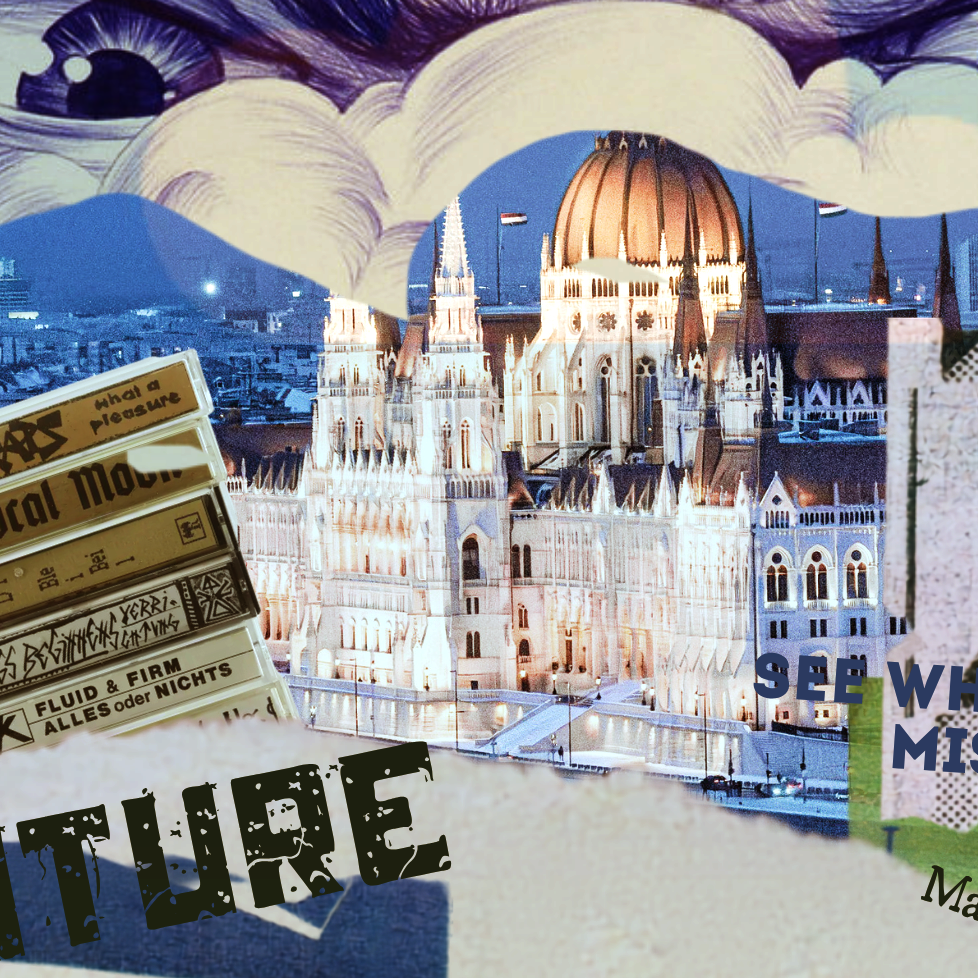
“If the world ever comes to an end, I’ll move to Vienna, because everything happens there 50 years later.” If we’re to believe composer Gustav Mahler—who supposedly coined that line—then punk should be kicking off in Vienna any day now.
Vienna-based author Wolfgang Zechner looks back on the time when word of The Clash and company finally made its way to the city on the Danube.
Peter Hein is probably not the reincarnation of Gustav Mahler. Still, the Düsseldorf punk pioneer once told me he had a similar impression when he played Vienna for the first time with his band Fehlfarben. These days, Hein himself lives in Vienna. Back in the wild ’70s and ’80s—and for quite a while afterward—he was still active on the banks of the Rhine, where he and fellow travelers like Male, DAF, KFC, and S.Y.P.H. were helping shape the blueprint for what would soon become known as the Neue Deutsche Welle (German New Wave).
In May 1980, Hein and Fehlfarben played at Vienna’s 20er-Haus near the Südbahnhof train station. At the time, Hein’s famous “gray haze” (Grauschleier) still hung over the city in bucketloads. Bleak, dreary, gray. Anyone curious about what Vienna looked like back then should watch the early episodes of the TV series Kottan Is Investigating. The Vienna on display there looked like a Czechoslovak fairy tale movie with all the fairy tales removed. A world without magic but packed with scenery.
And then there were the people: grim-faced seniors in enormous fur hats, trudging through a dead city carrying the burden of existence itself. At least that’s how I remember it as a child, visiting Austria’s capital for the first time sometime in the early ’80s.
A nice funeral. That was Vienna in the late 1970s. And whether it was really nice is up for debate. But nothing is more powerful than a good idea, and so, even in the world capital of the morbid—somewhere between the Central Cemetery and the Imperial Crypt—the little punk seed began to sprout. At least when it comes to early punk, Mahler turned out not to be much of a prophet. The seed sprouted surprisingly early.
The first signs appeared as early as 1976, when news of the new youth culture spread through music magazines and the radio show Musicbox on Ö3. Inspired by the musical upheavals in New York and London, small groups began forming in Vienna and soon grew into a scene of their own. New life stirred among the ruins of a dead city. Danube Canal instead of Rockaway Beach.
Anarchy in Austria!
One of the key moments came on October 2, 1977. The Clash’s concert at Vienna’s Porrhaus was a Big Bang for many. In true punk fashion, people reinvented themselves overnight, adopting names like Robert Räudig, Mickey Kodak, Panza, Lörkers, Ronni Urini, and Uschi Paranoia. Bands sprang up everywhere. One of them was Chuzpe, fronted by Robert Räudig—whose real name was Wolf and who worked as a mail carrier when he wasn’t making noise.
Other groups went by names like Pöbel (Rabble), Schund (Trash), Mordbuben AG (Murder Boys Inc.), Dirt Shit, and Die Böslinge (The Villains). A-GEN53 soon became the city’s first all-female punk band. Early gathering spots included places like the flea market at Kettenbrückengasse. Record stores began importing the right albums and singles. Between 1981 and 1983, the Gassergasse Cultural and Communications Center—a former squat—became one of the scene hubs before the city shut it down.
By then, however, the clock had already moved on. Punk? That was years ago. No time for breathing breaks—history was being made and all that. The so-called “good forces,” to borrow a line from a Chuzpe song, imported the cool aesthetics of British New Wave. As early as 1980, Chuzpe covered Joy Division’s newly released “Love Will Tear Us Apart.” The Viennese version added a dash of disco to the classic. The result was upbeat, and the impact was remarkable: unlike the original, the Austrian version actually made the national charts. The copy outperformed the original. That’s what you’d call chutzpah.
When I was nine years old, I recorded the Joy Division version from the radio onto a cassette tape. I was absolutely convinced it was an Austrian song. A spectacular case of childhood naivety. These days I know better. Love Will Tear Us Apart is probably not a Viennese folk tune. Emphasis on probably.
There’s another act of cultural appropriation I can’t resist sharing with fans of wonderfully obscure music. In 1981, the label Panza-Platte released the single “Franzi” by Der Eiserne Vorhang (The Iron Curtain). It was a Viennese-dialect version of XTC’s “Making Plans for Nigel.” If you’re struggling to connect XTC and Vienna in your head, don’t worry. There isn’t really anything to connect. That’s exactly why Franzi is such a gem—still sparkling today like a broken glass bead under the flickering neon lights of an abandoned subway tunnel.
Truth be told, Vienna never completely warmed up to the new youth movement. Compared to other major cities, the scene remained relatively small. Even punk’s trademark rebellion against the old guard never worked quite as well here as elsewhere. Vienna simply wasn’t a pop city.
In the former imperial capital, the village emperors—mostly male Austropop troubadours, aging rockers, and career musicians—weren’t about to surrender the throne. It’s no surprise that the influential 1979 compilation Wiener Blutrausch (“Viennese Blood Rush”) included plenty of artists who had little or nothing to do with punk. There was Minisex, a band with roots in the advertising world; the jazz-rock noodling of Metzlutzkas Erben; and the anarchic cabaret collective Drahdiwaberl. Some of it sounded suspiciously like the late 1960s. Maybe Gustav Mahler was right after all?
When the music industry began cashing in on Neue Deutsche Welle around 1981, Vienna’s punks got little of the glory. Others reaped the rewards—most notably Falco, former bassist of Drahdiwaberl. And because death is practically a Viennese specialty, it was two Viennese artists—Joesi Prokopetz and Manfred Tauchen—who helped carry NDW to its grave in 1983.
Their delightfully ridiculous sci-fi novelty single “Codo … düse im Sauseschritt” by DÖF became the last NDW song to reach the top tiers of the German charts. After that, it was all over. End of the line. Vienna station. Everybody off.
The first-wave punks mostly didn’t care. Many simply waited it out. Others disappeared into respectable middle-class lives. Too many were lost to drugs. Some stubbornly kept going. And some still are.
For years now, survivors and younger generations alike have been trying to preserve and memorialize the genre. The line between historical documentation and nostalgic mythmaking can be hard to spot. The Panza-Platte compilation De Guade Oide Zeit (“The Good Old Days”) offers a useful overview of a scene that was never entirely coherent and often contradicted itself.
Just like the old Wiener Blutrausch compilation, it includes a few acts that don’t quite fit the assignment. Take Novaks Kapelle, for example—a long-haired rock band straight out of the 1968 generation. Drahdiwaberl shows up again too. That’s still not punk, is it?
As they like to say in Vienna: Who cares, buddy.
People here have never been all that concerned with getting things exactly right. Not today. Not 50 years ago.
Wolfgang Zechner
This article was commissioned and produced in punk collaboration with KAPUT – Magazin für Insolvenz & Pop and Gegenüber the transatlantic magazin of the Goethe Institut North America.