

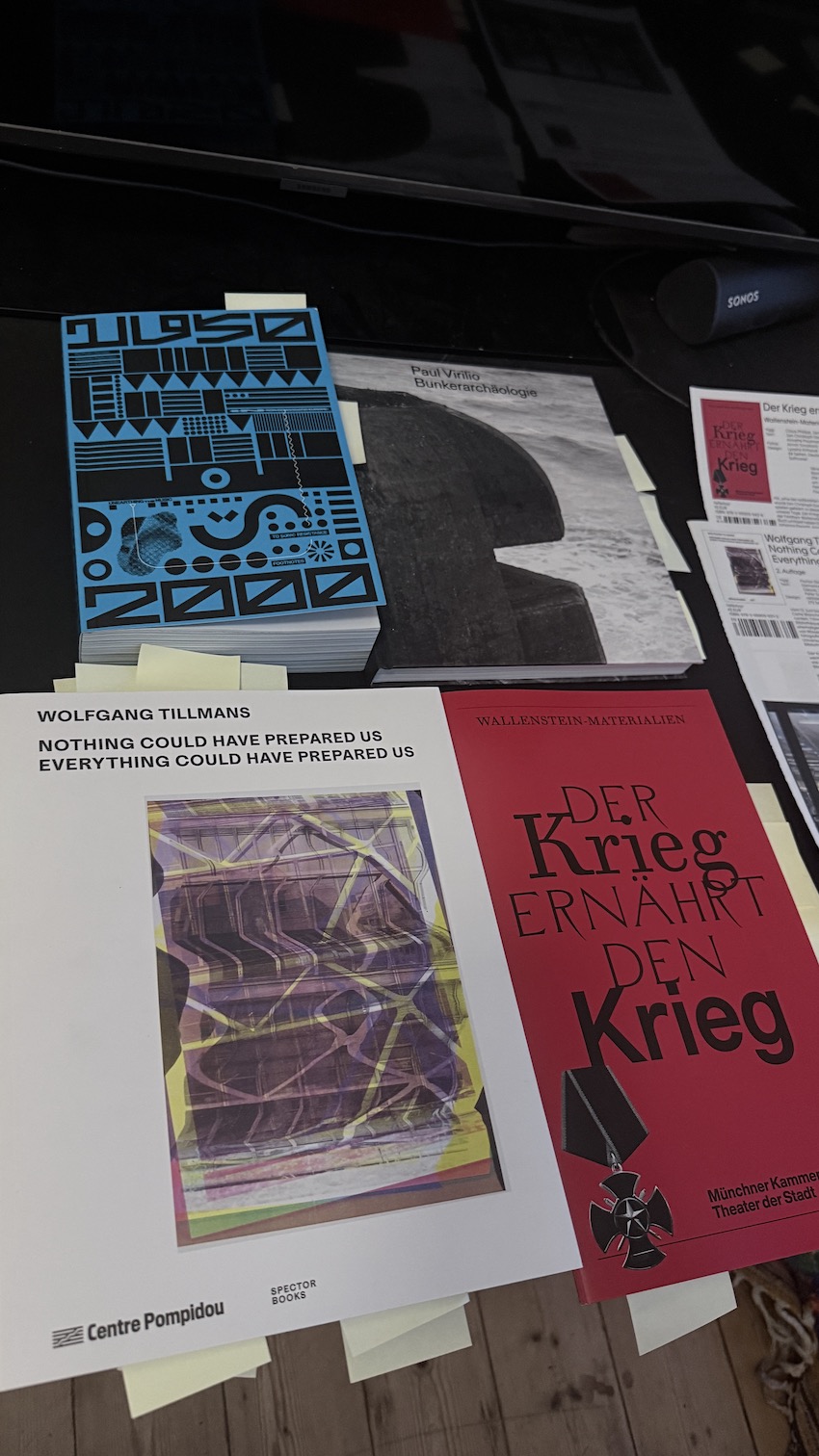
Spector Books feat. Sonic Resistance in Non-democratic Europe, Bunker Archéologie, Krieg & Wallenstein und Wolfgang Tillmans
On some page of ‘A Thousand Plateaus: Capitalism and Schizophrenia’ (originally published in 1980 as ‘Mille Plateaux’ and eponymous for one of the most important labels for electronic music), the standard work by Gilles Deleuze and Félix Guattari, which I bought while studying political science and sociology and tried in vain to read cover to cover several times over the years, on some page of this manifestation of a book, Deleuze and Guattari generously explain that one does not have to read a book from the first page to the last to feel and process its essence; on the contrary, one should not be afraid to jump in and out anywhere.
Whether this was really there or whether I imagined it in retrospect – I couldn’t find it again quickly (as is to be expected with more than 700 tightly paced pages) – it no longer matters. I was happy to take up this tactical instruction for reading (and, beyond that, for the philosophical-practical handling of experiences of capitalism) from the two authors and integrate it into my repertoire.
At least for me, this is very helpful when discussing books. Unlike music criticism, where I don’t feel as much pressure to grasp everything, writing about written works often comes with a different, higher expectation of myself – probably because I’m operating in the same discipline. Which is nonsense, of course, if only because not every book is written in a journalistic style – and certainly not in the case of the four titles from Spector Books Verlag, which arrived in a package at the Kaput editorial office last week; This was by no means a coincidence, as I specifically selected them from the programme (but to be honest, it is always very difficult to make a selection from Spector’s range, because without exaggeration, all titles are worth considering). In this respect, I would like to take this opportunity to congratulate Spector Books on its 25th anniversary.
In the current publishing catalogue the three Spector Books publishers Markus Dreßen, Jan Wenzel and Anne König look back in a suitably unpretentious manner on their very own quarter of a century of cultural work and an incredible 600+ publications.
I – ‘Unearthing the Music – Footnotes to Sonic Resistance in Non-democratic Europe (1950-2000)’
People like to approach books via the blurb on the back cover. An endeavour that is doomed to failure, at least for me, in the case of “Unearthing the Music. Footnotes on Sonic Resistance in Non-democratic Europe 1950–2000.” The font size and geometrically playful arrangement, especially against the blue background, prevent me from accessing it. The ambitious cover arouses curiosity, but it doesn’t reveal much more than that. So, let’s consult the classic foreword and table of contents.
Unearthing the Music is based on an online archive for experimental underground and protest music initiated in Portugal. This archive covers both the ‘real socialism’ of Eastern Europe and the regimes of Spain, Portugal and the Greek military dictatorship.
What does it mean for artists to operate in totalitarian, non-democratic systems? How do they position themselves against them? How do these conditions influence their own content and structures? And since the book covers the period from 1950 to 2000, it also provides a very honest analysis of the cultural changes that resulted from the collapse/transformation of these systems.
At 626 pages, Unearthing the Music is almost as thick as Mille Plateaux, which of course makes a complete reproduction impossible. It is remarkable what the three publishers Lucia Udvardyova, Rui Pedro Dâmaso and Alexander Pehlemann have achieved here in collaboration with authors such as Ivo Pospíšil, Chris Bohn, Hannelore Fobo, Alexander Pehlemann, Wolf Kampmann and Mara Traumane.
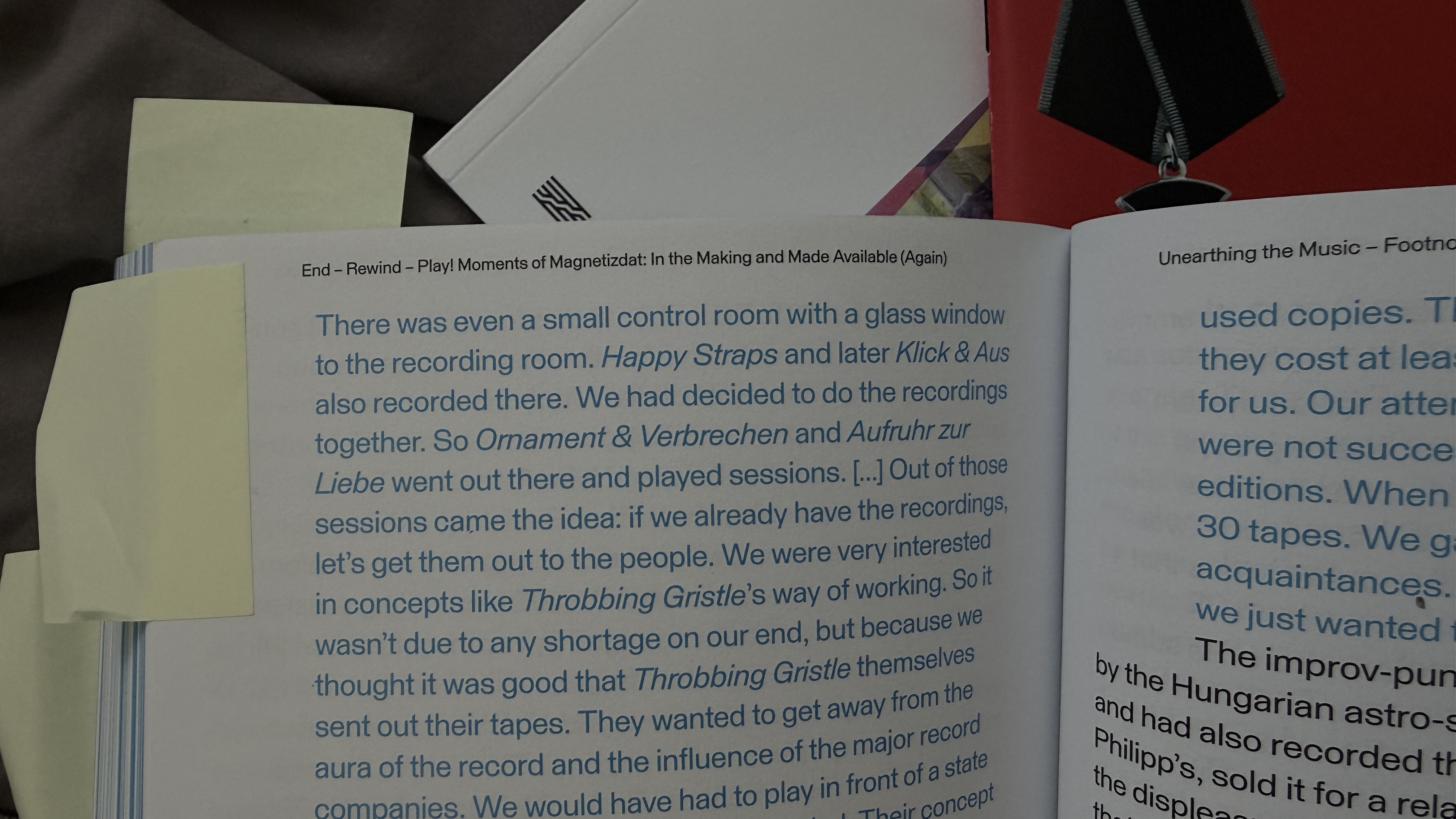
Ich zitiere von Seite 537:
(…) At that point, however, Assorted Nuts, the first cassette label in the GDR, had already been founded and was run by former Rosa Extra members Ronald Lippok, then with Ornament & Verbrechen, and Bernd Jestram, then a member of Aufruhr zur Liebe:
Ronald Lippok: „At that time there was the possibility to record with Thorsten Phillip. He had an illegal studio out in Berlin-Mahlsdorf. It was called ‘7 meters under the capital’ – a small bungalow with egg cartons on the walls. There was even a small control room with a glass window to the recording room. Happy Straps and later Klick & Aus also recorded there. We had decided to do the recordings together. So Omament & Verbrechen and Aufruhr zur Liebe went out there and played sessions (…] Out of those sessions came the idea: if we already have the recordings, let’s get them out to the people. We were very interested in concepts like Throbbing Gristle’s way of working. So it wasn’t due to any shortage on our end, but because we thought it was good that Throbbing Gristle themselves sent out their tapes. They wanted to get away from the aura of the record and the influence of the major record companies. We would have had to play in front of a state commission, they in front of a record label. Their concept fit our situation wonderfully. So we were able to create a more direct way of distribution and communication. Thus, the first cassette of the newly founded label Assorted Nuts came out of these recordings.“ (…)
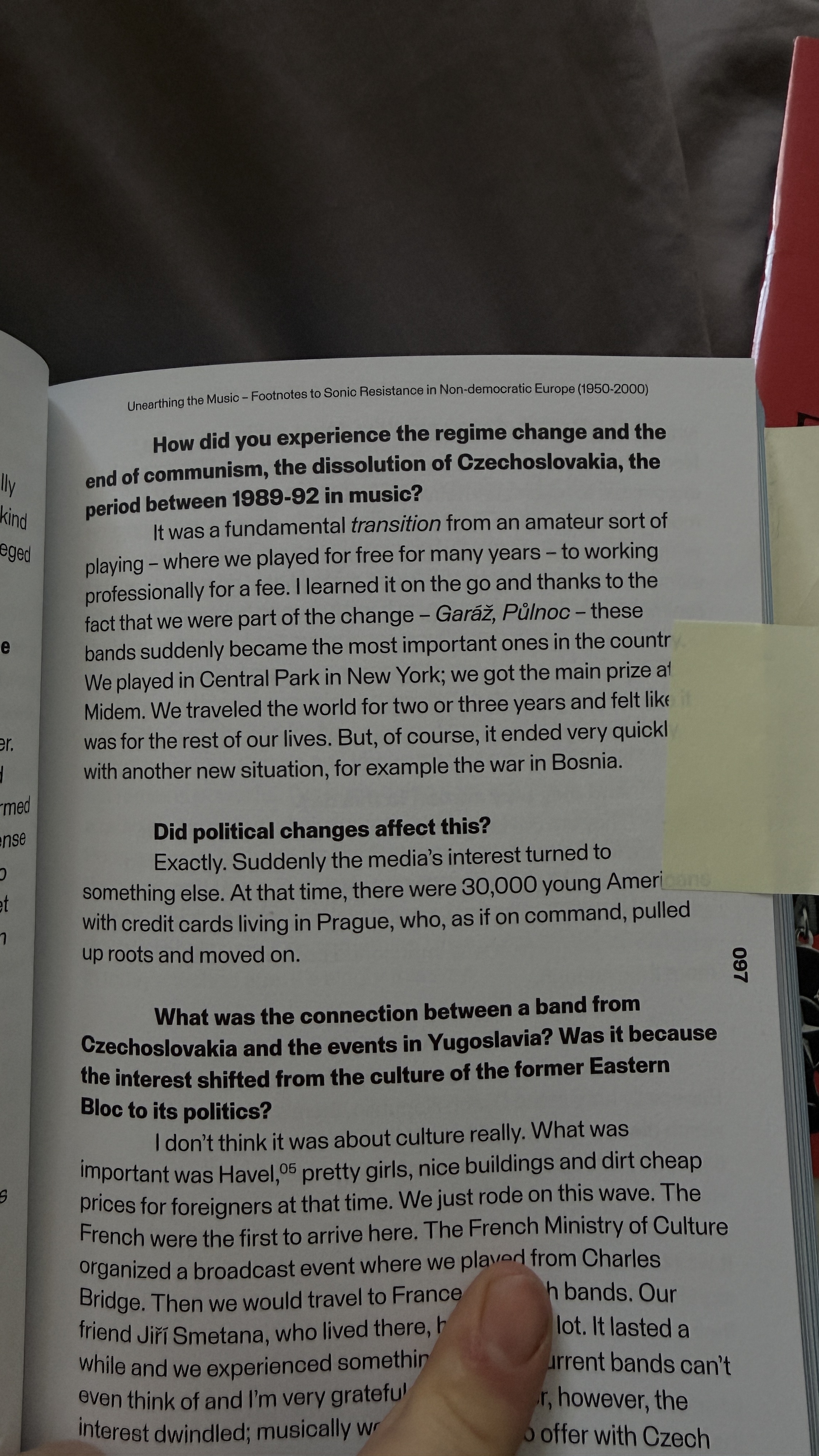
I quote from page 97:
Lucia Udvardyova: How did you experience the regime change and the end of communism, the dissolution of Czechoslovakia, the period between 1989-92 in music?
Ivo Pospíšil: It was a fundamental transition from an amateur sort of playing – where we played for free for many years – to working professionally for a fee. I learned it on the go and thanks to the fact that we were part of the change – Garáž, Pulnoc – these bands suddenly became the most important ones in the countr We played in Central Park in New York; we got the main prize at Midem. We traveled the world for two or three years and felt likt was for the rest of our lives. But, of course, it ended very quickl with another new situation, for example the war in Bosnia.
Lucia Udvardyova: Did political changes affect this?
Ivo Pospíšil: Exactly. Suddenly the media’s interest turned to something else. At that time, there were 30,000 young Ameri with credit cards living in Prague, who, as if on command, pulled up roots and moved on.
II – Wolfgang Tillmans: Nothing Could Have Prepared Us – Everything Could Have Prepared Us
The first impulse: another book with photos by Wolfgang Tillmans—who really, really needs that? But Nothing Could Have Prepared Us—Everything Could Have Prepared Us is much more than that: it is the documentation of a very special exhibition that took place from June 13 to September 22, 2025, at the Centre Pompidou in Paris.
Institutions often claim to have given artists free rein in their work—meaning the leeway they allow them while keeping them handcuffed. But the experimental installation that Wolfgang Tillmans has created on the entire second floor of the Bibliothèque publique d’information (Bpi) truly transcends any spatial limitations and establishes an unprecedented dialogue between architecture and artwork. The catalog conveys this beautifully by showing images of the works alongside photographs of the installation on double-page spreads, as well as through photographic insights (on the first pages of the catalog) into the working process at Tillmans’ studio, which has recreated the Centre Pompidou’s premises to scale in studio size.
I quote from page 162 (again quoted from “Artist’s Statement: Fondation Beyeler, Basel; June 12, 2017, in Wolfgang Tillmans: A Reader, ed. Roxana Marcoci and Phil Taylor (The Museum of Modern Art, New York, 2021), 260.”):
I’m aware how my brain fails me.
I think I said something, but / hadn’t.
I thought / saw something, but / didn’t.
I believe you said this, but in fact you said that.
The eyes are optical “instruments”; by default they are impartial.
They project light that falls through their lenses onto the retina.
I need to know what the brain does to what my eyes see.
To observe: What do I want to see?
What do I really see?
What do / see, and what do I want to see?
What is in the picture?“
Favorite pictures while browsing through the catalog:
„rat, disappearing, 1995“; Seite 28.
„Office Paper For Food Wrapping Recycling, Addis Ababa, 2019“; Seite 189
„Why we must provide HIV treatment information, HIV, i-base, London 2007“; Seite 230
III – Der Krieg ernährt den Krieg. Wallenstein-Materialien / War feeds war. Wallenstein materials
Why paraphrase when the publisher puts it so beautifully: “Schiller’s Wallenstein meets the present day: a program booklet like a battlefield. Between collage and research, between Schiller’s pathos and voices from Ukraine, it unfolds a polyphonic echo of war, power, and memory.”
Despite its striking red appearance and unusual format (a narrow A4, for lack of a better description), “War Feeds War” initially appears unassuming, in the sense that one might assume it is “merely” a program booklet for the production “Wallenstein. A Seven-Course Feast” by Jan-Christoph Gockel at the Kammerspiele Munich. But it is so much more: a thought-provoking dialogue of sources, quotations, and war, a stirring mix of everyday life, documentary imagery, and artistic interpretation.
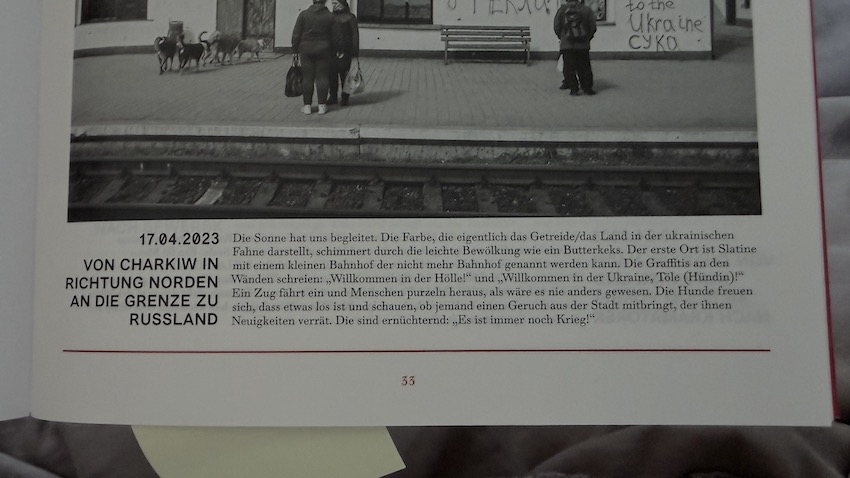
I quote from page 33 of Armin Smailovic’s text, written on April 17, 2023, in Ukraine (from Kharkiv heading north toward the Russian border): “The sun accompanied us. The color that actually represents the grain/land in the Ukrainian flag shimmers through the light clouds like a butter cookie. The first place is Slatine, with a small train station that can no longer be called a train station. The graffiti on the walls screams: “Welcome to hell!” and “Welcome to Ukraine, mutt (bitch)!” A train pulls in and people tumble out as if it had never been any different. The dogs are happy that something is happening and see if anyone is bringing a scent from the city that will tell them the news. It is sobering: “It’s still war!”
I quote from page 69 of the conversation between political scientist Cindy Wittke and Viola Hasselberg: “Negotiating peace in war – What makes a good agreement?”
Viola Hasselberg: In fall 2024, your book Negotiating Peace in War: Russia’s War, Opportunities for Peace, and the Art of Negotiation was published. Why did you write the book?
Cindy Wittke: The book is based on my many years of research on peace negotiations and unresolved territorial conflicts in Eastern Europe. Peace agreements often oscillate between legal and political binding force or even leave particularly contentious issues unresolved. So the question is: What makes a good agreement? Which actors, including external ones, can play a role in providing decisive impetus to ensure that these agreements are negotiated and that the actors who previously waged war against each other actually implement them? And, of course: What makes a bad agreement, and what lessons can be learned from failures?
The start of Russia’s war of aggression in 2022 made Western European society realize once again that wars have not disappeared from the European continent. The escalation of armed conflicts, especially in Eastern Europe, often comes as a surprise to many—but this is not the case.
Long-term political and strategic interests and dynamics mean that so-called “frozen” conflicts in particular repeatedly escalate.
I quote from the back cover text:
„Komm zu uns!
Wir sind die geilste fucking Truppe der Welt.
Wir bringen dir alles bei, was eigentlich verboten ist.
Propaganda der Wagner-Privatarmee“
IV – Paul Virilio: Bunker Archéologie
In the second half of the 1950s, French philosopher, urbanist, and media society critic Paul Virilio began photographing abandoned World War II bunkers along the French Atlantic coast. His particular interest was initially focused on the architecture, which he saw as a “precursor to a new architecture,” a “cryptic architecture.” The first exhibition of Virilio’s “Bunker Archeology” took place in 1975 at the Centre Pompidou, accompanied by the first edition of this book, which has now been reissued in French, English, and German to coincide with an exhibition at the Centre Pompidou.
I quote from page 37:
“…Spy specialists are literally being doubled, on the one hand by the proliferation of intelligence systems and on the other by the remarkable development of informant culture among the population, by amateurs. Special agents no longer have the privilege of exposure, of betrayal; the perfection of technical surveillance and tracking systems replaces them in numerous missions almost everywhere. Psychological warfare, in competition with
electronic warfare, also transforms hundreds of thousands of civilians into potential informants of suspects of all kinds: paratroopers, Jews, escaped prisoners … Information and social control become the principle of the spirit of defense: the radio provides immediate information about everything; it protects against unpleasant surprises, but in return, the authorities are informed by telephone of any deviation that occurs in the immediate neighborhood. This is one of the forms of civil struggle for the citizen of the totalitarian state, for the inhabitant of the citadel of Europe. …”
I quote from page 77:
June 6, 1944: “Allied landing in Normandy. Allied air superiority prevents any movement of German forces toward the front. The Atlantic Wall proves to be an easily surmountable obstacle at this point on the coast, and the great difficulties encountered by the Americans at Omaha Beach are due to the topography of this location, just as the failure to build a second artificial harbor can be explained by the extremely unfavorable
weather conditions.”
the Citadel of Europe. …”
Favorite pictures:
„Ein durch die Wanderung der Dünen freigelegter Bunker“; Seite 174
„Architektonische Details einer Banquette / Einfacher Betonschützengraben, der dazu bestimmt ist, sechs bis acht Soldaten aufzunehmen“, Seite 166
V
Speaking of the publisher’s anniversary and looking back on Spector Books’ impressive body of work, my favorite book is still „Das Jahr 1990 freilegen“ (Volte Expanded) by Jan Wenzel/Alexander Kluge, a 592-page contemporary document of touching and illuminating quality, published in December 2019, 30 years after the fall of the Berlin Wall and German reunification.
__________________________________________________________________________________________
„Unearthing the Music – Footnotes to Sonic Resistance in
Non-democratic Europe (1950-2000)“
Alexander Pehlemann/Rui Pedro Dâmaso/Lucia Udvardyova
Wolfgang Tillmans: Nothing Could Have Prepared Us – Everything Could Have Prepared Us ”
Der Krieg ernährt den Krieg. Wallenstein-Materialien
Claus Philipp/Jan Wenzel
Paul Virilio: Bunker Archéologie
Florian Ebner/Sophie Virilio/Jan Wenzel