

Proposing Another Way to Listen: Revisiting José Maceda’s Ugnayan with Aki Onda
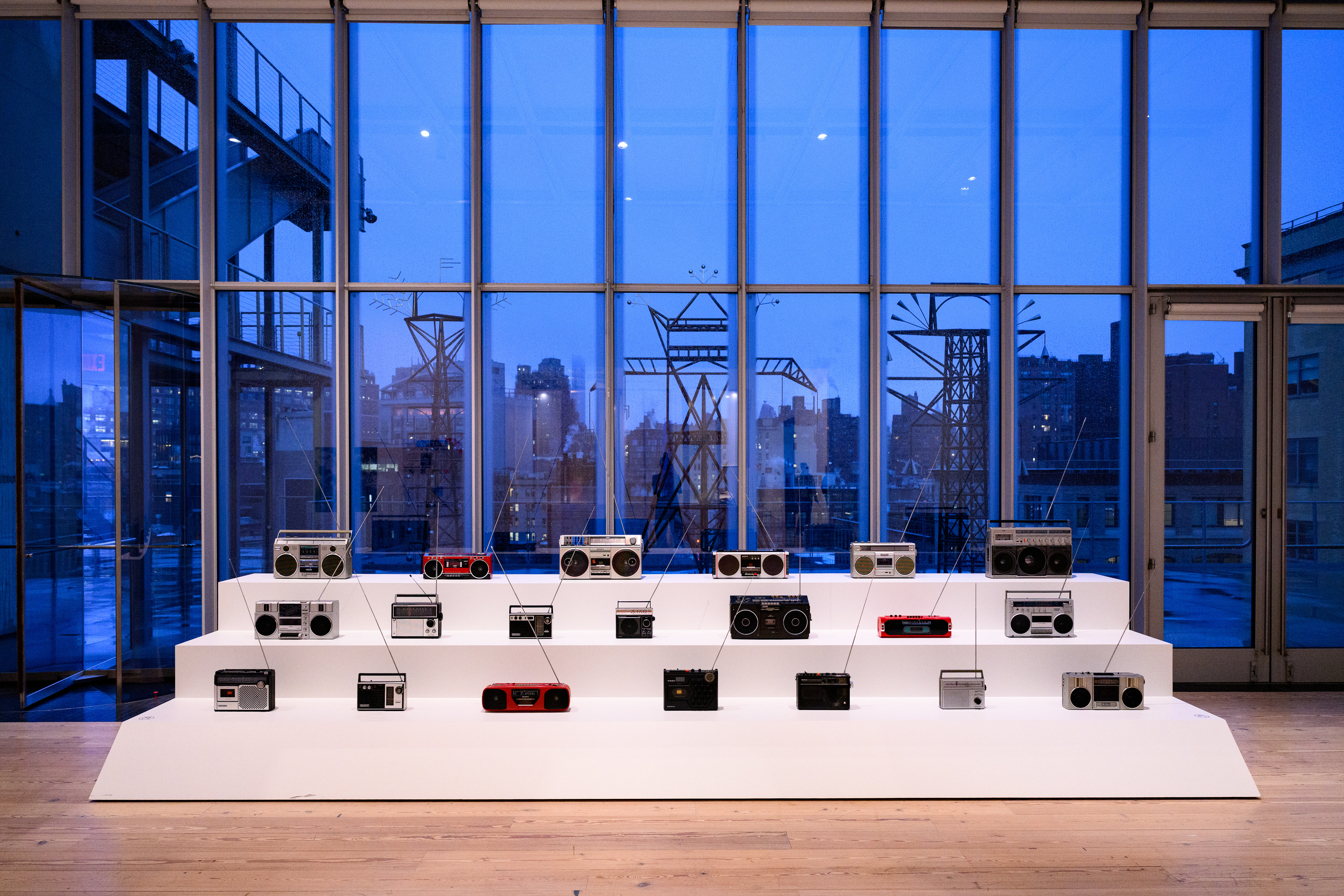
Installation view of Whitney Biennial 2026 (Whitney Museum of American Art, March 8–August 2026). José Maceda and Aki Onda, Ugnayan, 1974/2026. Photograph by Darian DiCanno/BFA.com. © BFA 2026
While visiting the Whitney Biennial, one work in particular made me come back again and again. Titled Ugnayan, the work was originally composed in 1974 by Filipino composer and ethnomusicologist José Maceda.
Conceived as a city-wide experiment, Ugnayan was broadcast simultaneously across thirty-seven radio stations in Manila, with its twenty tracks creating a constantly shifting composition that turned listeners into participants.
More than fifty years later, artist and curator Aki Onda has reactivated the work for the Whitney Biennial, bringing its participatory, fragmented experience of listening into the museum.
Drawing from Southeast Asian musical traditions while engaging with Western avant-garde techniques, Maceda transformed these influences into a distinctly Asian musical language, offering a different, locally rooted way of thinking about contemporary composition and collective music-making.
I spoke with Onda via email about bringing Ugnayan back to life in New York, its political contradictions, and what Maceda’s radical approach to listening might tell us today.
The installation is on view at the Whitney Museum through October 12.
Ugnayan was originally conceived as a decentralized radio network connecting twenty simultaneous broadcasts across Manila. In your reactivation, what aspects of Maceda’s original vision felt most urgent to revisit today, and what new meanings emerged through the Whitney context?
Aki Onda: Ugnayan was an audience participatory event that invited anyone with a transistor radio to gather at one of the 142 “Ugnayan Centers” such as parks, plazas, and street corners, established across metropolitan Manila. Thinking about restaging this work in New York in 2026, I’m particularly interested in the idea of these Ugnayan Centers as spaces of assembly.
What feels especially urgent today is that, even under Ferdinand Marcos’s dictatorship and during Martial Law, which had been declared two years earlier in 1972, Maceda was able to create informal public spaces across the city—not only for listening, but also for gathering, talking, eating, and even quietly plotting. While the state authorized the event, the work also opened opportunities for people to come together in ways that exceeded its official framework.
Perhaps something similar can happen when visitors to the Whitney gather around radios and form temporary, spontaneous collectives within the museum. There is something compelling about this as a model for navigating the authoritarian tendencies we are witnessing today, not only in the United States but elsewhere as well.
Radio has often been described as a democratic medium because of its accessibility and reach, but it has also been used as a tool of state power and control. How do you position Ugnayan within this tension?
Aki Onda: It is ironic that Maceda’s masterpiece Ugnayan became entangled with the Marcos regime, adding layers of political complexity to the work. At the same time, the project could only have been realized with the state’s support. Without the government’s ability to coordinate all 37 radio stations in Manila for a simultaneous broadcast, such an ambitious undertaking would simply have been impossible.
Yet Maceda’s artistic vision came from a very different place. As an ethnomusicologist, he studied collective music-making in village rituals and ceremonies throughout Southeast Asia, and these experiences profoundly shaped his compositional thinking. For him, radio was a way of reintegrating music into everyday life and creating a shared participatory experience on an urban scale.
For First Lady Imelda Marcos, who also served as chairperson of the Cultural Center of the Philippines (CCP), Ugnayan offered an opportunity to project an image of national unity under the regime. The government sought to capitalize on Maceda’s expertise in Filipino indigenous music and his emphasis on collective participation. Maceda, however, was not interested in promoting a narrowly defined ethnic nationalism. Throughout his career, he explored musical traditions that crossed political borders and advocated for the idea of “Asian musics”—a perspective that sat uneasily with the regime’s nationalist cultural agenda.
In this sense, Ugnayan is defined by a series of contradictions. It depended on state power while pursuing participatory ideals. It was embraced by an authoritarian nationalist regime while embodying a transnational musical vision. And it drew upon indigenous performance practices while relying on modern mass media technology. These contradictions are essential to understanding both the work itself and its historical legacy.
More broadly, I’m not entirely convinced that radio is inherently a democratic medium. Radio transmission may be widely accessible, but broadcasting institutions rarely operate independently. Their programming is typically shaped by governments, corporations, political parties, or other funding structures. This reminds me of Tetsuo Kogawa’s free radio movement in Japan during the 1980s, which attempted to escape precisely these institutional constraints by creating small-scale, community-operated transmitters outside the mainstream broadcasting system.
What interests you about radio specifically, as opposed to other contemporary communication technologies? Is there something in its material limitations, its noise, interference, and fragmentation, that remains politically or aesthetically relevant?
Aki Onda: What interests me most is that Maceda did not conceive Ugnayan as a fixed musical object or a composition that anyone could hear in its entirety. Rather, he was interested in creating a system through which twenty pre-recorded tracks could be multiplied by thousands of transistor radios, generating a constantly shifting mass of sound that covered the entire city.
As a result, no two listeners experienced the work in the same way. Some people may have heard the full hour-long broadcast, while others encountered only fragments as they passed through the city. The balance among the twenty simultaneous broadcasts also differed from place to place, depending on the surrounding radios, their tuning, reception quality, and the acoustic environment. Interference, overlap, and incompleteness were not technical flaws but integral elements of the composition itself.
Although on a much smaller scale, Maceda explored a related idea in his 1968 work Pagsamba, performed at the circular Parish of the Holy Sacrifice church at the University of the Philippines in Quezon City. The work was written for one hundred voices, Filipino bamboo instruments, and gongs, and involved a total of 241 performers dispersed among the congregation, all facing the center of the church where Maceda conducted. Because performers and audience members were intermingled throughout the space, every listener experienced a different balance of voices and instruments depending on where they stood or sat. Here again, Maceda sought to dissolve the distinction between performer and audience, creating an experience closer to a communal ritual than to a conventional concert.
Looking across these works, what seems most radical is not radio itself but Maceda’s insistence that music exists through the collective experience of listening. He embraced contingency, multiplicity, and spatial difference rather than a single, ideal version of the work. Those qualities remain politically and aesthetically resonant today, especially in an era increasingly dominated by personalized media and algorithmically curated listening experiences.
Listening to Ugnayan at the Whitney, I was struck by the impossibility of hearing the work in its entirety. One encounters only fragments, overlaps, and interruptions. How important is this condition of partial listening within your interpretation of the work?
Aki Onda: I think that was also true of the original event in 1974. Many participants, listeners, and bystanders encountered Ugnayan only partially. Some may have heard it briefly while passing through the city, others may have stayed longer, but very few experienced the entire composition from beginning to end. I imagine Maceda anticipated this. Partial listening was not a limitation of the work but one of its fundamental conditions.
Whether “full” or “partial,” there is another aspect of Ugnayan that I find interesting. Many suggest that the public response was, in many ways, surprisingly muted, or even almost apathetic. The work may simply have been too experimental and too idealistic for many listeners. Most people had little familiarity with avant-garde music, and it has been estimated that only a small percentage of the population was familiar with Filipino indigenous musical traditions. After centuries of Spanish colonial rule and decades of American occupation, Philippine musical culture had become quite Westernized, so the sounds of the indigenous instruments that Maceda employed would have seemed unfamiliar, even alien, to many listeners.
I sometimes wonder whether this limited public reception, or simply saying an unsuccessful event or failure, inadvertently protected Maceda in relation to the Marcos regime. Although Imelda Marcos strongly supported Ugnayan, it was the only project of Maceda’s in which she was directly involved. After that, she largely disappeared from his artistic activities. The following year, Maceda premiered Udlot-Udlot, another large-scale outdoor work with eight hundred high school students, at the Cultural Center of the Philippines. While Maceda continued to work regularly with the CCP throughout the 1970s, this was not because of Imelda Marcos personally, but because of the support of the composer Lucrecia Kasilag, who served as the CCP’s President and Artistic Director. In other words, Maceda’s relationship with the CCP should not be understood simply as a relationship with the Marcos regime.
For me, this raises a broader question about how artists navigate the contradictions of working under authoritarian governments. In the Philippines during the 1970s, a significant portion of cultural production was supported by state institutions that were themselves entangled with the dictatorship. Looking back, it is important to recognize these contradictions rather than reduce artists to either collaborators or resisters. Maceda did not choose the political conditions in which Ugnayan was realized, and understanding the work requires acknowledging the complexity of those circumstances.
While we discussed Ugnayan in terms of radio, participation, and politics, it is also one of José Maceda’s most remarkable musical achievements. From a compositional perspective, what makes the work so exceptional, and why do you consider it one of his masterpieces?
Aki Onda: As a composer, Maceda changed the style of his compositions roughly every decade or so, while maintaining his signature theory of ‘Drone and Melody,’ regardless of the instruments he used. In the 1960s, he focused on composing for Asian indigenous instruments. In the early 1970s, he adopted electronic devices such as cassettes and radios for sound diffusion. Then, in the 1980s, he began combining Asian indigenous and Western instruments. After the 1990s, he even wrote works exclusively for Western instruments, including piano and orchestra.
1974’s Ugnayan is probably the most significant of his compositions up to that point, as it represents the culmination of many of his earlier experiments. It was meticulous in its conception, technologically cutting-edge for its time, and deeply engaged with the fusion of the ancient and the modern. More importantly, it demonstrated Maceda’s commitment to moving beyond the established idioms of Western musical composition and exploring new possibilities for collective musical action.
There are several reasons why Ugnayan is so special. First, Maceda’s use of indigenous bamboo instruments, gongs, and other traditional instruments had become so sophisticated through his extensive experimentation during the 1960s and ’70s. When you look at the score, it is striking to see how meticulously everything is notated. You can really sense the clarity and precision of his musical vision.
Second, Ugnayan is not simply an imitation of so-called “village music.” Maceda incorporated techniques associated with Western contemporary music, such as large-scale mass structures and an intense attention to timbre. You can hear influences from composers such as Varèse and Xenakis. But Maceda discovered a completely unique, distinctly Asian way of achieving similar musical effects. He transformed these ideas rather than simply adopting them.
Third, the relationship between the performers and the audience is highly unconventional. Ugnayan is fundamentally a participatory work, involving an enormous number of people—hundreds of thousands, or possibly even a million. Maceda had previously composed large-scale works involving hundreds of performers, but Ugnayan operated on a completely unprecedented scale.
The question is why he envisioned a performance in which such a vast number of people would participate directly. I think the answer can be found in his study of collective music-making in ancient village rituals and ceremonies. Maceda was deeply interested in how music could function not simply as something performed for an audience, but as a communal activity that brought people together. Maceda had a strong interest in social philosophy that represents how music functions in society. In that sense, the extraordinary scale of Ugnayan was not merely a matter of spectacle. It was the logical culmination of his long investigation into collective musical experience and his search for an alternative to the conventional model of composer, performer, and audience.
And having presented it at the Whitney, how was it to experience contemporary audiences encountering the piece? Did their engagement with the work reveal anything new about the composition itself?
Aki Onda: After the opening of the Whitney Biennial, I once spent a few hours in the gallery space of the Ugnayan installation on the sixth floor of the museum, just to simply observe how visitors responded to the work. Usually, in a biennial or large group exhibition, people spend only a very short amount of time with each work. But I was surprised that many people stayed with Ugnayan for quite a while—listening to the music, contemplating the installation, reading the texts, and looking out at the city outside. I began to feel that one of the strongest draws was the music itself. It seemed to resonate with people very directly, even though the piece comes from a very different historical and cultural context. The location of the installation was also significant. From the gallery space, visitors can see the vast expanse of Manhattan and its skyscrapers. That view allowed them to imagine Maceda’s original idea of blanketing the entire metropolis with sound. There was something grandiose, almost majestic, about the story, and I think the scale and ambition of the idea could still be felt by audiences as well.
What was also interesting was how some people became curious about the technical system behind the work. This installation is an incredibly complex radio transmission system. I carefully sourced vintage radios, and they were converted to digital tuning so that we could achieve extremely precise frequencies. New York has 44 FM radio stations, so the 20 frequencies used for this project had to be carefully selected to avoid interference with the city’s dense commercial radio spectrum.
Inside the white platform, we installed 20 handmade transmitters. Many visitors asked me how the system worked, and I was able to tell them that it really is a radio transmission installation—there is no “cheating.” You hear the music from the radios, and the sounds are sent from the transmitters. I’m very grateful to the Whitney team for supporting such a technically demanding production. The entire process took several months, working closely with the radio transmission specialist I brought onto the project. We put an enormous amount of energy into making the system work precisely, and I think perhaps the visitors could sense that energy, even if they didn’t know exactly how much technical work was happening behind the scenes.
In that sense, experiencing the work with contemporary audiences gave me a new appreciation for how Ugnayan operates on several levels at once. It is music, but it is also architecture, technology, and a way of imagining the city as a collective space. Seeing people engage with it today made me realize that Maceda’s central idea—the possibility of using sound to connect people across a vast urban environment—is still remarkably powerful.
Your work often engages with infrastructures that shape how sound travels through space. What drew you to Maceda’s interest in communication systems, and how does it connect to your broader artistic practice?
Aki Onda: Yes, Maceda and I share many interests. You mentioned the relationship between space and sound, which can operate in both physical and social contexts. But there are also many other connections: the use of electronic devices for sound diffusion, his strong attachment to tape recorders, the blending of cultural beliefs and spirituality, and his interest in bringing the ancient and the modern together. In that sense, I have been researching Maceda’s work for many years, but at the same time, that research has also been a way of investigating my own artistic interests.
What drew me most strongly to Maceda’s work was probably his cosmopolitan perspective. He studied Western classical music in Manila and Paris, and then, while studying in the United States, he encountered the Indigenous music of the Philippines, which eventually led him to explore musical cultures across Southeast and East Asia. He spent a decade deeply immersed in ethnomusicology, carrying tape recorders into the field to document musical practices, rituals, and folkways. Then, remarkably, he began his career as a composer at the age of forty-six, bringing together his knowledge of Asian musical traditions with techniques from the Western avant-garde.
I relate to that trajectory very strongly. I was born in Japan, but my father’s family immigrated from South Korea. I grew up in Asia, but I have built much of my career in the West, including spending two decades in New York. So I have always felt that my cultural identity is not necessarily confined to a single place or tradition.
There is something Maceda said toward the end of his life that I particularly relate to: “I’m a Filipino composer, but I don’t confine myself to national borders. I consider my composition to be more universal. I don’t want to pigeonhole myself as specifically Filipino. Whatever I need, I can borrow from anywhere.” I strongly identify with that way of thinking. For me, Maceda’s work is not simply an example of how to combine Asian and Western traditions. It is an example of how an artist can move freely across cultures, histories, technologies, and geographies, taking whatever is necessary to develop a personal language. That is also how I understand my own practice and, more broadly, how I see the world.