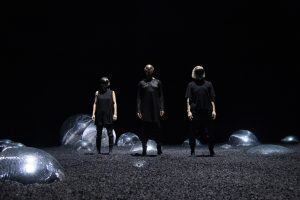


“I search for the sound inside the sound.A note is never just a note. There is air, attack, grain, overtone, decay, vibration.”
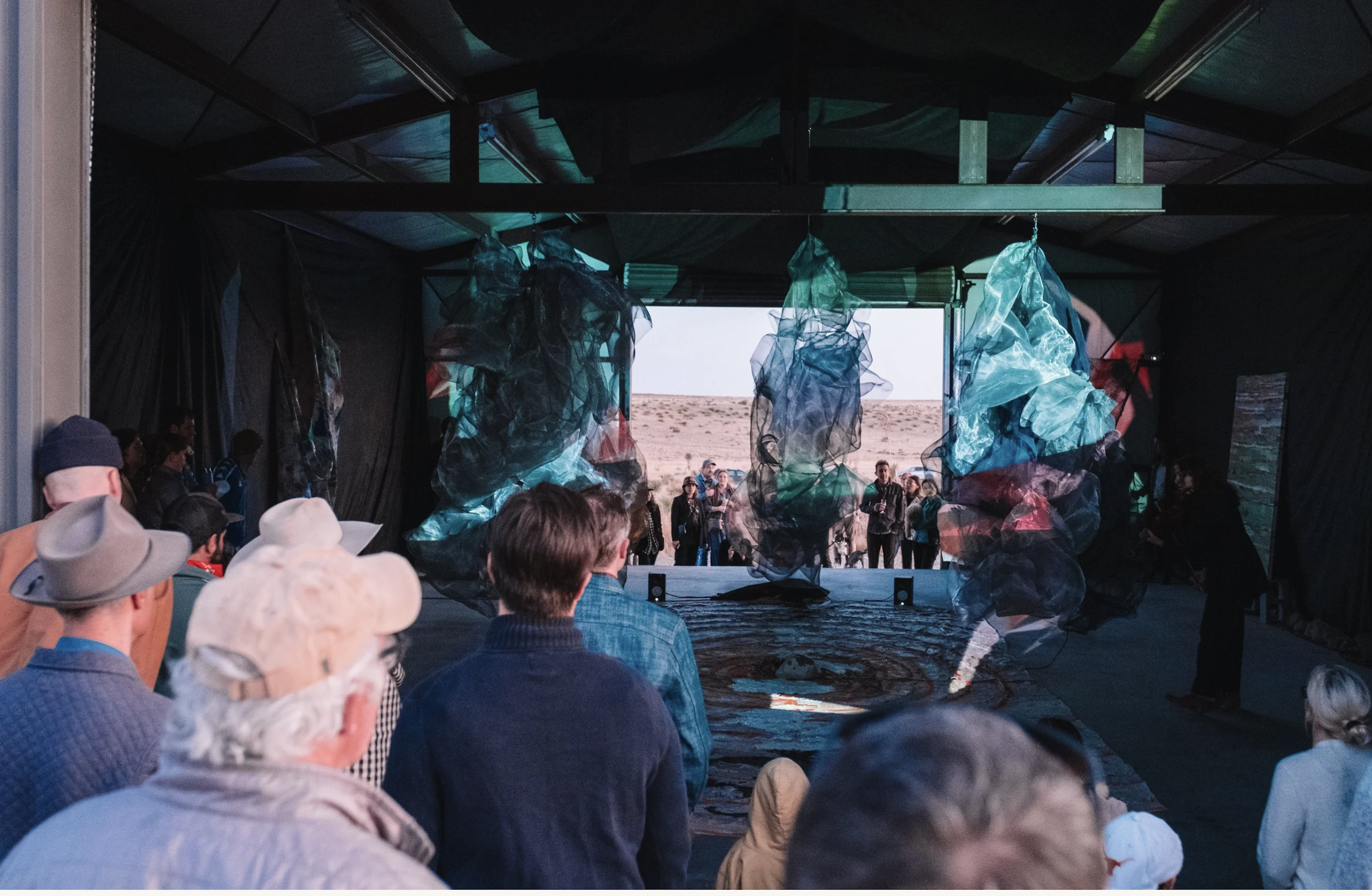
People standing in the fieldwork piece “TIme Travel Devic” by Rob-Mazurek in Marfa.
Rob Mazurek and Chad Taylor have spent almost three decades refusing to respect the borders that are supposed to keep such things apart. The duo first played together with in Chicago in 1997 – and from there made the Chicago Underground Duo into a continually mutating laboratory for improvisation, electronics, composition, rhythm, noise and abstraction.
On 31 October, the duo brings this history to Jazzfest Berlin, presenting primarily material from “Hyperglyph”, their new album on International Anthem and their first duo release in eleven years. The long pause has apparently done little to diminish the telepathy: Mazurek describes trust as the fundamental constant between him and Taylor, while the music keeps changing with everything they have experienced in the years between records.
Mazurek’s artistic universe extends far beyond sound. A highly active visual and interdisciplinary artist, he calls himself an “Abstractivist” and approaches music and visual art as inseparable forces that continually feed and transform one another.
In our conversation, we talk about Chicago’s experimental music ecosystem, the AACM and Art Ensemble of Chicago, his life in the desert of Marfa, the unstable category of jazz, technology and AI, collaboration, silence, psychedelia and the question that seems to drive his entire practice: how can radically different things become one thing without losing what makes each of them distinct?
You’re coming to Berlin with the Chicago Underground Duo for Jazzfest Berlin. When you look at the duo today, what do you feel is still fundamentally the same about its musical language—and what has changed most since you and Chad Taylor started working together in 1997?
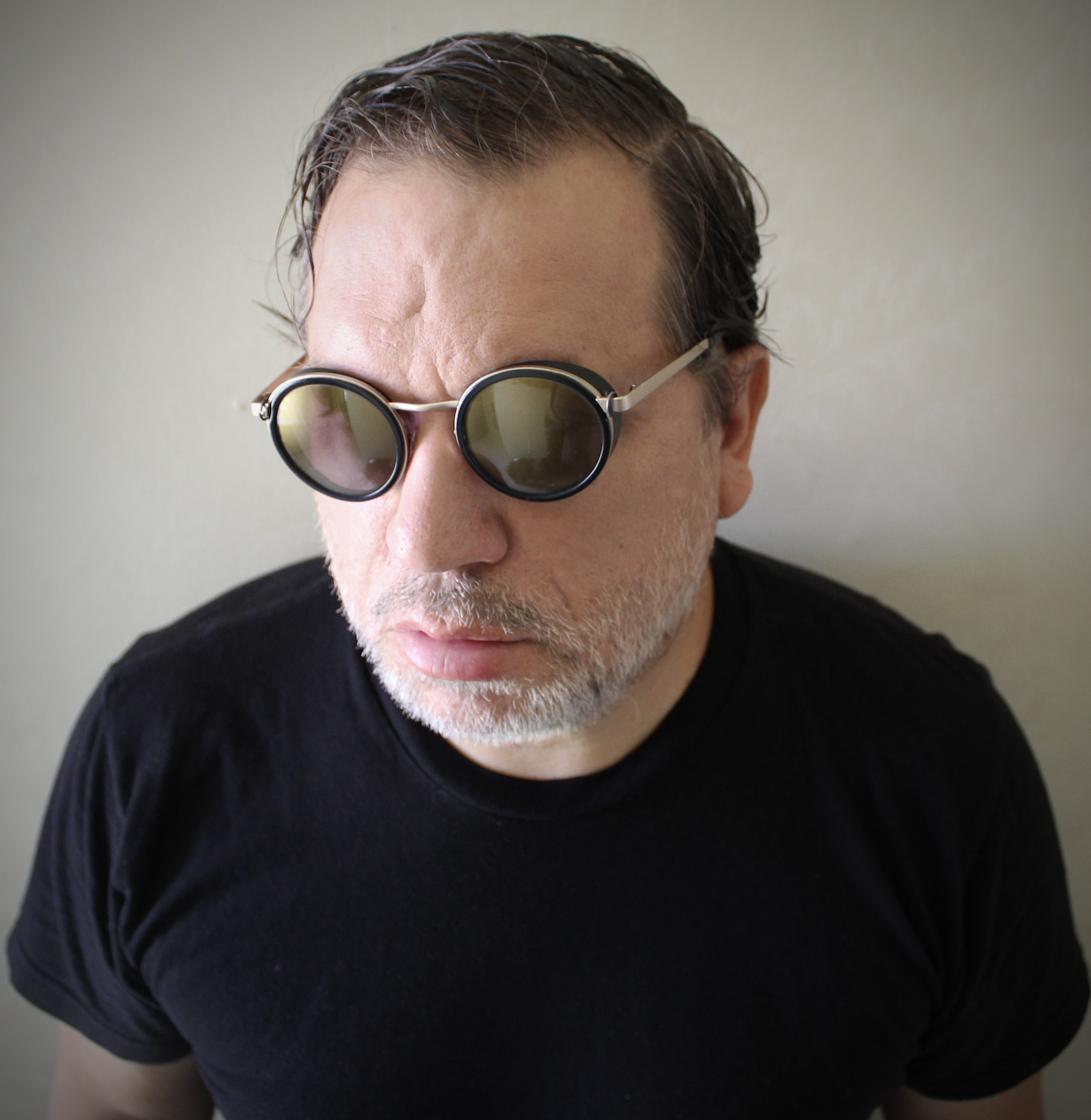
Rob Mazurek (Photo: Britt Mazurek)
Rob Mazurek: The fundamental thing that remains is trust. Chad and I have been making music together for almost thirty years, and there is a kind of communication that develops over that amount of time that is difficult to put into words. We can move very quickly from something extremely delicate to something explosive, from a song or melody into complete abstraction, and there is never a feeling that we have left the music.
What has changed is everything we have experienced between then and now. We are different people. Our ears are different. Our relationship to time is different. We have absorbed thousands of sounds, places, people, losses, discoveries.
“Hyperglyph” feels very much like the culmination of all of this, but also strangely like a beginning. There is a freedom on this record that I find incredibly exciting. We are not trying to sound like the Chicago Underground Duo. We simply are the Chicago Underground Duo.
Chicago Underground has always seemed less like a fixed band than a kind of open musical organism. How do you understand the identity of the duo today, after all these years and so many different musical contexts?
Rob Mazurek: I like the idea of an organism because an organism has to breathe and transform in order to remain alive. Chicago Underground has existed as Duo, Trio, Quartet, Orchestra and in other configurations, but for me the Duo has always been the nucleus—a very concentrated energy source.
The identity is not really stylistic. It is a way of approaching sound. We can bring electronics, composition, improvisation, rhythm, silence, noise, melody into the music and none of these things have hierarchy over the others. They are materials. Chad and I take these disparate materials and somehow they coalesce into a singular thing. That is still fascinating to me.
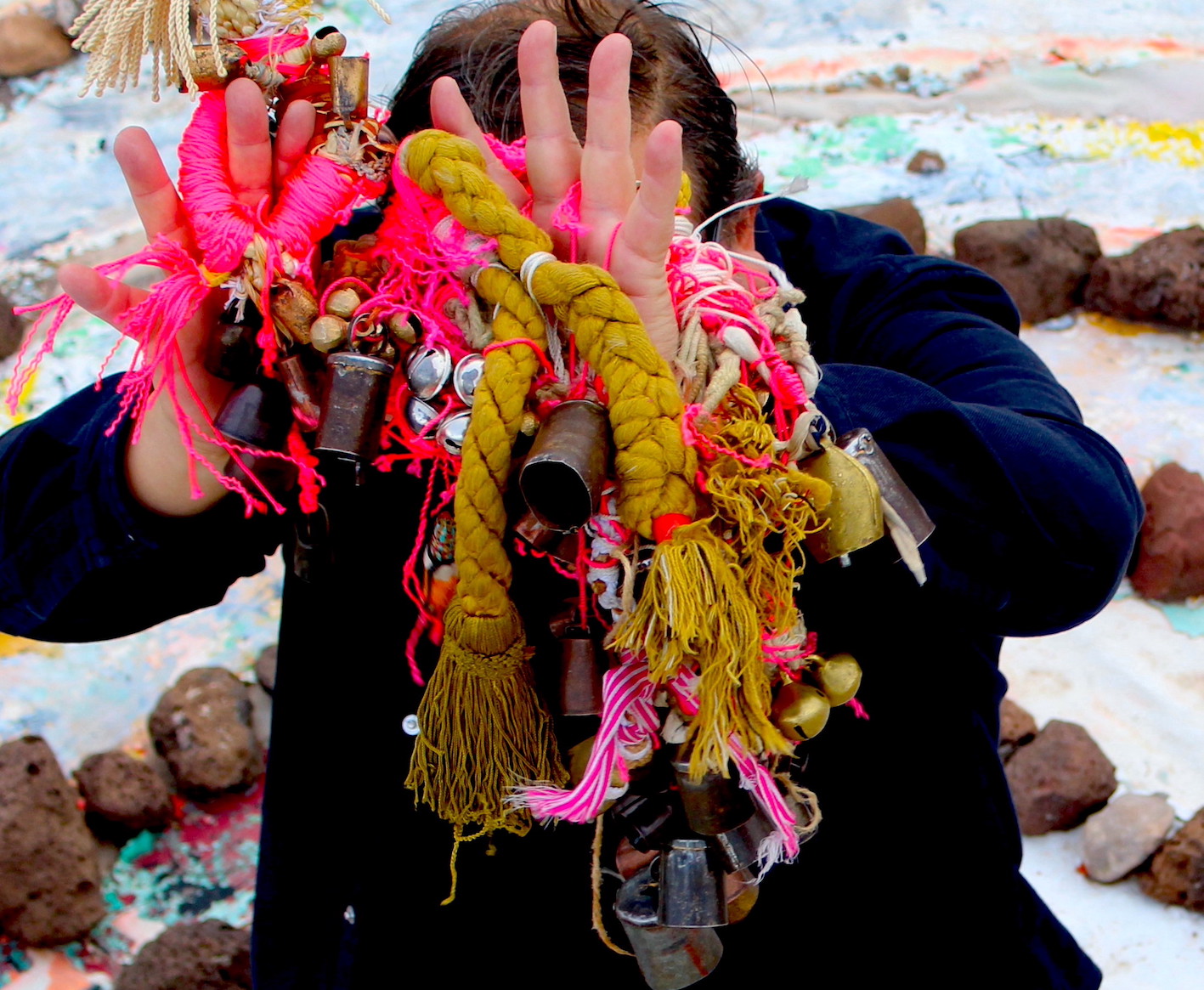
Rob Mazurek, “Lightning Dreamer” (Photo: Britt Mazurek)
You are now living in Marfa, a small town in the middle of nowhere in Texas. What made you move there? And what impact does living in Marfa have on the sound and musical thinking of the Chicago Underground Duo?
Rob Mazurek: I was searching for space. Physical space, mental space, sonic space. Marfa and the Chihuahuan Desert gave me that immediately.
Living here has radically affected the way I hear. The scale of the landscape is enormous, but at the same time you become aware of incredibly small things—the sound of wind moving through grass, an insect, a distant train, the electrical hum of something miles away. Silence in the desert is never actually silent. It is full of information.
I think this has entered my music as a greater awareness of space and duration. You don’t necessarily need to fill everything. One sound can contain an enormous amount of information if you really listen to it. And of course the art! Donald Judd’s work here is always an inspiration and the influx of contemporary art that happens here is also extraordinary. I can hang out with Christopher Wool and Charline Von Heyl on any given day. Amazing.
Since we are talking about cities and influences: what made you include “Chicago” in the band name in the first place?
Rob Mazurek: Because Chicago made the music possible.
I lived in Chicago for 30 years and Chad lived there for a time as well. I first played with Chad in Chicago when he was 17! Chicago has this extraordinary history of musicians creating their own systems, their own ensembles, their own labels, their own spaces, their own definitions of what music could be. When Chicago Underground began, we were part of that continuum while simultaneously trying to create something completely our own.
“Chicago” meant a certain kind of independence to me. You could respect history deeply without becoming imprisoned by it. Art Ensemble of Chicago was and still is a big influence and they only lived in Chicago a short time. Universal.
Chicago is a city well known for its huge and influential music community. Which corners of the city, and which people, have been most important to you?
Rob Mazurek: Chicago in the 1990s was extraordinary because scenes that supposedly had nothing to do with one another were constantly colliding. You could be around musicians connected to the AACM, people making improvised music, electronic musicians, post-rock bands, experimental artists, visual artists—all of this was happening simultaneously.
For me there were people like Jeff Parker, Chad Taylor, Tortoise, Jim O’Rourke, Gastr del Sol, John McEntire, Casey Rice, Sam Prekop, and so many others. And then there was the more avant guard Chicago lineage— Muhal Richard Abrams, Roscoe Mitchell, the Art Ensemble of Chicago, Fred Anderson. Places like the Green Mill, The Empty Bottle and Fred Anderson’s Velvet Lounge were important because you could actually encounter this music.
There was an incredible exchange of information. Nobody needed to ask permission to combine things.
As we speak of influences—are your parents also artists? Was music of huge importance in your family home?

Rob Mazurek (Photo: Britt Mazurek)
Rob Mazurek: My parents were not professional artists. Music was present, but I didn’t come from a family where becoming an artist was somehow predetermined for me. My relationship to music became an obsession through listening and through the discovery that sound could contain entire worlds.
Once I discovered that, there was really no turning back.
You’ve moved between jazz, free improvisation, electronics, experimental rock, noise, psychedelia and contemporary composition without seeming particularly interested in maintaining the borders between those worlds. Was that always a conscious position for you, or did it simply develop out of the way you listened and played?
Rob Mazurek: I never really understood the borders.
I understood that people needed categories to talk about music, sell records, organize festivals, whatever. But as a listener I didn’t experience music that way. If something resonated with me, it entered my world.
Eventually I realized that the music I wanted to make had to reflect the way I actually heard. A beautiful trumpet tone, a synthesizer frequency, a drum pattern, silence, distortion, a piece of architecture, a painting —they could all exist in the same field.
That became very important to me… a kind of transformation. How can radically different things become one thing? Especially concerning sound and vision.
Going back to the beginning: what was it about the Chicago music scene in the late 1980s and early 1990s that made it possible for a young musician like you to imagine music with such a distinct personal character?
Rob Mazurek: There was permission in the air.
Not permission from an institution—almost the opposite. People were making things because they needed to make them. You saw musicians inventing entire languages and creating situations where those languages could exist.
Chicago also had a certain toughness. You had to do the work. You had to play. You had to listen. And because there were so many different musical communities existing next to one another, you were constantly being challenged.
That environment gave me courage to trust the strange things I was hearing internally.
Chicago has a very particular history of collective and experimental music—from the AACM to the Art Ensemble of Chicago and beyond. How important was that lineage to you when you were developing your own voice?
Rob Mazurek: Profoundly important. The AACM demonstrated that you could create a complete universe around your music. Composition, improvisation, visual presentation, philosophy, community—all of these things could be part of the work.
The Art Ensemble’s idea of “Great Black Music: Ancient to the Future” was incredibly powerful because it destroyed the idea that experimental music meant rejecting history. You could carry history forward while simultaneously imagining something that had never existed.
I learned from that. Not to imitate the sound, but to understand the possibility.
At what point did you realize that you didn’t necessarily have to choose between being a “jazz musician” and being part of a broader experimental music culture?
Rob Mazurek: Very early. I never wanted to choose.
I love the trumpet. I love improvisation. I love the history of this music. But I also love electronic sound, visual art, architecture, noise, Morton Feldman, Stockhausen, Miles Davis, Sun Ra, dub, Brazilian music, punk rock, silence.
Your cornet playing has always existed in an interesting tension between tradition and abstraction. What is it that you search for in the sound of the cornet?
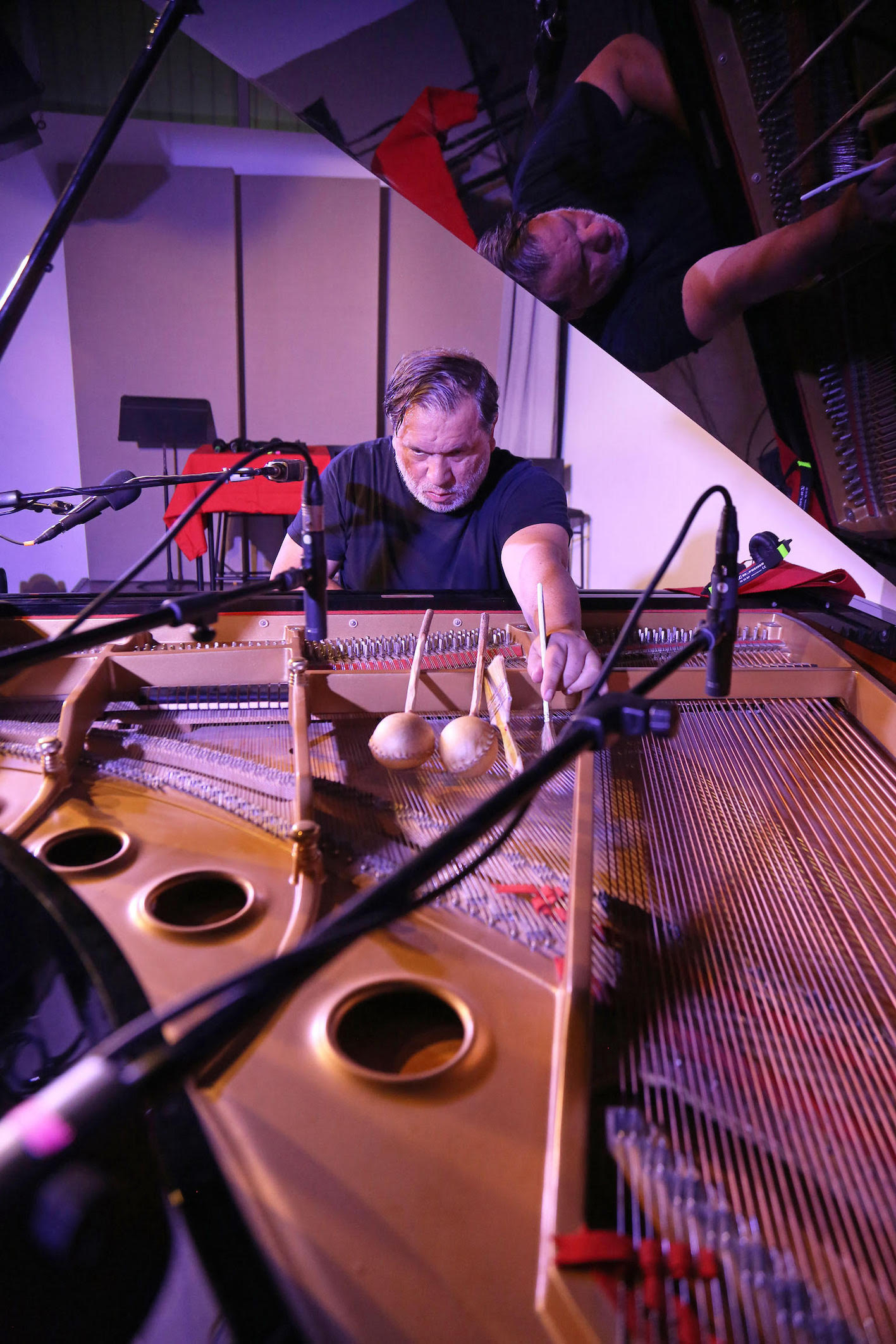
Rob Mazurek: I search for the sound inside the sound.A note is never just a note. There is air, attack, grain, overtone, decay, vibration. Sometimes I want something incredibly pure and direct. Other times I want the sound to fracture until it almost stops being identifiable as a cornet.
I am searching for resonance—for the point where a sound becomes physical and somehow changes the space around it.
I feel more like a painter when I am playing at this point.
And what is it that you search for in music in general, the ones by others and your own one?
Transformation.
I want music to change my perception, even if only for a second. I want to hear something and suddenly understand time differently, or become aware of a feeling I didn’t know I had.
I am less interested in perfection than necessity. Why does this sound need to exist? Why this sound now? The music I love creates questions rather than answering them.
You were part of a generation that experienced the emergence of sampling, affordable electronics, computers and new recording technologies as an expansion of the musical vocabulary. How did technology change the way you thought about composition and improvisation?
Rob Mazurek: Technology expanded the palette enormously.
Suddenly recorded sound could become compositional material. Electronics didn’t have to sit behind acoustic instruments as decoration. They could become another organism in the music.
With Chicago Underground especially, I became fascinated with real-time transformation. A cornet sound could enter a machine and return completely altered. An acoustic gesture could generate an electronic environment.
For me the important thing was never the technology itself. The question was always: can this create a sound or a relationship that I could not have imagined otherwise?
These days, we all talk about the influence of AI on the music industry and on music itself. What is your position on AI, both as an artist and within your own practice?
Rob Mazurek: I am curious about AI because I am curious about almost any tool that can transform information. But I am also cautious.
For me art comes from experience—from living, listening, failing, loving, losing people, traveling, touching materials, being in a room with another human being and not knowing what is going to happen next. I don’t want technology to remove that uncertainty. That uncertainty is precious.
If AI becomes another tool for transformation, I am interested in seeing where artists take it. If it becomes primarily a machine for imitation, efficiency and replacing human imagination because it is cheaper, then I find that profoundly uninteresting—and potentially destructive.
The question for me is not whether AI can make music. The question is what kind of relationship to being alive the music contains.
The Chicago Underground projects became a particularly important space for exploring the intersection of acoustic improvisation and electronics. Do you see any “brothers and sisters in crime” out there—artists with whom you feel you share certain tactics, ideas or sounds?
Rob Mazurek: Certainly, but I tend to feel kinship more through attitude than through sound.
I am attracted to artists who refuse the hierarchy between acoustic and electronic, composition and improvisation, beautiful and abrasive. People who create their own systems rather than simply operating inside an existing one.
There are many artists doing this now, which is exciting. But I don’t spend much time thinking about who sounds like us. I am much more interested in hearing someone whose work makes me think, “What the hell is this?”

Rob Mazurek (Photo: Britt Mazurek)
You have worked with an extraordinary range of musicians and projects over the years. What are you actually looking for when you enter a collaboration?
Rob Mazurek: A distinct voice.
I don’t want someone to give me what I already know. I want them to bring their complete universe into the situation.
The best collaboration is when strong identities meet without being diminished. Something emerges between them that belongs completely to everyone and completely to no one.
That is one of the great things about playing with Chad. He is absolutely Chad Taylor. I am absolutely myself. And then there is this third thing called Chicago Underground Duo.
Is there a particular quality in another musician that can still surprise you after decades of improvising?
Rob Mazurek: Fearlessness combined with deep listening.
Someone can play something completely outrageous, but if they are really listening it can be exactly the right thing. Conversely, somebody can play almost nothing and completely transform the music.
I am still surprised by musicians who can change the gravitational center of a piece with one gesture. Jeff Parker comes to mind.
Your work has also repeatedly dealt with ideas of futurism, cosmic music, psychedelia and altered states of perception. What attracts you to these ideas, and do you think of music as a way of accessing realities that language cannot quite reach?
Rob Mazurek: Absolutely.
Sound is invisible, but it moves matter. It enters the body. It changes our perception of time. That alone is extraordinary.
I have always been interested in cosmology because it forces us to confront scales that are almost impossible to comprehend. Billions of years, enormous distances, stars exploding, light traveling through space—and somehow here we are, these tiny beings making sounds and asking questions. Music allows me to enter those questions without having to resolve them. It creates a space where contradiction, mystery, terror and beauty can coexist.
Let me come back to Marfa as a place. Has living in that landscape changed the way you listen, compose or improvise? I am especially interested in the influence of desert silence on you.
Rob Mazurek: The desert changed my understanding of silence. Silence is not emptiness. It is potential.
When you stand in the desert and really listen, the scale of what you’re hearing becomes enormous. A sound miles away can suddenly feel intimate. Wind has depth. Space itself seems audible.
That has absolutely affected my work. I am interested in creating music where silence isn’t simply the absence between events. Silence is an active material. It pushes against the sound.
My group Alternate Moon Cycles travels these spaceways.
Is there a specific sound you connect with Marfa?
Rob Mazurek: Wind.
But also the distant freight trains at night. You can hear them coming from incredibly far away. The sound slowly enters your perception, grows, changes the entire landscape, and then disappears again.
That is almost a composition in itself.
You’re playing at Jazzfest Berlin. Jazz as a genre has changed enormously during your lifetime, and the word “jazz” seems increasingly unable to contain the music being made under its name. Do you still find the term useful—or would you rather leave it behind?
Rob Mazurek: I have enormous respect and love for the history represented by that word. I would never want to erase it. But I don’t find genre particularly useful when I am making music. Improvisation is essential to what I do, and that connects me profoundly to this history. But the music also contains electronics, composition, noise, rock, contemporary classical music, visual thinking and many other things.
Maybe the problem isn’t the word “jazz.” Maybe the problem is our desire to make words contain things that are fundamentally unstable. Music is much more unruly than language.
Finally, after such a long engagement with improvisation and experimental music, what are you still curious about? Is there something you feel you haven’t figured out yet?
Rob Mazurek: Almost everything.
In some ways I feel I am just getting started.
I am still trying to understand what resonance actually is—not only acoustically, but between people, objects, images, spaces, memory. How does energy transfer from one thing to another? How can a sound become an image? How can an image become a score? How can disparate things come together and suddenly become one thing without losing their individual identities?
The older I get, the less interested I am in answers.
I want to make the questions more precise, more beautiful, more impossible.
Last question: what and why is your record of 2026 so far?
Rob Mazurek: Victor Vieira-Branco’s Bark Culture recording “The Giant Is Awkward” is pretty astonishing in its resonance, complexity and bliss. I really enjoy listening to it. I wish I had more time to listen to other peoples music.
So much greatness out there. The possibilities seem endless.