

Akufen “I butcher Sound”
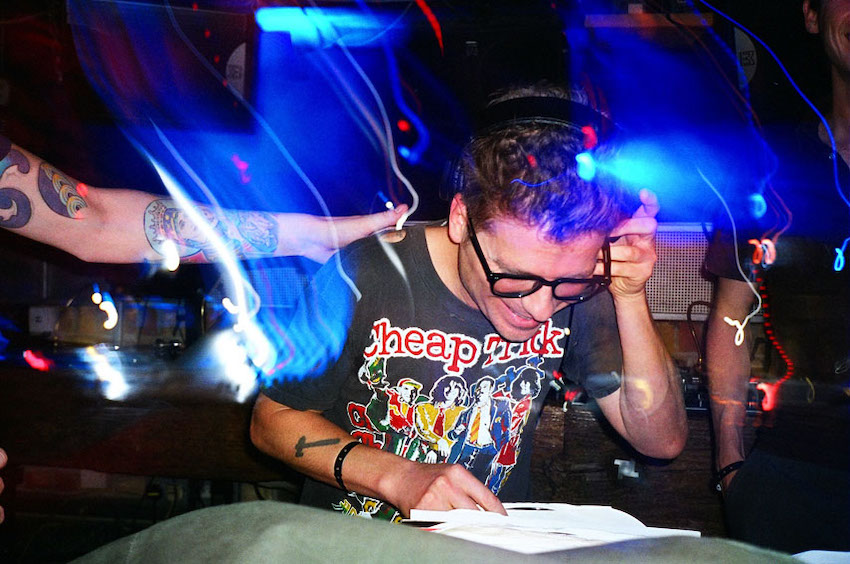
Marc Leclair ( aka Akufen im Fabric, London, 2003
When you say Akufen, you also have to say Montreal. And when you say Montreal, you also have to say Mutek. Without the festival, the city would never have experienced this musical boom. It has become something of a link between the local scene and the international minimal and experimental context. For three years now, festival director Alain Mongeau has done an excellent job of putting together a balanced line-up of global players and local heroes. And there’s more: the Mutek Festival is not only about performances, but just as much about communication, both between the artists and with the audience. Everything is still nice and compact, you constantly bump into each other, chat, and then listen to the next artist. It’s no coincidence that the festival is often referred to as the smaller, nicer brother of Sonar, the electronic music festival in Barcelona, which has unfortunately gotten out of hand. And so, thanks to Mutek, new connections were formed, such as those between Akufen and the Cologne labels Traum and Trapez, whose operators Riley Reinhold and Jaqueline Klein were guests here last year.
Montreal in May feels a bit like a vacation in France. This is partly because most people here speak French, but also because of the large number of good restaurants along the main street, St. Laurent. The city feels extremely lively. Just a few weeks ago, things looked very different. Winters here are very harsh and often last well into spring. But when summer suddenly arrives, it really does feel like those overused metaphors about butterflies emerging from their cocoons or flowers blooming. Everyone sits outside. Euphoria spreads. Even rain showers don’t chase anyone indoors. Ideal conditions, then, for Christoph Büscher and me when we arrive by train from Toronto.
We have a blind date at the train station: Jon Berry, Force Inc. representative for North America and—as it turns out over the next few days—a damn nice guy, has kindly announced himself as our welcoming committee. And, thanks to the codes of subculture – or perhaps the typically German physiognomy of my companion and me – we hit it off immediately. After quickly checking into our charming bed and breakfast, we head straight to the official cocktail reception at SAT, one of the three festival venues.
Normally, events like this are simply a waste of time. But Mutek is different. Not only will the festival be opened, but the release of the latest issue of local art magazine Parachute will also be celebrated. In keeping with the festival, its 107th issue is dedicated to the theme “Electrosons_Electrosounds” and features contributions from Force Inc. label mogul Achim Szepanski, Philip Sherburne, and Martin Pesch, among others. Parallel to the magazine, a CD of the same name is being released, featuring Oval, Pan Sonic, and Carsten Nicolai, among others.
Tim Hecker, who contributed an essay and a track to the issue, performed a magnificent ambient set after a few speeches in French. Next up was Akufen with a 30-minute set of material from “My Way,” his debut album released last month on Force Inc. (see also article in Intro #94): a small preview of his regular set scheduled for Friday and a welcome to the festival from the man who represents the new sound of Montreal like no other protagonist of the scene – and who is actually the reason for my trip to Canada.
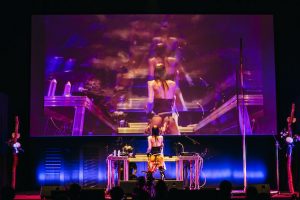
Marc Leclair (Akufen) has taken minimal music to a new level with radio samples in the style of Cadavre Exquis collages. There are more than a few questions left unanswered. But for now, it’s all about listening. His performance is a bit weird in this context, more like an art performance than stimulating club music – as I recently experienced during his guest appearance at Studio 672 in Cologne. Here and now, people stroll past him casually, drinking cocktails and making small talk. However, a small group has gathered in front of the stage, which is beautifully located in the middle of the room and can be walked around, and they jump along enthusiastically, celebrating their man. He, in turn, seems completely satisfied with the unglamorous circumstances. He grins modestly and just looks happy. As happy as someone must be who has just returned from a successful European tour and is allowed to open the event of the year in his home country.
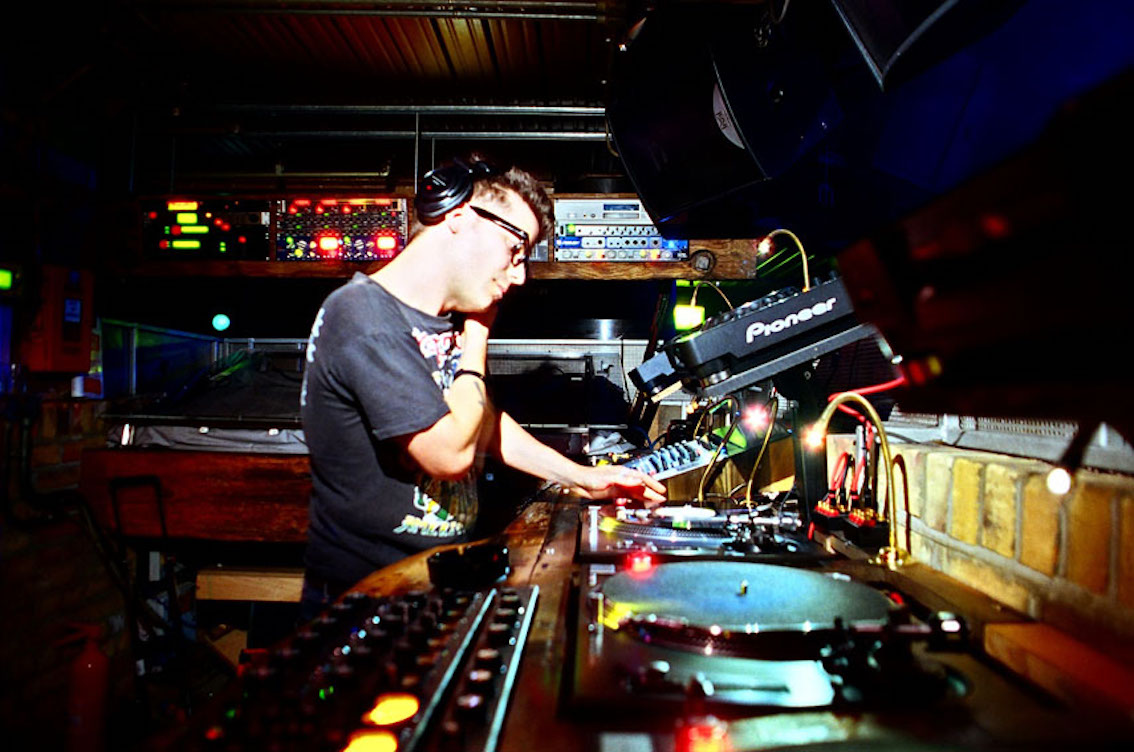
Marc Leclair, doing his Akufen dj thing
A NEW DAY RISING
As mentioned, Mutek is about more than just music. This may also be due to the fact that Alain Mongeau has been responsible for the multimedia program of the FCMM (Montreal International Festival New Cinema & New Media) for nine years (or rather, was until recently, since May he has been devoting himself exclusively to Mutek), the local film festival that takes place every two years. For this festival, he has put together events with interesting producers and DJs every evening. And it was through this work that he first came up with the idea of creating an independent festival for electronic music.
This year, Mongeau initiated a small conference at the local Goethe Institute. The conference addressed topics specific to Canada, such as national cultural policy, as well as global issues, such as whether electronic music is more than just sound today, whether it also aims to bring about change, and to what extent this counteracts aesthetic stagnation. I myself sat on the panel stage on the topic of “the challenge of promoting electronic music.” Other participants included Jon Berry, Heath K. Hignight (freelancer for Urb, XLR8R, Alternative Press, among others), Philip Sherburne (freelancer for The Wire, XLR8R, SF Weekly, among others), and Patti Schmidt (CBC Radio Canada / “Brave New Waves”). The problems in Canada/Montreal seem to be the same as everywhere else. It’s difficult to get the larger, more mainstream magazines interested in the “right” music – and at the same time, the effectiveness of such crossover attempts is also being questioned. Old discussions. And old problems. Too many releases, distributors who don’t do enough for the respective releases, and the recurring question of how to get people excited about them.
People, in general. As much as Montreal is perceived as a big thing from the outside, the phenomenon is small and manageable on the ground. From a hobby psychologist’s point of view, this always seems to lead to that “at home you feel like” underrated thing. But there’s really no reason for it. After all, Force Inc., the mother of all techno labels, has just moved its North American branch from New York to Montreal – and has already settled in quite well here, as evidenced by the compilation “Montreal Smoked Meat” and the Akufen deal, among other things. However, Jon Berry isn’t quite over his New York Turkey yet; he still misses the urban canyons and the hustle and bustle of the city that never sleeps, he tells me. But he appreciates the advantages of his new home. Montreal is still very cheap: 400 euros for a one-room loft measuring approximately 120 square meters. And we’re not talking about just any square meters. From here, you can see the whole city.
Klar, dass da der richtige Soundtrack aufgelegt werden muss, als wir zusammen mit dem schwedischen Produzenten Hakan Lidbo und dem amerikanischen Journalisten Heath K. Hignight abends im Arbeitsloft rumhängen. Wir kommen in den Genuss des für Oktober angekündigten zweiten Luomo-Albums. Deep House auf der nächste Stufe. Ergänzt um cheesy discoeske Momente. Das hier hat Hitpotential, ist sich die anwesende Crowd schnell einig. Und plötzlich steht ein neuer Begriff im Raum: Digital Disco. Und wenn man so über die nächtliche Skyline von Montreal schaut, im Hintergrund Raz Ohara fast schon stöhnend „Disconize me“ haucht, dann scheint Digital Disco auf Luomo genausogut zuzutreffen, wie es der ideale Begriff für Akufens Cut-up-Wahnsinn ist.
But back to where we started. To the loft. In Cologne, that would be more than a bargain. So it’s no surprise that, alongside the local music scene, the cost was the main reason for Force Inc.’s move to Montreal. How does Jon Berry actually see the local music scene? “It’s definitely one of the most vibrant communities in the electronic music scene. The stylistic range and productivity of the producers are simply incredible. There are so many labels and artists here now: Ninja Tune, Turbo, Bombay, Alien8, Constellation… and Tiga, David Kristian, Akufen, Mateo Murphy, Tim Hecker / Jetone, Fred Everything, Kid Koala… Unlike New York, where I lived for eight years, people here are much more open and communicative. They support each other. It’s great for me to be able to advise them and contribute to their development in this way. And that development is truly remarkable. I think it won’t be long before musicians like Deadbeat, Mike Shannon, Crack Haus, Steve Beaupré, Eloi Brunelle, Algorithm / Jeff Milligan, and Ghislain Poirier become better known internationally. In my opinion, they are the spearhead of this city – I wish we had enough opportunities in our label roster to release them all. Akufen’s newly founded label Risque will probably fill this gap and become something like the blueprint for the talent that exists in the city.”

(Photo: Thomas Venker)
MEET YOU AT THE AKUFEN SHOW
While the first two days of the festival were dominated by laptop art performances (at Ex-Centris) and, in the broadest sense, listening and toe-tapping electronica (at SAT), the club aspect of Mutek’s program kicks in over the weekend. On Friday evening, Matthew Herbert (with his Radioboy project, see Intro #92), Akufen, and Hakan Lidbo played one after the other at Metropolis, a rather beautiful, three-story old theater. Three performers by the grace of God. Akufen, however, is the one who most reliably provokes hysteria. The exception to the rule. At home you feel like a star. I could go on writing forever and also rave about the incredibly beautiful Luomo performance at the same venue the next day, but space is limited. It’s time to start the minidisc (yes: 2003!) and take some photos. The latter is done for the sake of staging on Mont Royal, Montreal’s flagship mountain with breathtaking views of the city and surrounding area. I settle down comfortably on a meadow with Marc for a chat.
TA-TA TALK TO ME
Marc, you’ve just returned from your European tour. How was it?
Marc Leclair: All in all, it was really good, except for one show in Denmark. They were expecting hits, but not mine. I was just another act on stage. The venue was also too big. I prefer a more intimate setting. But I can’t complain, traveling is such a privilege. I meet so many interesting people all over the world who become friends.
You’ve been on tour in Germany before. Did you notice any differences? I’m asking this, of course, in light of the fact that you’re reaching a new level with “My Way,” going from a 12-inch tip to something like the next big electronic star, if you’re not already halfway there.
To come back to the original question: I really didn’t think it would be so intense. Suddenly, I’m a normal guy in the charts, I’m respected, and I’m working with all these interesting artists. I enjoy that. But if it gets to be too much, I’ll change direction again. I don’t need to become a big pop star. I need to constantly reinvent myself, ask myself new questions to get new answers. My music is a kind of psychoanalysis that helps me find answers about myself.
The whole hype isn’t just about you, but about Montreal. Although I noticed during the panel that people here don’t see it as a big deal. As is so often the case, it always seems much bigger from a distance.
The scene is actually getting bigger and bigger. Montreal has always been a very active city. We have so many good producers here. All that was missing was a certain moment of attention to take it to the next level. And Mutek was definitely that moment. I hope it doesn’t turn out as bad as Sonar. They’re expecting 100,000 people this year. That’s crazy. I’m definitely not going there. Without Mutek, I would never have become what I am today. I owe a lot to Alain Mongeau and the festival. Many artists have talent, but only a few know how to present themselves well. I’m very shy, for example. I would never have had the courage to approach labels. As an artist, you often wonder how others have made it. That would be a good topic for a panel discussion. Many musicians think that at some point someone will knock on their door and express interest—but that’s not how it works. You have to reach out, ask others what they think. I don’t mean that you should immediately want a contract, but simply that you should get feedback from the labels: Do you like the material? What should I change? First you have to communicate. Later you can do business. It’s all very different from the rock community, where a label signs you for many years. In electronic music, you’re in much higher demand because most labels are rather small.
Were you in rock bands in the past?
I was an academic musician, so to speak. I played guitar and piano in a fusion jazz band. I’ve always liked jazz. And I really like swing: Django Reinhardt, Stefan Rebily. I think the swing in Akufen was inspired by these people. House music has its roots there.
Speaking of communication and gathering tips: How close are the local structures actually? Is there a lively exchange between labels such as Revolver, Dumb Unit, Hautec, Killer, Oral, or Blue Recordings? And what role do you see yourself playing—after all, you’re something of a figurehead at the moment?
Mutek not only put us on the map, it also brought the scene together. Unfortunately, musicians often think they’re alone in what they do. Mutek showed us that there are more of us in the city. That made us all much stronger, of course. My role? Well, by chance, Mutek came into being just when I was ready. I’m very happy if I was able to open the door for others. But it’s nothing special; others have done it before me. There are many people here who have been laying the groundwork for ten years. It’s all a question of timing. If Mutek had been created five years ago, it would never have had this impact. If the musicians aren’t good enough, even the best structures won’t help.
Force Inc. moved to Montreal some time ago. This could not have been a more significant signal for the city. How was this perceived within the scene? It is not only one of the major labels for electronic music for me, but also one of the few that has never stagnated and has always sought new styles. Was that also the deciding factor for you to make your debut album there?
The Force Inc. thing actually started in Frankfurt. Achim asked me if I wanted to make an album with him. And, to be honest, I wasn’t exactly thrilled about it. Achim is a character, a very interesting person. But when you meet him for the first time, that’s not exactly representative of who he is. I didn’t feel comfortable with the idea at the time – to cut a long story short, I turned him down. I felt that I needed to release more 12-inch singles. Recording an album is completely different from releasing 12-inch singles. An album has to tell a story, be coherent and versatile. Akufen was too young for that at the time.
Then Jon made a name for himself here in Montreal, and we became friends. He then made me the offer—and I had to turn it down again. I think he liked that, because a lot of artists in the city give him demos. With me, he could be sure that I wasn’t friends with him because he runs a big label. Then one morning I called him and told him to come downstairs because we needed to talk. At the time, he had a work apartment in my building. If I had accepted Achim’s first offer, it would have been more of a business deal. It’s important to me that I’m friends with the people I release music with. Otherwise, the material has no meaning. The labels have to feel that they’re getting something special. I hate it when artists send their tracks to ten labels. It’s like applying for a job. That’s not how music should work. If I make tracks for a particular label and they don’t want them, I don’t release them. I do it like they did in the last century: the king gave the artists commissions.
You’ve released on quite a few labels, including Revolver, Perlon, Background, Traum, and Force Inc. Many people like it when artists release on just one label, because there’s something loyal about it. Diversification is often seen as a strategy.
Releasing on one label also helps the others. I don’t like the fact that there is so much politics in electronic music. You know, if you limit yourself to one label, you also limit yourself creatively. A label has a certain sound. And that’s not what I’m about. I have so much cultural background knowledge that I want to apply as diversely as possible. It’s nice to explore different soundscapes, for yourself and also for all the labels. Of course, it’s not good to release on too many, otherwise you really become a label whore.
Speaking of versatility, “My Way” has turned out to be very diverse. The album features cut & disco house tracks such as “Even White Horizons” and “My Way,” but also more dubby, subtle spatial studies such as “Installation.” Was it your intention to present an album that represents the whole spectrum?
I definitely wanted to present a synthesis of my catalog from the last three years. It’s a greeting card to everyone who helped me get my material released. Because it was a risk for everyone. Perlon, for example. They did a double EP with me. It could have been a total flop, as I wasn’t familiar with the format. But it was the only way I could see if I had greater capacity. The title couldn’t be more direct in reflecting my working method over the last few years: I was determined to do it my way.
Okay, when you talk about going your own way, that immediately brings me to comparisons with the work of Matthew Herbert. Do you see any similarities?
We both pursue the same goal: We’re both dissatisfied with the machines and software available on the market – too many musicians sound the same these days. And we both make it difficult for listeners. Our music unsettles people, a bit like a UFO: They don’t know where this music comes from. And that’s why they ask questions. If you present people with standards, you also stifle their imagination. But I don’t have a direct message. My music is far too vague for that. I think it’s important to leave as much room for interpretation as possible.
You told me the day before yesterday, after the SND gig, that you like to talk about things other than music in interviews. And what are those topics that are important to you? Matthew Herbert is very concerned with current political issues.
Musicians hate talking about their music in interviews, about how they work. Whether I’m meeting up with friends or hanging out at home with my wife, I almost always just talk about music. Of course, sometimes you wake up in the morning and wonder if you’re even interesting anymore. If people can talk to you about anything else. I really enjoy talking nonsense. I’m a huge horror movie fan. I love talking about that.
Do you like Dario Argento?
Of course. He’s a master of his craft. I really enjoy talking about him. But also about my family. The last few weeks in Europe have been tough: so many interviews. And always the same questions. You don’t want to constantly repeat yourself, but if you work extremely hard to avoid being redundant, you get completely blocked.
Did you redirect the interviews?
I wish I could do that already, but I’m just starting out with this interview thing. I already feel much more relaxed today than I did a few weeks ago. A lot depends on whether you can create an intimate atmosphere. For example, I did an interview with the BBC, and there was a camera between me and the journalist—but he was so interested that I eventually stopped noticing the camera. But with a lot of journalists, it seems like they’re just doing a job, not really putting their heart into it. I have a problem with journalists who are trying to prove themselves—you find that type a lot, especially here in Montreal.
That’s why I’ve always liked fanzines so much. You know the writer is into it. Sometimes journalists don’t know anything about you at all. It’s absurd.
Du gibst die Interviews ja auf Englisch. Ist das eigentlich seltsam für dich? Immerhin gehört Montreal ja zum frankofonen Teil Kanadas, und Englisch/Französisch war hier zumindest lange Zeit eher ein Konflikt als ein Nebeneinander. Dass es durchaus Identitätsmomente besitzt, hat man ja auch bei der Eröffnungsveranstaltung gesehen, bei der durchweg alle Reden auf Französisch gehalten wurden.
You’re giving the interviews in English. Is that strange for you? After all, Montreal is part of the French-speaking part of Canada, and for a long time, English/French was more of a conflict than a coexistence. That it certainly has its own distinct identity was evident at the opening ceremony, where all the speeches were given in French.
Let’s talk about Dario Argento for a moment. Are you familiar with Phantom & Ghost? The singer is also a big Argento fan. He incorporates quotes from Argento’s films into his lyrics. Could you imagine doing that?
I’ve started working on a new project—one that I hope will last a while: Horrorama. As the name suggests, the inspiration comes from all the horror movies I watch practically all the time. My girlfriend is going crazy. I can’t help it, though; I’ve always liked being scared. As a kid, I used to go into the woods alone.
The project is heavily influenced by the Hammer Movies of the 50s, the films with Peter Cushing and Christopher Lee—for me, the best period of the genre. I like that creepy atmosphere, which usually also has a touch of irony, something funny. B-movies are so cheesy. Serious A-movies often bore me because they’re too serious and think gore alone is enough. I prefer the more subtle films that play with suspense and, precisely because of that, have so much more adrenaline. With directors like Hitchcock, you don’t see anything, but something is always happening. “The Blair Witch Project,” for example, is a masterpiece in my book. Unfortunately, the film has become a merchandising disaster, and there have been bad sequels, but the original is brilliant. I held my girlfriend’s hand from beginning to end. Every time night falls, you get all tingly, and when it’s day again, you breathe a sigh of relief. But you always know that something bad is going to happen in the end.
Oh, horror movies, squats, spiritual and black magic—all of that attracts me.
My current music is very refreshing and uplifting, but I also want to explore darker avenues. I named my first release on Revolver after Jack the Ripper’s fifth victim: “Mary Jean Kelley.” Jack the Ripper is one of the highlights of my horror fantasies. When I wandered around the area where he was active, I could feel the energy of those bygone days. I like places with a lot of history. I don’t like new houses. Although I’m a big tech enthusiast, I’d rather live in an old house because of the spirits that are active there. “My Way” was created in a house in northern Canada, a house without ghosts.
I thought you lived here in Montreal.
I rented a house in January to produce the album in one place. The house wasn’t inspiring. Next time, I want to rent a really old house. Something like in “Misery” or “The Shining.”
Is Horrorama all about atmosphere, or do you also sample directly from films?
It’s all about atmosphere, not the sounds. I want to create my own vision of horror.
That’s probably for the best…
.If I were to do that, I could easily imagine it becoming uplifting, like with Akufen. There won’t be any cut-up samples in Horrorama. It’s a completely different project. And then I have another one: Music For Pregnancy. Four of my friends got pregnant in the same week—that inspired me. And, of course, my friend’s pregnancy five years ago. A first track from this project was released on Oral-B 2. The idea is to record nine tracks, one for each month.
Are you familiar with Raymond Scott’s “Music For Children” series?
I’ve heard of it. It’s appealing to create music for a specific group of people. It’s about understanding the context. Of course, I don’t know what it’s like to be pregnant, but I’m trying. I’d find it very appealing to make music for people with intellectual disabilities and play it for them and see how they react. I simply need a challenge right now. The goal is to reach people other than club-goers, people who aren’t so easily satisfied.
You’re being a bit too hard on your music. I think it definitely presents a challenge for many.
Of course, buying music satisfies me, but not completely. My audience is quite arty. I’m probably not being entirely fair to my music if I dismiss it as uplifting, but sometimes I really do think that. My self-definition as an artist goes far beyond the house and techno context. In the future, I don’t want to use percussion anymore, to get the groove solely from the sounds. I tested all the tracks on “My Way”: even when I removed the hi-hats and kicks, the pieces still worked.
Your name is the phonetic spelling of the French word for tinnitus: Acouphène. I read in the very nice interview with Sascha Kösch in De:bug that you associate the following chain of associations with it: sound disturbance, depression, suicide. Sounds pretty nihilistic for a project name.
It was meant to visualize the music. Akufen isn’t something that’s easy to handle at first, but you can learn to deal with it.
There’s this surrealist game: cadavre exquis, where everyone writes a word on a folded piece of paper. In the end, a sentence emerges that has to be interpreted. You do the same thing with sounds. And you talk about working with intention, so, guided by empathy, letting chance take its course.
I’m very inspired by the Surrealists and Dadaists, who were all about spontaneity. If you think too much, you lose the essence. It’s important to approach it playfully.
Does that also have something to do with experience? Do you think the production process will become more and more planned? Right now, it still has something very childlike about it.
Oh yes, definitely. As an adult… I never really grew up. I still watch the same horror movies with the same enthusiasm. If you look at the current music scene, a lot of it is too cerebral. I think it’s important that music is also light.
What do you say to the following categorization: You’re breaking up minimal techno by crossing it with a futuristic version of disco. The result is then digital disco.
I don’t know if that’s accurate.
To be honest, we coined the term for Luomo.
You know, I don’t really care what you call the music. I define my music by microsampling, as that’s the most indicative of my way of working with radio samples.
I think the disco element in your music also comes through in the dancing. It’s not the straightforward tech-house style, but more of a joyful hip sway. You can really let loose to your music just as much as, say, at Studio 672 when they open up towards the end and play some R&B.
Sure. But disco is still too straightforward for me. As I said, the best groove for me definitely comes from Django Reinhardt and Stefan Rebily, from swing. So, digital swing. Or even better: digital funk.
I saw the promo photos of you as a butcher: with a cleaver and covered in blood. You still seem proud of it. After all, you posed for the cover of the Montreal city magazine wearing an apron, holding a cleaver, and covered in blood. And then I found out that you really used to be a butcher. As a vegetarian, that’s quite a shock for me, of course. Being a butcher is, if you’ll excuse me, one of the worst jobs you could choose.
Very few people understood the idea; it was about the cut-up technique. I “butcher” sound. That’s my problem with Germans, because so many of you are vegetarians. The photo was supposed to be on the cover of De:bug—but they rejected it and instead put a small photo of me in the corner. You know, I was a butcher, but not in one of those awful large slaughterhouses, but in a very small operation where only very old horses were slaughtered. I have a lot of respect for animals. I would never go hunting, because I could never kill an animal. Many hunters kill just for sport, which I reject. But others, like the Native Americans, for example, hunt with great respect for nature. Our operation worked with small farmers who brought in their very old horses, which were on the verge of dying. And we didn’t raise any cattle—I don’t eat them either—only horse meat, which is very healthy. I don’t approve of raising animals solely for their meat—the horses we slaughtered had a good life.
I was a vegetarian myself for three years—and had a burnout due to a lack of protein. I simply don’t have the time to read up on a vegetarian diet.
I have to tell you a little anecdote. When Mika Vainio played at the “20 To 2000” event in Berlin, he walked around all evening with a tray on which lay a slaughtered deer in its own blood. He went on stage with it. And came off again with it. Finally, someone asked him what it was all about: It was a gift for Carsten Nicolai. And Mika felt it had to experience the magic of the stage before it could be eaten. I got the story from Thomas Brinkmann.
[laughs] I can just imagine Thomas telling that story.
Did you work as a butcher for long?
Oh no, only a few years. I needed a job. But I never felt bad about it. I have a lot of respect for nature. I’ve never killed a spider or an insect.
Can you make a living from music now?
Yes, for about a few months now.
And before that?
I had a full-time job. That was tough, of course. I was always very tired. And one day, my girlfriend told me I should quit; she would take care of us for a year. It simply had to be done, as she couldn’t go on like that.
That was fantastic of her.
Yes. She really believed in me. And she knew how much my job was wearing me down. I was working the night shift as a cartoonist—I’m a painter, illustrator, and cartoonist, after all. I had to draw bad comics from 10 p.m. to 9 a.m. I barely saw my daughter during that time. We moved to a more affordable area in Ontario where she worked as a teacher—and I received unemployment benefits. That’s how I was able to create Akufen. And it worked.
You just did it your way.
Exactly. I needed that. Every artist has to get to the point where they can focus on their work for six months to a year.
Most are afraid of losing that little bit of security. It’s this strange mentality of surviving until you’re allowed to die… You have to take risks. That’s what this business is about. You have to risk everything. If it works out: great. If not, you have to keep going.
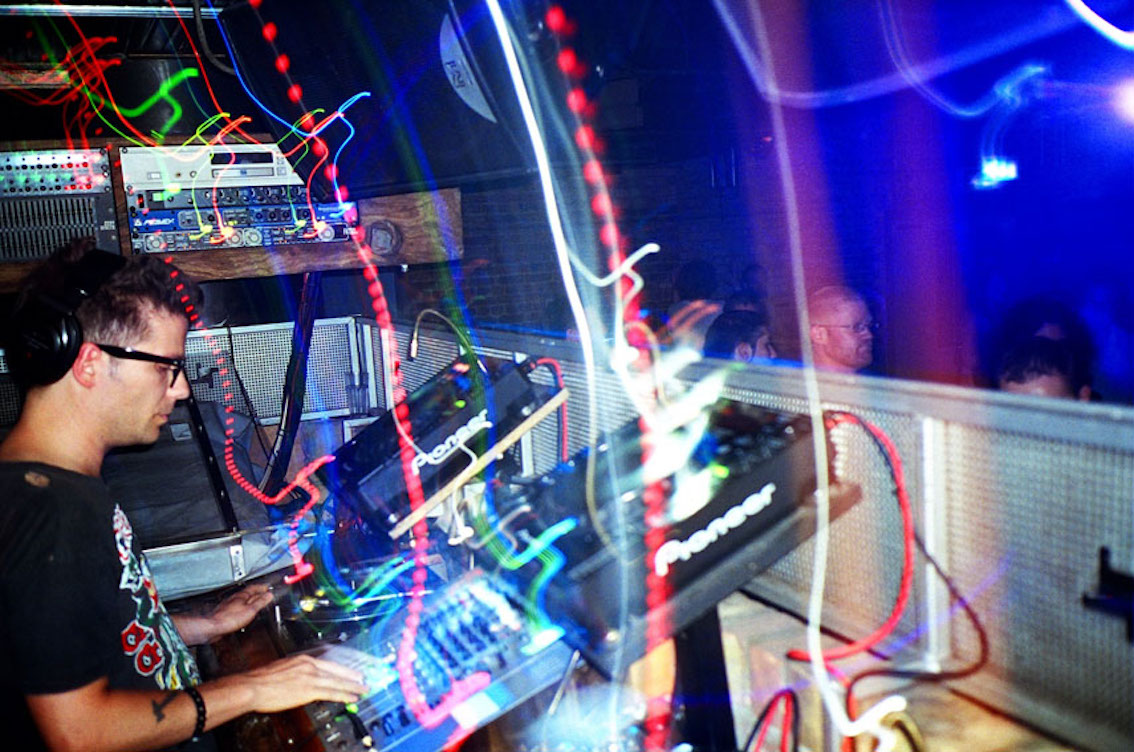
at Fabric, London, 2003