

Chris Ryan Williams: “I’m a relatively introverted person. Leaving my house to get on the bus or the train and just “being” there is a shared experience that I don’t take for granted.”
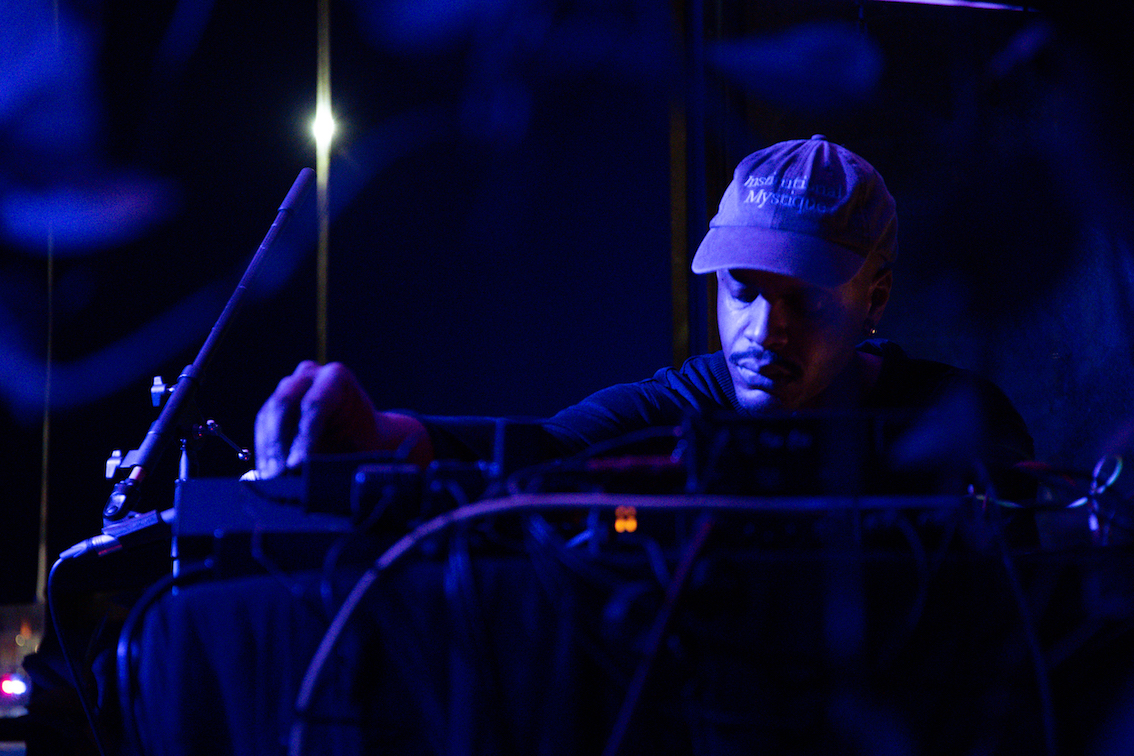
Chris Ryan Williams (Photo: Jojo Smith)
The screen flickers, and for a fleeting moment, the transatlantic distance between Cologne and New York dissolves. Chris Ryan Williams is sitting in New York home, he must leave for the airport right after our conversation; a flight to Los Angeles beckons. Despite the impending travel, he appears almost meditative, while behind him the invisible, jagged energy of Brooklyns Flatbush hood vibrates through the air. We are here to discuss his latest work, “Odu: Vibration II”; an album that functions like a geological layering of sound—deep, cavernous, and punctuated by sudden, sharp edges of light. It is the result of a process he describes as “unraveling,” an attempt to construct a reality that exists just beneath the surface of the visible world.
.
Chris Ryan Williams: Oh, that’s incredible. It has a real salon vibe, that’s really beautiful. Are you in Cologne?
I am. This is my living room, my workspace is tucked into a corner. This is our chill space with all the records and books —everything happens in this space.
Chris Ryan Williams: Fantastic. I really hope we can meet up when I’m in town for the show. I actually remembered that we’d been in touch before because I wrote to you about your space Kapute Szene.
It’s a small world. We just had Stefan Mathieu as a guest in Kapute Szene to share his special knowledge about sound, I think you also worked with him in his role as a mastering engineer in the past.
Chris Ryan Williams: Unbelievable. That was actually the first time I saw his face. We’ve only ever— (laughs) —it’s like, okay, so that’s what he looks like. He’s brilliant. He’s secretly making everyone’s music sound incredible, at least among all the people I’m following right now. He seems to be the go-to person for that level of sonic depth.
I met him through Terre Thaemlitz, an old friend who played in Monheim for the Monheim Triennale (which I co-curate) twice. They go back to the Mille Plateaux days. It’s funny because Stephan lives in Bonn now, which is a very quiet city. He seems to like the proximity to everything else. It’s all about the different layers of a place, right?
Chris Ryan Williams: Yeah, definitely different layers. That makes sense.
I’ve prepared a few directions for us to explore. I’ve been spending a lot of time with the new record, and I was struck by how you’ve described your process as one of “unraveling”—that every vibration has to unravel a new one. I’ve been wondering: does this process happen purely within the music, or are you describing a shift within yourself?
Chris Ryan Williams: I often don’t think the music necessarily has to be a reflection of the process. For me, the music is more like a byproduct of the process. I’m going through that unraveling myself right now. “Odu: Vibration II” is this first attempt at creating something like a universe that can hold many different ideas and things that I’m processing in my life. It’s a way to hold the various impressions I encounter living in New York and meeting these amazing musicians who are here.
I feel like I’m peeling back the things that have been imposed on me—imposed on my perception—so that I can get to a core, to a truer feeling. It’s both cosmic and very deeply built into my own internal state. With this album, it’s about going into a cave, looking beneath things, digging and pulling apart so that this process becomes something new on the other side, rather than moving from point A to point B with a fixed idea.
For example, I’m currently working on another iteration of this cave experiment, which will be a multimedia piece at Roulette in May. I’m actually going back into the caves in about a week and a half. I’m just trying to stay open. I think I’ll maybe play some of the recordings in the cave, do a projection, and see what happens—how I react to it—and maybe even take my horn into the caves. It’s really a process where I’m not necessarily thinking too directly about the result or what it’s going to be. This record was just a stop along the way that I was very happy with.
When you talk about “the caves,” I’m curious about the literal nature of it. I read that before this project, you had actually never been in a real cave. Is the “cave” still a metaphor, or have you found your physical caves by now?
Chris Ryan Williams: In the meantime, exactly. It’s funny because it’s often talked about and written about as a metaphor, and I guess in some sense it was, but it was always intended to be a literal cave. I just didn’t have enough time during the creation of this piece to go there before I finished it. It was just the way things landed. I had to present something, I was offered a performance, and that was where I was at in the process. It was essentially “pre-cave.”
I was trying to imagine myself there and project myself into it, rather than presenting something else. I really wanted to lean into this cave thing, and I had already been reading a lot about it. Much of it has to do with re-contextualizing or re-thinking a process of knowledge formation—what we consider in Western society to be a “fact” or something worth building a foundation on. A lot of that deals with Plato. I love Plato’s Allegory of the Cave, and I was reading that alongside things that were pushing back against it from Pan-African perspectives.
I thought, “Well, I should actually go to a cave.” (laughs) I know the allegory is an allegory, but I’m interested in the literal manifestation of a cave and what that will do to me. So yes, now I’m visiting caves. I went to one in Puerto Rico right after “Odu: Vibration II” came out. My wife is Puerto Rican, so I have a connection there. We’re going back in about a week and a half to a different cave.
That’s fascinating. As a child in Southern Germany, we had many caves nearby. My grandfather used to take me to caves and castles when I was very young. I was obsessed with them. For me, caves were never scary; they were positive, adventurous places where I was with someone I loved. They felt like these amazing subterranean worlds rather than dangerous ones.
Chris Ryan Williams: Yes, they’re incredible. They are awe-inspiring places. We don’t have many places that simulate that experience of going underground into that kind of darkness. Those are things I take from the allegory, even if Plato wasn’t necessarily talking about that specific kind of darkness—the way sound manifests differently down there, the noises you hear, and the way reflections bounce back. I think all those things are really interesting in terms of how we create our reality. When you go into a cave, you’re entering these different realities.
Are you making actual audio recordings there, or are you just soaking up the inspiration to see how it filters into your work later?
Chris Ryan Williams: I am doing field recordings. Since this record was made before I went, it doesn’t have field recordings in it, but I will be using them moving forward. I’ve taken some impulse responses and captured reverb, but I’ve also recorded the giant bugs—I’m actually terrified of all that stuff. Part of it is me conquering my fear—the fear of the dark—and facing it. (laughs)
Have you seen the Werner Herzog film about caves? “Cave of Forgotten Dreams?”
Chris Ryan Williams: No, someone just told me about that recently.
You should watch it, especially for his voice. He has this very calm, monotone German accent telling the history of the cave. It makes you feel like nothing can be dangerous because he sounds so in control.
Chris Ryan Williams: That’s amazing. I love his voice.
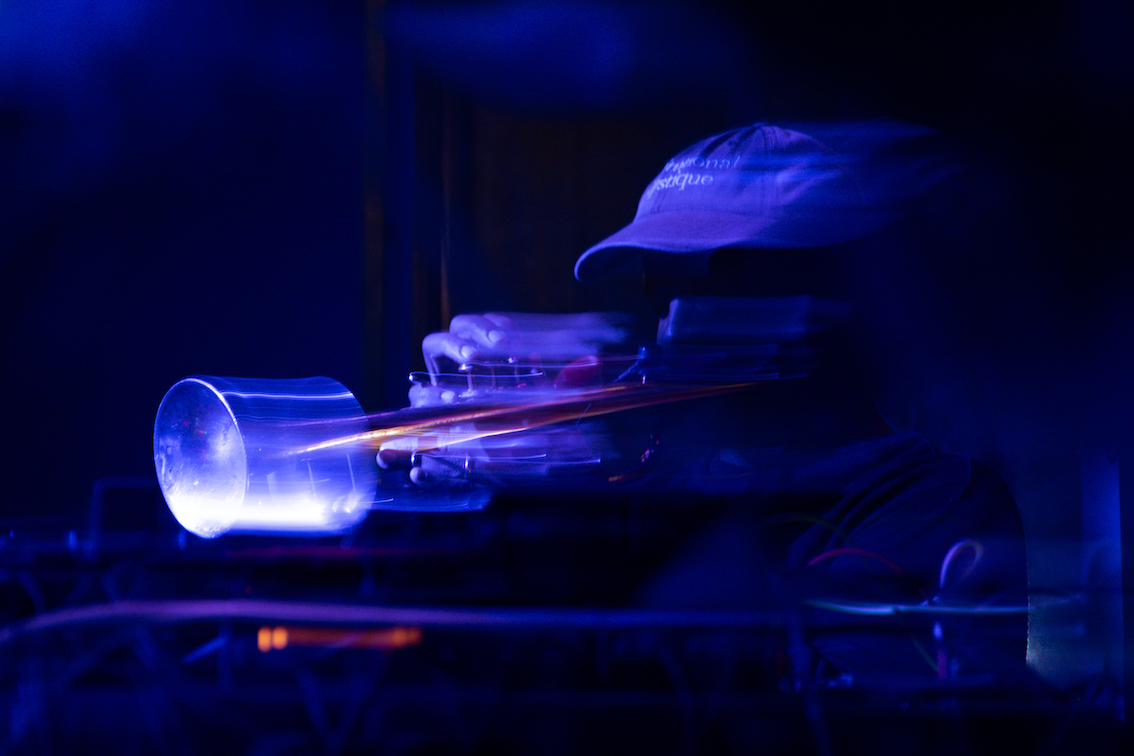
Chris Ryan Williams (Photo: Jojo Smith)
Let’s step back for a moment, as we’ve already gone quite deep into the earth. When you approach music in general, what are you searching for?
Chris Ryan Williams: I’m looking for modes of communication that aren’t based on a specific language. I hope that we can find ways for the musician to communicate with the audience, musician to musician, or even just sound communicating with sound. That’s what I’m always looking for. I grew up playing in bands and loved the relationships that manifest through sound. I feel very lucky that sound has carried me to different parts of the world and allowed me to be received by audiences.
I’m doing this solo tour right now, and the last six or seven months have been very focused on solo music. Previously, I was never that interested in playing solo. I liked listening to it—it’s an important part of the practice of improvised music—but personally, it didn’t draw me in because I love communication. I love being in bands, duos, and trios. I realized that—much like the cave thing—part of me was just afraid. I wasn’t sure what would be on the other side of “just me.” But over the last six months, I’ve become very excited about solo music and how the communication between me and the audience becomes more direct. In music, I’m just looking for connection.
So for the Stadtgarten show, you’ll be performing solo rather than with the ensemble from the record?
Chris Ryan Williams: Stadtgarten is solo. Solo is less expensive, you know? (laughs) It’s a lot, man. It’s hard to tour with a bunch of people.
You played at Stadtgarten about two years ago, right?
Chris Ryan Williams: I did. I played with local musicians. The bassist Florian Herzog has this project where he brings over New York musicians to meet with musicians in Cologne. I was there with my duo H x H, which includes Lester St. Louis, an amazing cellist and electronics musician. We’ve been working together for about four years. Actually, I’m getting on a plane to go work with him in about an hour, which is why I’m glad we could fit this in. But Florian was so kind to bring us over. We played with Fabian Arends, a wonderful drummer. We had a great time at Stadtgarten. We played in the outdoor area.
It’s a beautiful spot. I do shows there with my kaput partner Linus for our “Talking Kaput” series in the summer. I particularly like the Green Room for its chilled and communicative vibes.
Chris Ryan Williams: It changes the dialogue with the audience dramatically compared to a dark room. Part of the reason for the “darkness” approach—well, there are probably several reasons, but one is mystery. Opacity is important for people to take that extra step when they’re listening to music—so they place themselves in it and actually do some of the work, rather than just being passive recipients. I want people to lean in when they hear what I’m putting out. I hope those references are scattered enough that people reach for them and see where they sit in that constellation.
I mean, there are simple interpretations: here is the dark, there is the light, this is the Eurocentric version versus what we’ve left in the shadows. But if we skip the obvious: reading your influences while listening to the record felt like a perfect fit for the sonic experience. The record is mixed fantastically. If I closed the room and made it dark, I’d feel like I was truly trying to find out where I am while the sound is constantly shifting. It’s like navigating an uncertain environment.
Chris Ryan Williams: I’m really happy to hear that. It’s just another opportunity to get people to search and reach. I’m not interested in making music that is consumed passively. I’m curious, by the way—and this can be off the record—how you would categorize the genre of this album? A lot of people have been calling it an ambient record, which I find funny, but I can see why.
You mean how I would position the record? It’s an ambient record if you reduce it to the word—you’re creating an ambiance—but it’s not “ambient” in the popular sense, because it’s much more experimental and challenging. Most people associate ambient with feel-good sounds where everything is relaxed. This is ambient in the sense of environmental music.
Chris Ryan Williams: I like “environmental music.”
It’s very close to avant-garde theater pieces or film scores where the musician has the freedom to create space. When you spoke about things happening in your life only after they appeared in the line of sound, and you reworked the sound afterward—you can feel that. You’re restructuring the timeline after the fact.
Chris Ryan Williams: Absolutely. That’s one of the more important things. The timescale involved not having been in a cave yet, making the record, then going to the cave, and then mixing it. I performed the music live, went to the cave, and then mixed it. That really informed the final product because it was originally a live representation and now it exists as this studio album. I’m glad that comes across.
How was that process of transition? I read that you didn’t really work digitally before the pandemic. Did you expect those skills to lead you so far away from the “I am a trumpet player” path and toward creating soundscapes on a completely different level? Or did you just think, “It’s COVID, no one is available for recording, I’ll just record my trumpet and do some post-production”?
Chris Ryan Williams: It was more of the latter. Then, as I started to dive deeper into what was possible, it overlapped with my interest in electronic music. I was already a huge fan of the LA beat scene—Flying Lotus and Brainfeeder. When I moved to the East Coast right at the beginning of the pandemic, I started learning Max/MSP and Ableton. I was listening to George Lewis’s Voyager and looking at Sam Pluta—I was getting interested in a very different, East Coast-oriented set of approaches to electronics. Then I started a group called Hester; we both love Autechre. Seeing how far they pushed things was exciting, but I didn’t know how it would interact with my trumpet playing.
I’ve always been interested in vastness and long-form playing, which is funny because the trumpet doesn’t naturally lend itself to that. But as I got deeper into electronics, I realized there was a different vantage point for creating soundscapes or longer, wider gestures. Electronic music lends itself to that more naturally. At some point, I wanted to bring that back together. My H x H project is sometimes purely computer music with no trumpet, and I love that. But my solo music now, post-Odu Vibration 2, is very focused on the trumpet. It’s trumpet-centric, even with the pedals and synths. It’s exciting to be back on the instrument that feels like home, even if it’s augmented or doesn’t sound like a trumpet at all. I’m still doing the same thing I’ve been doing since I was thirteen. This electronic journey had to go way out there just to come back to the instrument.
It’s a good moment to return to it, because many electronic artists are now integrating live instruments into their shows. It’s become quite popular to include “real” instruments that aren’t part of the standard electronic repertoire.
Chris Ryan Williams: I love seeing that. It makes sense that we’d want to go back to earlier technologies that are closer to the body.
How did you experience the mixing process for the recordings from Roulette? You have something that came out of a live improvised flow, and then you have the world of editing and changing, which is the opposite of improvisation—you can get lost in it forever. Was it a flow, or did you find yourself lost in that process?
Chris Ryan Williams: I definitely had moments where I was “lost in the sauce.” While I was editing or experimenting with the mixing—taking the multitracks from Roulette and shaping them—I eventually worked with Kevin Ramsay, a fantastic mixing engineer who was actually at the show. That made a huge difference because he understood what the music felt like in the room at the time. I had to set a deadline for myself. AKB Recordings told me, “If you want this to come out by this date, we need it by then.” That was good for me because I could have tinkered with small things forever.
I don’t know what the next process will look like. After this solo tour in April, I go back to Roulette in May. I’m interested in the process of documenting and turning it around quickly. I haven’t done a traditional studio recording yet, and I wonder what that will be like. Right now, I’m excited about capturing the fire and then re-presenting it—maybe not even trying to represent the “fire” anymore, but something else, knowing that the fire is already in every cell of it. It’s okay to pull it apart and present something different.
But you also—to stay with the metaphor—added some air and water later that wasn’t originally in the room. You added other sounds and layers afterward, right?
Chris Ryan Williams: Absolutely. I found ways to make it wider, denser, and deeper. Live, we had a “two-stereo” situation—it wasn’t a true quad setup—and that was the experience. Going back to what you said about listening on headphones, I wanted to provide that, and that wasn’t in the original multitracks. I brought in synthesizers and field recordings.
Little side note: the field recording at the beginning of “Waning” is from Joseph Kamaru, the Kenyan musician known as KMRU. He released the H x H album last year. He had done a collaboration with Ableton years ago, presenting field recordings from Kenya. I had downloaded them and forgotten about them. Then I found a file and thought, “This transports me,” and so it found its way onto the record. Months later, Joseph messaged me saying, “I love the record, it’s so cool how you used that.” It was a funny coincidence, but I’m glad the music traveled and brought things from the continent that I didn’t necessarily know were there.
I just had lunch with Stefan Schneider, who was talking about playing a concert with him. Again: Small world.
You just mentioned Autechre, which makes sense when talking about caves and darkness, because they play in total darkness now. I saw them at Primavera Sound. You’re outside in the madness all day, and then you go into a room, the lights go out, and you’re in the dark for ninety minutes. When I read your quote that “the deeper you go, the more the demons are your own,” it reminded me of that. What “demons” are you referring to? In that darkness, you start thinking about who is sitting next to you or what those noises are.
Chris Ryan Williams: I think that goes back to entering other realities. We are such visual creatures; our culture is built on visual references. Instead of literal demons, I’m thinking about the thoughts that come up that wouldn’t come up if you were processing things visually—sensations that only come when you’re dependent on touch, sound, and smell. I’m interested in providing a space where you lean into that and tap into what is deeper within you. As you go deeper, you realize it’s the same thing that is deep within the person sitting next to you. The ways in which we are different are mostly on the surface. Sound can strip away those superficial visual things we’re obsessed with and get to the things that are actually similar.
It’s interesting because, on one hand, you give with „Odu: Vibration II“ the listener a lot of “packaging”:
– the humid mystique of Apichatpong Weerasethakul’s cinema
– the traditions of three-horn music
– the vibrational poetics of cave spaces
– The Allegory of the Cave
– Marimba Ani’s writings
Good music opens doors to books, films, and art. But on the other hand, you’ve talked about wanting people to have a physical reaction—an “ecstatic transcendence.” You hope the music allows them to open up to something within themselves that, even if it’s a scary thought at first, turns into something positive.
Chris Ryan Williams: I hope that all those references lead back to the body. What I love about Apichatpong Weerasethakul’s films is that I can fall asleep in them—literally. I think the first time I saw Uncle Boonmee, I fell asleep, woke up during the fish scene, and thought, “What the hell is happening right now?” (laughs) But it’s a bodily experience. In his most recent film, Memoria, they are searching for a very specific sound.
I want my references to be processed in a way that people go into their bodies. Music comes from within you; it makes you vibrate. I want my music to hit the person who has never read Plato or seen an Apichatpong film. I want it to make them feel something. I’m not going to force people to turn off all the lights, but that’s how I want my sound to be processed.
This idea of falling asleep and waking up is part of it. Even if we plan art precisely, the listener doesn’t have to experience the whole timeline. It’s like Deleuze wrote: you can open a book on page 78, stop at 80, and take something away that moves you. Years ago, a friend of mine, DJ Lena Willikens, was only playing short parts of tracks. I asked her, “Don’t you listen to the tracks all the way through before you play them?” She was offended! As a music critic, I was lecturing her, but years later I realized I was being too strict. It’s about what you take from the experience—it could just be the beauty of a single sound.
Chris Ryan Williams: Arthur Jafa has an exhibition at MoMA right now where he curated works from the collection. He placed them in a salon style. Hanging a Basquiat next to a Cy Twombly—I don’t need the “whole thing”; I feel it. There are a hundred layers to a thing, and maybe you jump to layer 95 and that’s the one that speaks to you. To go back to caves: those are complex systems connected underground. I’m not a spelunker; I’m never going underwater in a cave. But I can collect the energy of what made it to this part of the cave. I don’t view that as a loss.
I liked how you placed important art references alongside the influence of the shape of the light, the air, or the sound of the street. It’s all a mix.
Chris Ryan Williams: Absolutely. My collaborator Lester and I talk about how some of our favorite sounds are just the hum of electrical lines in a small town in South Carolina, where we both happened to live at different times. We know what that feels like. That’s my favorite sound, but so are Miles Davis’s ballads. They hold the same weight in my head. They both have depth, life, and history.
Speaking of the hierarchy of sounds: you’ve worked with a great list of artists. But how important are the non-artists around you—the person you have coffee with every day? Is that a big part of your experience?
Chris Ryan Williams: My music changed so much when I moved to New York because I could interact with people on the street. In the US, there’s such a car culture, and I’m a relatively introverted person. Leaving my house to get on the bus or the train and just “being” there is a shared experience that I don’t take for granted.
My neighborhood is very Caribbean—Haitian and Jamaican. I live right off Flatbush Avenue, which is a major artery. I hear religious music blasting from the speakers of passing cars. I live across from a grocery store where I see the regulars. That communal approach to living is something very special in New York. I haven’t even fully processed how much it’s affected me, but it’s night and day from when I moved here six years ago.
Especially compared to a car-centric city like LA, where you can easily forget the rest of the world exists outside your own bubble.
Chris Ryan Williams: Absolutely. I’m flying to LA directly after this conversation. It’ll be interesting to go back and experience that. LA is a great place to visit, but I love New York for that exact reason.
Was it in New York that you connected with Piotr Orlov and “Dada Strain”?
Chris Ryan Williams: Absolutely. I met Piotr during my first year through Jaimie Branch, another amazing trumpet player. She was so kind and welcoming; she told me, “You have to meet these people.” She invited me to a gig she was doing with Angel Bat Dawid, where she wanted a trumpet choir. Piotr was at that show. He’s one of the best people in the city—a great organizer with a vision for the rhythm, improvisation, and community happening in New York right now. DJs, electronic musicians, and jazz musicians all overlap, and Piotr is right at the center of it.
Is it more about the connection, or does he also stimulate you artistically in terms of sound production?
Chris Ryan Williams: I’d say more on the level of connection. We talk about what’s happening in the community. I was talking to him while I was preparing the release of the H x H album, this album, and the History Dog album. They all came out in the same year. He uniquely understood where each one sat in the New York ecosystem. His role feels almost like an archivist, but he’s so in it that he’s not positioning himself “outside.” He’s right there with us, putting on shows and talking to the musicians.
Would you say you’re a workaholic, given you released three records in a year? (laughs) Or are there even any musicians these days who aren’t workaholics?
Chris Ryan Williams: That’s the better question! (laughs) My wife would say yes.
Is she a workaholic too, or is she better at taking breaks?
Chris Ryan Williams: She’s a video artist and she can manage a life a little better than I can. (laughs) But I feel lucky. This is work, but it’s also my passion. For a long time, I wasn’t putting out my own music; I was just participating in other projects. This last year felt special because I finally put my own stamp on things. I have a duo album coming up in September with Ka Baird—an amazing flutist and vocalist. You should check her out. K-A B-A-I-R-D. You’d love her music. I love working on music. “Workaholic” is probably the right word.
But your senses must get tired. Your ears can’t work on sound forever. Did you have to learn that? Enthusiasm can make you blind to the fact that your ears need a break.
Chris Ryan Williams: To be honest, since “Odu” came out, I’ve been pretty exhausted. I haven’t really been able to listen to music in a focused way, even for pleasure. I think I’m still in that phase. It’s a strange place to be, because I still have to pay my bills. (laughs)
I think you’re not alone. This winter has been tough for many people; it’s time for spring. You used a nice metaphor earlier, describing your music as a sculpture. Do you have a visual experience while you’re working? Stefan and I also talked about this aspect of “sculpting.”
Chris Ryan Williams: I think of the object as being defined by the gestures that make it up, rather than a specific, literal shape. For instance, at the beginning of “Visage” with Kalia, there’s a little “click” that happened. Kevin, the mixing engineer, wanted to take it out. I said, “No, the click is the point where it begins.” We had just gone through nine minutes of expansive sound, and we needed something sharp to define the space. It’s not a “chill” ambient record; you need those sharp edges. I think of the gestures at the beginning and the end—the way the music turns a corner—as the things that make up the object. That’s where the sculpting comes in: “This is a sharp edge, this is a rounded approach, this part is smooth.”
I have one last question. I read that you work as a lecturer. What are the three pieces of advice you give your students?
Chris Ryan Williams: I guess I need to update my bio! (laughs) I haven’t been a lecturer for a long time. I taught at universities when I lived in LA, and I’ve given private lessons in New York. I love the “music as mentorship” approach, but I don’t know if I’ve figured it all out yet myself, so I don’t have a perfect answer for you.
No worries, we’ve covered enough. Thank you for your time. You have a flight to catch.
Chris Ryan Williams: I definitely have to go now. Thank you so much, Thomas. It was really great talking to you. See you soon. Take care.