

Sleaford Mods: “It’s very rare that I’m on a positive streak”
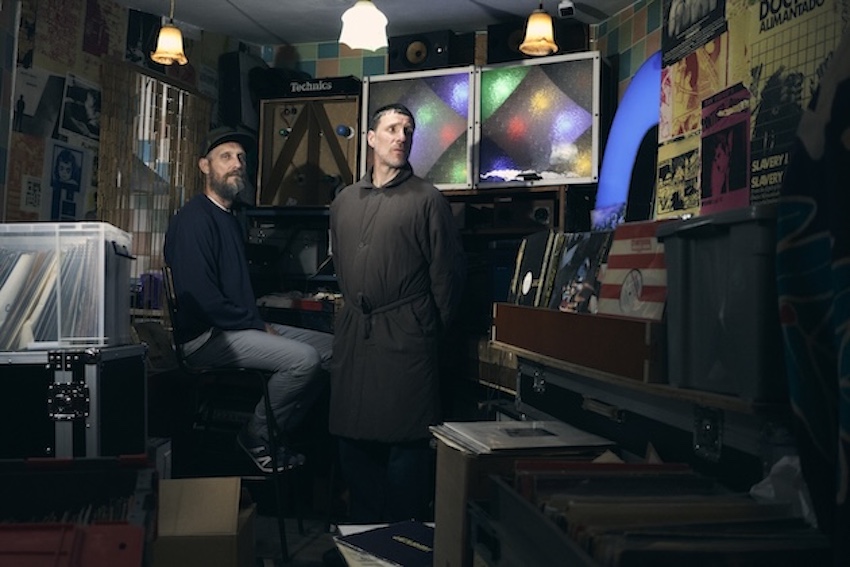
Since their emergence, Sleaford Mods have channelled frustration, wit, and social critique into a sound that feels brutal and funny at the same time. On their new album “The Demise of Planet X”, Jason Williamson reflects once again on political exhaustion, masculinity, consumerism, and ageing without softening the edges. He talks to Christina Mohr candidly about collaboration, anger, hope, and why staying human matters more than ever.
Jason, why is your album called “The Demise of Planet X” and not “The Demise of Planet Earth”?
Jason Williamson: Because I feel like it’s the idea of the demise of an already dead planet. It feels as if we are constantly in a rotation of crisis, bad news, death, war, disease, viruses—whatever. We’ve become more separated from each other, obviously. I mean, these aren’t new arguments or perceptions, but it feels as if the planet has already combusted, so to speak, and we’ve got this new horizon that is just the same as the old one. Yeah, I think so.
We both were teenagers in the 80s and we grew up with acid rain, the Cold War, and “Two Tribes” going to war. Do you think it’s getting worse still?
Jason Williamson: Yes, it’s certainly getting worse. But at the same time, what hasn’t changed is the fact that we do not have to get worse with it. There must be some kind of mechanism within ourselves that protects us from what is largely a negative landscape. In short, it goes back to that old English saying: keep calm and carry on, which I don’t think has ever been truer, you know what I mean?
Yeah, but you’re not keeping calm, are you?
Jason Williamson: No, not really. But at the same time, I am. Music is a vehicle for me to become what I feel like internally, which I couldn’t normally do in normal society. Creativity is an outlet for that. Our expression is very good for communicating messages that aren’t, for the most part, accessible, that aren’t really for the mass market. So yes, I kind of use the music for that, you know what I mean?
I try to understand… in “Bad Santa”, you’re bringing up toxic masculinity, isn’t it?
Jason Williamson: It’s so hard to find positive role models for men. Yes. Currently, if people are feeling vulnerable, ignored, alienated, nationalism is always seductive—it gives a sense of belonging. But at the same time, you’ve got an intellectual take on it with people like Jordan Peterson, and to a certain degree Joe Rogan.
You could almost argue that people like Andrew Tate present themselves in an intellectual, studied manner. And so this appeals to young lads. Definitely. Because there is nothing more seductive than knowledge, than integral knowledge, than extensive, deep knowledge. So if you present yourself as intelligent, academic, then it’s even more appealing if you’re spinning these “alpha male cheats of propaganda,” you know, these lies, essentially. And they are everywhere. Tate has this perfect physique. He’s got this fearless attitude. He’s usually surrounded by luxury things, women, lots of young women. These things are seductive for a lot of people. It’s just the way it is.
And you know, these aren’t necessarily lies. But because they are truths—if you know the culture of misogyny or the patriarchal iron fist is a reality—it’s a truth. But it’s the wrong truth. It’s dark. It’s miserable. It doesn’t give any answers. In fact, the only answers it does give are extremely negative, answers that will usually keep men in the corner, on their own, very alone.
How did you get together with Aldous Harding?
Jason Williamson: I’ve been a fan of Hannah’s for years. We met in Tasmania at a festival, a long time ago, when we did our first Australian tour. We played a festival there. Aldous was on the bill as well. I was just completely taken by her music. It occurred to me straight away that she was a very special performer and person, you know what I mean? So, yes, we kept in contact. I did a collaboration with her on her last album, Warm Chris, on a track called “Leathery Whip.” I’ve always wanted to repay the compliment and get her on a song of ours. But it was never quite right until we started writing “Elitist’s Goat.” It was a chorus I couldn’t sing myself, and as soon as we put it down in the studio, it occurred to me that Aldous Harding would sound brilliant on it. Luckily, she was in Bristol around April, and that’s when we got together.
Are you looking for female singers especially?
Jason Williamson: Yeah, I mean, it’s not necessarily just female singers, but female singers largely have a kind of vocal tone that sits right with the ideas that we’ve got. Do you know what I mean?
Can you explain a little more?
Jason Williamson: Well, there just seems to be more of an interesting range, I find, with a lot of female performers. I’m also a big fan of the classic hip-hop pairing of a rapper and then a singer, usually female. The two really complement each other. So, you know, it’s that as well, I think.
What’s the story behind the last track on the album, “Unwrap”?
Jason Williamson: The song was placed at the end because all these songs discuss global politics, domestic politics, and the ways we argue with each other—culture wars, etc. “Unwrap” is really the only thing that we, as members of a Western society, contribute to: consumerism, the wheel of capitalism—basically buying things. “Unwrap” to me says: here I am talking about all these profound things, but at the end of the day, all I can really do is buy something online, wait for it to arrive, and discuss it with friends. This is the only real activism we’re successful at.
Have you ever thought that Sleaford Mods would come as far as you are now?
Jason Williamson: No, I’m not the greatest person to comment positively on myself or the band in general. I’m always thinking it’s going to fuck up, it’s going to be shit, or people are going to lose interest. It’s very rare that I’m on a positive streak. But saying that, we seem to maintain a large audience that feels like it’s growing. Yeah, it definitely is.
How do you deal with expectations of fans or listeners? Do people sometimes ask why you don’t make a track about a specific problem?
Jason Williamson: Yeah, which is just stupid, isn’t it? I don’t cater to anyone apart from myself when it comes to lyrics. Sometimes it’s a bit disappointing if people think I was better when I was younger. That criticism always gets to you. But apart from that, there’s no real pressure. It’s just like: this is what we do. If you don’t like it, fuck off.
I’ve seen your tour poster for Berlin. It says “no war, no death.”
That’s a strong line, but there will always be death.
Jason Williamson: Well, I think it’s more about being humanists. Nobody likes seeing others in pain—it’s just senseless. I don’t see how choosing a side really helps anyone. It just creates debate narratives. People argue constantly because deep down they know they’re powerless. We’re just morbid spectators.
You have to choose one side.
Jason Williamson: No. There are arguments, sure. Criticism should be levied at governments, at people going to war. Of course. But then where does it end? It doesn’t go anywhere because nobody listens, especially the masses. We’re lab rats for the people who run countries. We’re allowed a little breathing space, an hour a day to distract ourselves from oppression, rules, ideologies—but that’s largely it.
Would you call yourself a poet?
Jason Williamson: No.
Why not?
Jason Williamson: Because so many fucking wankers call themselves poets. Absolutely not. It’s a terrible word. I like writing words and would like to think mine are better than most—but I wouldn’t call myself a poet.
Do you worry about AI?
Jason Williamson: No. If AI takes over, people are welcome to it. If they want to be seduced by a faceless, soulless entity that churns out information, they’re welcome.
It’s said you once went to a club in your hometown and were shocked.
Jason Williamson: Yeah. It was a local nightclub in Grantham. I moved back at 35, destitute, struggling with alcohol and drugs. I frequented this club with people I went to school with, all doing the same thing. It was depressing and intoxicating—the hopelessness and darkness inspired me lyrically. By then, I’d made four albums and was developing what Sleaford Mods would become. I was constantly refining the sound.
On your new album, some tracks remind me of The Specials.
Jason Williamson: Yes, thank you. It’s quite uplifting. There’s a lot of uplifting sonics. Andrew was responsible because I’d send him crude acoustic ideas on voice notes and ask him to actualise them into bigger sounds. He brought in organ-heavy, ska-inspired elements, which I found interesting. I leaned into it, listening to „More Specials“, „Selecter“, and „The Beat“.
You’re always recognisable, even if you use “old” sounds.
Jason Williamson: What do you mean by “old”?
The Specials sound—I’m sorry, “old” sounds too negative.
Jason Williamson: No, man, I’m fully into that. I think it’s okay to use older music—you can always pull something new from it without being retro. A lot of new music doesn’t appeal. I listen to older stuff and like to think we’ve done something new with it.
Let’s switch to “The Good Life.” I thought it was about people being locked in a hospital, but it’s about arguing with other bands. Can you explain?
Jason Williamson: Yeah, I spend a lot of time slagging off bands. I don’t name them anymore—it’s almost cheesier to name them. It’s more insulting to use vague images. This stems from therapy and childhood experiences of not being seen. So the song starts with criticising bands, then Gwendoline Christie acts as an inner voice, reflecting what I feel internally. And the chorus says: it’s okay to be happy. It’s a complex track with multiple layers.
Is it stressful to do social media?
Jason Williamson: A little. Sometimes it’s unhealthy. But you have to do it as musicians, creatives, or actors. It’s part of what we do to keep afloat.
And how do you create hope to keep going?
Jason Williamson: By thinking for myself, making my own conclusions, realising when I’m wrong, being honest. Strength, inner strength, love, family, life. Life is beautiful. Not for everyone, I know, but for me it is. Acknowledging that helps me move along, not worry about war, destitution, or death. It’s classic wisdom that young people scoff at—but as you age, these things are the only things that really matter.