

“Eu Sou o Rio” / „A futuristic self-portrait of the city and a song that tells more about Rio than any tourist brochure“
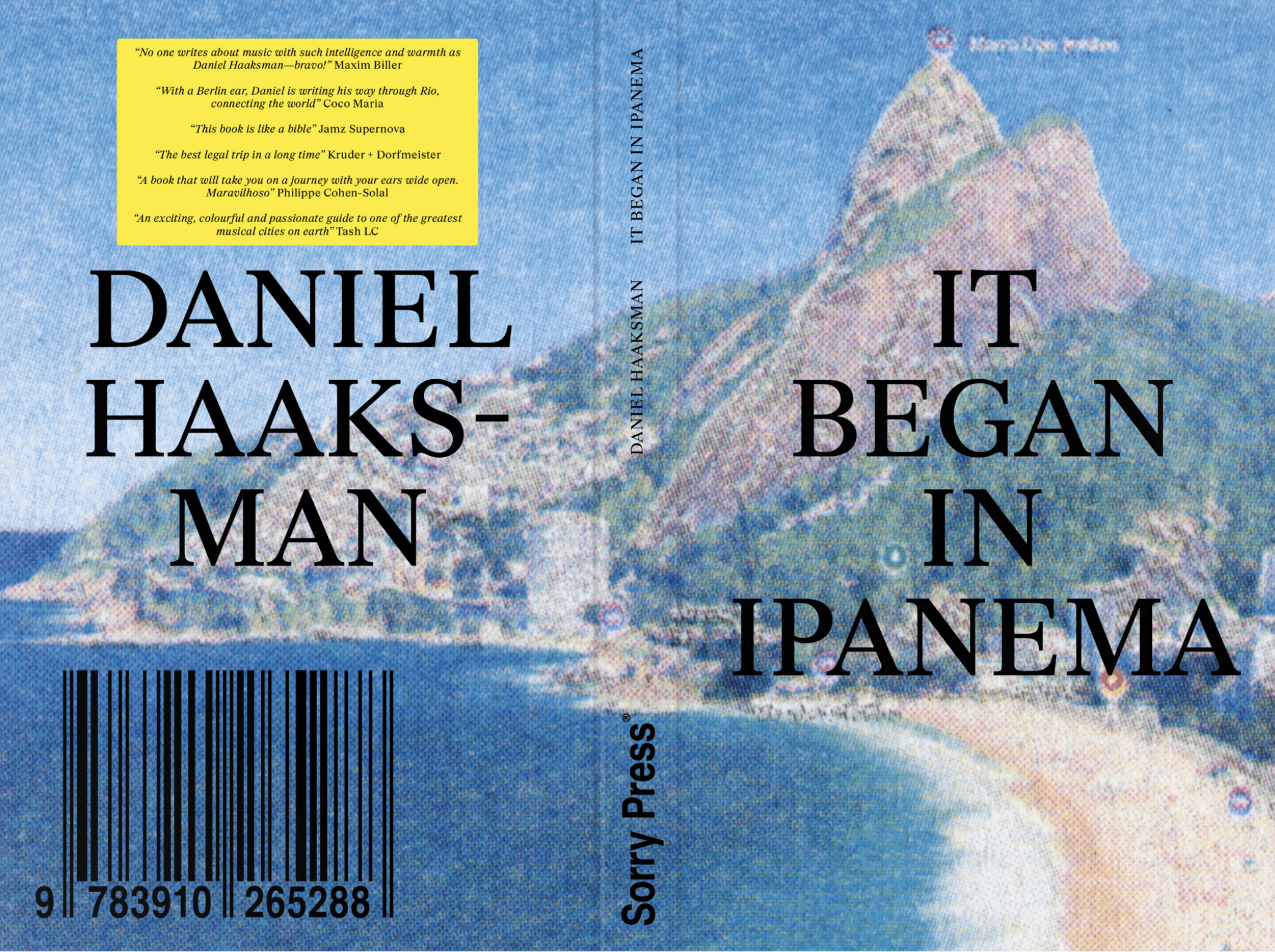
„IT BEGAN IN IPANEMA – A musical travel-guide of Rio de Janeiro“ by Daniel Haaksman (Sorry Press®)
Mit dem Titel seines Buchs „It Began in Ipanema“ legt der Berliner DJ, Produzent, Autor und most of all deep music lover Daniel Haaksman eine bewusst falsche Fährte. Denn die Musikgeschichte von Rio de Janeiro on beyond, die er zu erzählen weiß, beginnt natürlich nicht ausgestellt am Strand, sondern in den Hügeln, Hinterhöfen und improvisierten Studios der Stadt. Haaksman nimmt uns in seinem Vorwort zum Buch mit zurück in das Jahr 2004 und somit zum Beginn dessen, was nun bereits eine mehr als 20jährige persönliche Spurensuche und Annäherung an Brasilien und seine Menschen und Musik ist. Er lässt uns teilhaben an dem geradezu ekstatischen Paradigmenwechsel, den Baile Funk für ihn im Abgleich mit seinem damals zur Routine gewordenen Alltag im europäischen DJ-Zirkus bedeutete.
Mit seinem Buch kartiert Haaksman Rio anhand von fünfzig Songs und erzählt von den Spannungen zwischen mystischen Projektionen aus der Distanz und der erlebten Wirklichkeit vor Ort, der Diskrepanz von popkulturellen Kanon und den Entdeckungen in der Peripherie und im Schatten dahinter.
Wir freuen uns sehr, das 15. Kapitel an dieser Stelle mit Euch teilen zu dürfen.
from: „IT BEGAN IN IPANEMA – A musical travel-guide of Rio de Janeiro“ by Daniel Haaksman (Sorry Press®)
15
The other face of the city / Black Future “Eu Sou o Rio” (1988)
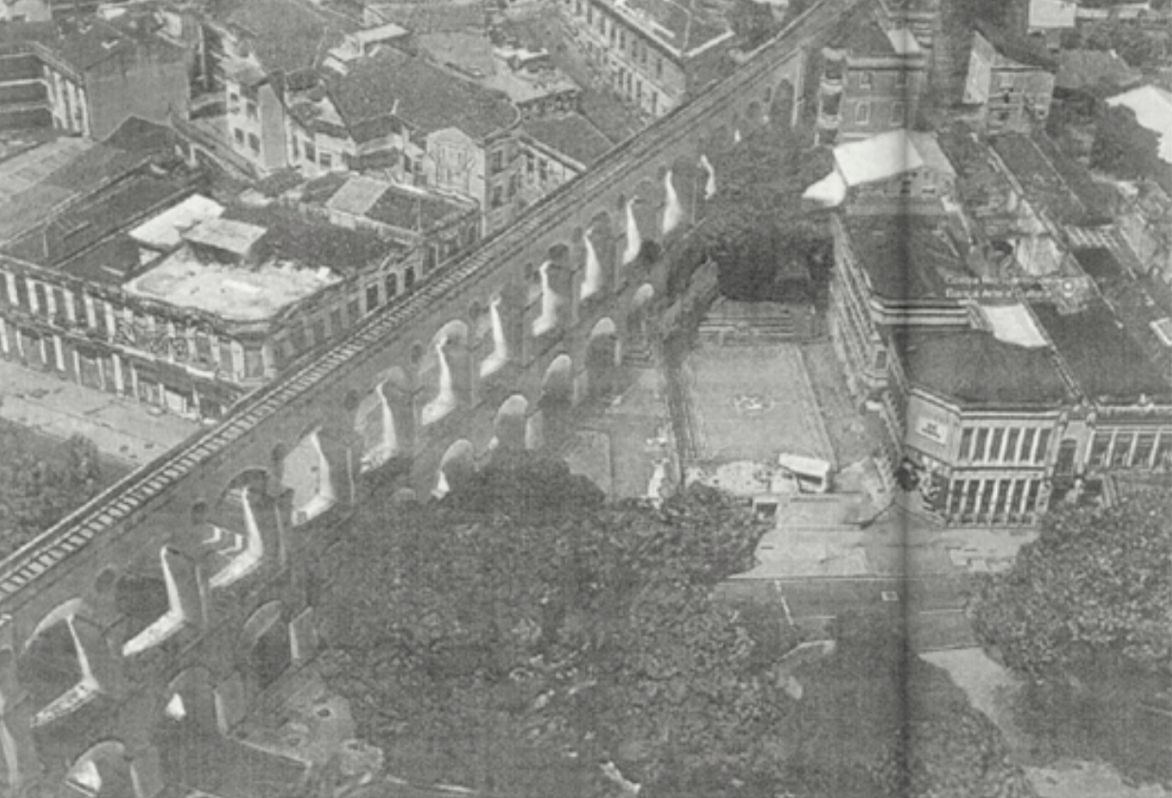
Every city has places that become legendary precisely because they were considered run-down in their heyday. Lapa, in the center of Rio, was one such place in the 1980s. A mythical district in the heart of the metropolis that the official city had long overlooked. While the world continued to stare at Copacabana and Ipanema, a different pulse beat in Lapa. The Arcos da Lapa, the colonial aqueduct from the 18th century, over which the yellow tram, the “Bonde” (pronounced “bondgee”) still rattles today, stood like abandoned dinosaur bones in the center of the neighbourhood at that time. Beneath it, the night and its actors gathered. There were traders, gamblers, prostitutes, street children, artists, outsiders. Under theopen sky or on the street, people danced, stole, drank, loved, sometimes all at once. In the midst of this urban heat, musical worlds that were still strictly separated elsewhere began to intersect. The bars in Lapa, often no more than living rooms with a refrigerator and amplifier, invited improvisation. Here, samba was free of tradition and resembled a dialogue with the moment. Sometimes it met jazz, then reggae, funk, and in the mid-1980s, post-punk, which was slowly finding its way from São Paulo to Rio. European electronic music also dripped slowly into these sound ecosystems, via pirated cassettes or bootleg compilations with music. Lapa absorbed everything and spat it out again in a new form. Musical boundary-crossers such as Fausto Fawcett and Black Future found fertile ground for their experiments in this chaotic climate. It was a time when Rio began to reinvent itself musically on the streets.
At the same time, Lapa was a dangerous place. Anyone who moved between the Arcos at night knew that there was no guarantee of safety. Police violence, crime, and poverty shaped everyday life. But it was precisely this state of affairs that created a special relevance. The art that emerged here was an expression and a survival strategy. Amidst this archaic urban theatre, Lapa was a place of possibilities, beyond picturesque backdrops and the pressure to impress. It was a place where music was unleashed. Anyone who really wanted to understand Rio in the 1980s could skip the beach promenades of the south zone and find the ambiguities of Rio in an intense dialogue in the center of Lapa.
If you try to understand Rio de Janeiro during this period, a song like “Eu Sou o Rio” by Black Future helps. The band, which formed in the 1980s, almost at the end of the Brazilian military dictatorship, was never part of the official heritage of Música Popular Brasileira, or simply MPB*. It was too loud, too angry.
Even its band name, in English, is a blatant rejection in a city where almost no one speaks English to this day. Today, Black Future could be interpreted as an Afrofuturistic band name avant la lettre, but with their name, the band rather imagined that the future would not look particularly rosy. With “Eu Sou o Rio” (“I am Rio”), Black Future created one of the most beautiful, truest songs about Rio, but hardly anyone knows it. The song begins with a rattling beat, a kind of futuristic samba that immediately rejects itself. The kick drum chips in and sounds much too thin for Rio standards. Then a weird guitar riff and the voice of Marcio Bandeira come in. Haunting, defiant, a mixture of spoken word and warning cry, confrontational:
“Não me veja no postal / não me filme no carnaval / eu sou o verdadeiro Rio…”
(“Don’t see me on the postcard / don’t just film me at Carnival / I am the real Rio…”).
What emerges here is not a narrative of exoticism or melancholy. Black Future engages in a kind of acoustic urbanism, condensing the urban space into sound. The song functions like audio graffiti on the smooth surface of the tourism industry. It scratches the image and lets life shine through, reminding us that Rio is a divided city, socially and geographically, but also emotionally, marked by blatant social injustice. Musically,
“Eu Sou o Rio” is a bastardisation of synthpunk, Afrobeat, funk, and new wave. A kind of Brazilian DAF meets Gilberto Gil in a state of emergency, musical DIY resistance, born in the shadow of repression. The lyrics of “Eu Sou o Rio” are a tour of the city’s dark side, a catalogue of places and characters that don’t
appear in any glossy brochures. The legendary Galeria Alaska appears, Rio’s gay and lesbian stage of the 1970s, where drag queens and night owls provoked the establishment. Next door, the bizarre heroes of subculture march by: Zé do Queijo, a kind of mafioso from the suburbs. The samba geniuses Zé Kéti
and Cartola (whose songs we’ll encounter later on these pages). And Joãosinho Trinta, who wanted to have Jesus Christ parade through Carnival as a beggar. Even Madame Satã, the Black drag legend of the 1930s, half gangster, half artist, flashes between the lines, as if Rio were recruiting its saints from the gutter. The bad kids of Black Future also ironically comment on the Brizolão, the boarding schools for the poor invented by Governor Leonel Brizola in the 1980s, which sound more like
social punishment camps than educational advancement. The way Black Future pronounces the word is already an accusation, a grid of syllables in which the students seem imprisoned.
Meanwhile, they claim that “the future is black,” as if it were a threat, a promise, and a smug punchline all at once. It cannot be ruled out that for Black Future, the present was already black, and the musicians seemed to revel in it. It is no coincidence that this visionary band never achieved great success, but that is no flaw. Black Future was too far ahead of its time and too deeply rooted in its own scarred reality. Today, “Eu Sou o Rio” sounds like an echo from the future that was produced in the past. A futuristic self-portrait of the city and a song that tells more about Rio than any tourist brochure because it does not try to sell itself. With “Eu Sou o Rio,” Black Future created an acoustic monument to the twilight world of Rio de Janeiro that has lost none of its validity to this day.
* MPB*
stands for Música Popular Brasileira. The term refers to a broad category of Brazilian popular music that emerged in the 1960s, blending traditional styles such as samba and bossa nova with influences from folk, jazz, and rock. MPB is closely associated with strong songwriting, poetic lyrics, and social or political commentary. Rather than a single sound, MPB functions as a cultural label for artist-driven Brazilian music rooted in national identity.
Daniel Haaksman
„IT BEGAN IN IPANEMA – A musical travel-guide of Rio de Janeiro“
ISBN 978-3-910265-28-8
Sorry Press®
Theresienstr. 16
80333 Munich, Germany
info@sorry-press.com
© 2026 Sorry Press® and Daniel Haaksman. If any copyrights have not been
acknowledged please reach out to Sorry Press or the editor.