

Transatlantic Breathing Exercises: Colin Stetson & Brìghde Chaimbeul
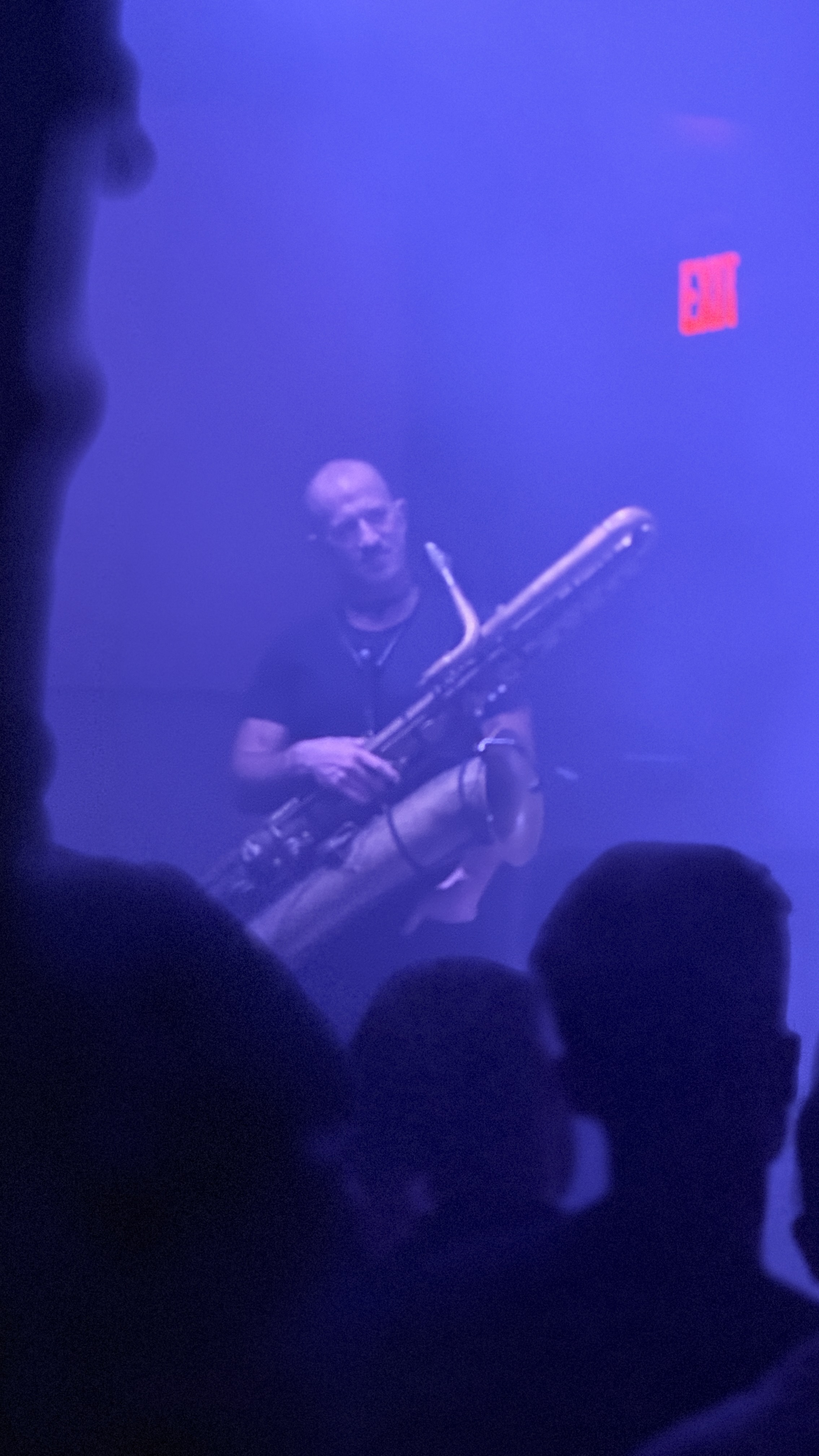
Colin Stetson (Photo: Thomas Venker)
Bagpiper Brìghde Chaimbeul and saxophonist Colin Stetson recently forged a Cologne-Monheim-New York connection at Pioneer Works in New York.
Is that really Laurie Anderson standing next to me on the balcony of the nonprofit cultural center Pioneer Works in New York, intently recording Colin Stetson and Brìghde Chaimbeul’s performance with her cell phone camera? The bizarrely glowing green and red display images—which suggest a very specific app and careate wonderfully alienated, experimental visuals—reinforce my belief that it’s her. That’s New York for you—or more precisely: that’s Brooklyn. Because we’re in Red Hook, Brooklyn, one of the five boroughs of this global metropolis that has most recently undergone gentrification. But enough with the star-struckness—after all, that’s frowned upon in New York, where it feels like you see a famous person rushing past you every five seconds and where definitely no one has any patience for unwanted attention.
It’s not hard to forget about Anderson anyway, because Stetson and Chaimbeul begin their performance—their fourth together and also the official release concert for their collaborative album *All the Light in the World*, released three days earlier on Envision Records—with surprising exuberance, almost euphoric energy. The only drawback: Unfortunately, the sound in the balcony isn’t great. The stage lighting, lost in a hazy gray, doesn’t help you a lost in the music either, especially with the ceiling seven meters high. So do what you should always do anyway: head to the front of the stage and get close to the musicians.
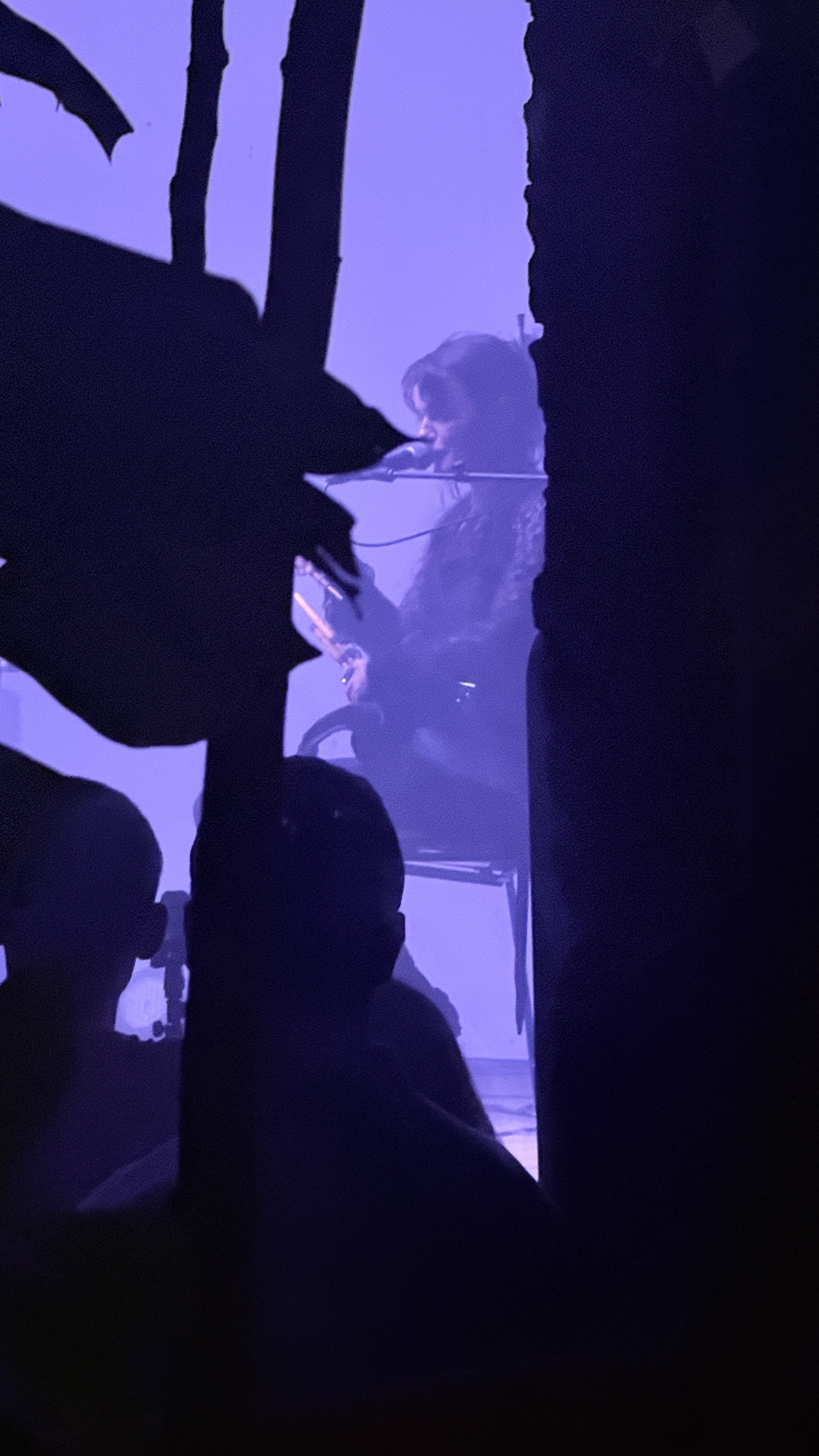
Brìghde Chaimbeul (Photo: Thomas Venker)
Yes, the music these two create demands intimacy: with the body, with the breath—in their case, quite literally, with the bagpipes and saxophone—and also with the visually and aesthetically captivating instruments, which you find yourself wanting to watch very closely as they fill with air and then expel it, filling the space with sound. Chaimbeul’s smallpipes lay down a continuous foundation that is at once soft yet almost maliciously rumbling, while Stetson’s bass saxophone hops, stumbles, takes up the thread, and shifts the pulse. Beneath and in between: clicks, groans, cracks, breath. The instruments do not merely sing together; they watch each other with fascination as they constantly shift in form and sound. Yet after an initial, inviting gesture, the set gradually becomes more static (in the sense of stretching out the moment), more microscopic, and more droning. The sounds seem to stand still, yet they are constantly changing at their surface and core. Despite all the folkloric connotations that arise situationally, Chaimbeul’s bagpipes should be understood as much more than a reference instrument. They are nothing less than a world-breathing apparatus capable of reorganizing time. Stetson works his way into this stream of time and sound, as if he were trying to uncover a second, (as yet) hidden rhythm from within his instrument.
Perhaps it is this physical dimension that eventually tips the evening into the cinematic—into that realm where sound evokes images without having to illustrate them. I think of and feel the tracking shots (and the accompanying sensations of vertigo) of Argento and Fassbinder, the tension between beauty and menace, between the lust for life and shame. Out of the eternal darkness, a knocking from below sharpens my senses once more, followed by the sweetness of a melody—a memory of light and movement. We experience music of vertigo, of confusion—but also music of exploration: breathe, listen, breathe, keep searching.
Another thought that has stayed with me all night is how closely these two musicians are connected, for me, to my own story as a co-curator of the Monheim Triennale. Both were invited there as “Signature Artists” and shared performances that left a lasting impression on local and international audiences: Colin in 2020, 2021, and 2022; Brìghde in 2024 and 2025. But beyond that, their fantastic performances at Cologne’s Stadtgarten and at the moers festival are also part of this story. Stetson was, among other things, an “Artist in Residence” in Moers in 2015—as in Monheim, at the invitation of Reiner Michalke. Chaimbeul, in turn, performed not only at the Monheim Triennale (where Colin had nominated her) but also as part of the Night of Surprises in 2024 and with her solo program in 2025 at the Stadtgarten.
It’s certainly fair to say that both artists’ careers are closely intertwined with Cologne and North Rhine-Westphalia. Especially since what the New York scene in attendance at Pioneer Works in Brooklyn perceives and experiences that evening primarily as a North American event is, historically speaking, inconceivable without the international connections to places like Cologne, Monheim, and Moers. I know these are big words, but not least because the special funding conditions for experimental music that still exist in Germany and neighboring European countries have created a resonant space here for this specific milieu of artists—one that enables new constellations: a space where one can venture down the unknown path instead of clinging to established patterns of sound and collaboration out of fear. Pioneer Works, by the way, is also one of those incredibly important spaces that make this possible.
And so, on this evening, that intertwining becomes intensely audible through the artistry. Toward the end, the music by Chaimbeul and Stetson surges even more, growing bigger and bigger and bigger—without relinquishing its existential duality. Visually, this process is intensified by the haunting, somber, almost malevolent images, which, according to an announcement by Chaimbeul, were filmed on her Scottish home island, the Isle of Skye. The happy ending to this night lies in the intensity of the emotions this music is capable of evoking: I am (still) breathing, therefore I am (still) alive.
This text was originally published in German on the Jazzstadt website