

„We’ve produced seven festivals this year. It’s not great for one’s mental or physical health — but at least life isn’t boring.“
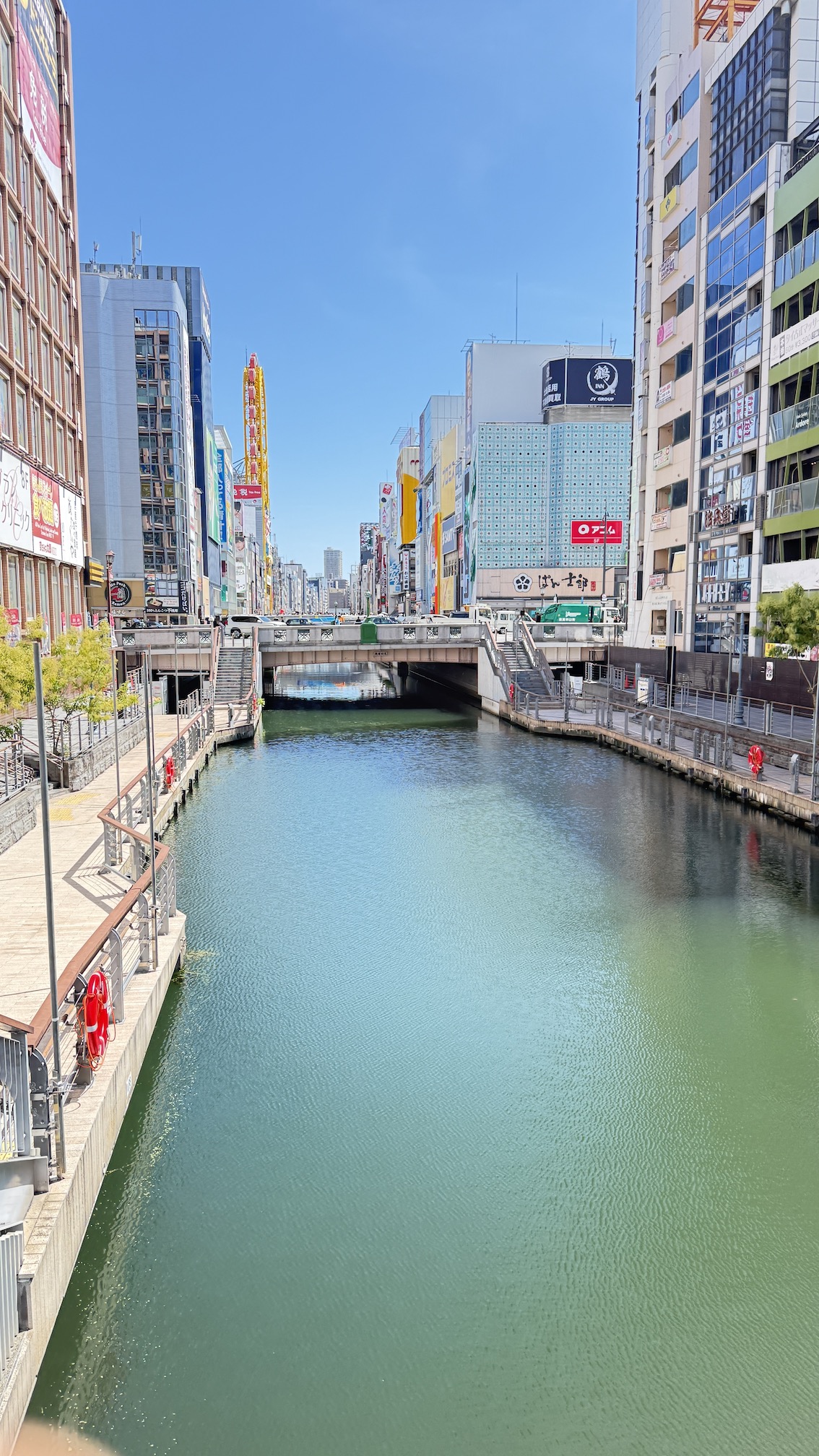
Osaka, Dotombori River
I – Welcome to Osaka.
It’s not Tokyo’s sleek futurism, nor Kyoto’s elegant tradition; Osaka has –once you leave Amemura, the trendy, youthful fashion and culture district – def some edge, a willingness to let sound spill into dark alleyways. A good example is still Namba Bears, the legendary, long-running underground live music venue, known for hosting experimental and noise acts, founded in 1986 by Boredoms guitarist Seiichi Yamamoto.
That specific 80´s scene is still relevant as the city’s contemporary music scene carries the scars and grandeur of its avant-noise past: Boredoms, Hijokaidan, Incapacitants loom large in memory — and influence.
That legacy is in active conversation with bands like Goat (jp), led by Koshiro Hino (who performed several times at Unsound Osaka this year), or artists like Doddodo, who continues to push electronic extremes with breakcore, glitch, and a kind of kinetic ferocity. Or Cö shu Nie, who mix melodrama, electronic texture, and pop structure in ways that defy easy labeling, now operating via their own label RVRNC. Meanwhile, a label like EM Records under Kōki Emura, with its embrace of ambient, experimental pop, dub, folk, is quietly curating a map of Osaka’s latent futures.
You get it: Osaka is a city where sound history always lingers in the air. It was also here, at Expo ’70, that an eighteen-year-old Ryuichi Sakamoto stumbled into a sonic hall of mirrors: Stockhausen spiraling in a spherical auditorium; Tōru Takemitsu threading strings through modernist architectures in his work „Crossing and Seasons“; Yuji Takahashi („Egan“) and Jōji Yuasa („Music for Space Projection”) projecting futures on tape; Xenakis constructing with „Hibiki-Hana-Ma“ cathedrals of noise for the Steel Pavilion (which also featured sonic sculptures by François Baschet); and Fujiko Nakaya filling the Pepsi Pavilion with her „Fog Sculptures“.

„sakamotocommon OSAKA 1970/2025/OSAKA/RYUICHI SAKAMOTO“
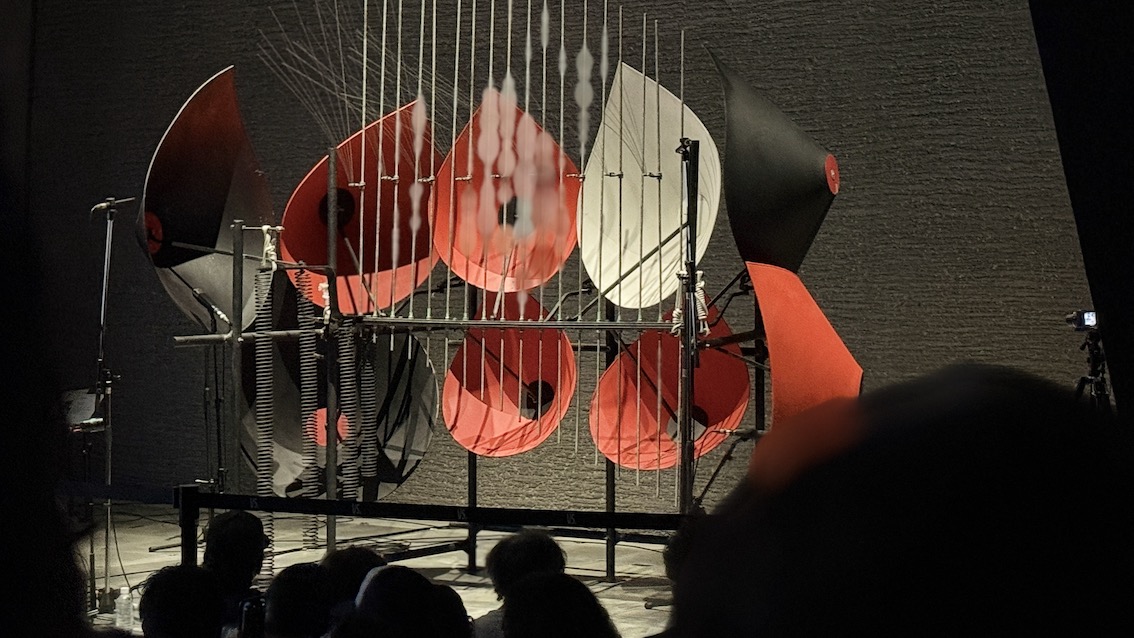
Baschet sound sculptures
Those encounters — oscillating between utopia and chaos — became a kind of secret grammar for Sakamoto’s career. Half a century later, their echoes return in „sakamotocommon OSAKA 1970/2025/OSAKA/RYUICHI SAKAMOTO“, the exhibition that set the stage for Unsound’s Japanese debut night.
Inside VS., a newly opened space in Umeda, the Baschet sound sculptures from Expo ’70 gleam again, joined by freshly built siblings from the Tokyo University of the Arts restoration team. They are not just artifacts but live instruments, resonant with memory and possibility — and Unsound, true to form, handed them over to Keiji Haino to wring out new dimensions of feedback and breath. It’s a gesture typical of the festival: reverence twisted into experiment, history folded back into the now. It was not the best performance of Haino I saw, but it was still an remarkable and very special one.

The tools of Keiji Haino
Across three days and three venues, Unsound Osaka moved like a spider through its theme: WEB. Threads stretched between Poland and Japan, between club and concert hall, between the global avant-garde and Osaka’s noisy, stubbornly local underground. Jim O’Rourke and Eiko Ishibashi for example refracted the electronic works of Polish pioneer Włodzimierz Kotoński into shimmering live translations at the stunningly awesome opening concert; Koshiro Hino bent signals around Rai Tateishi’s performance on the second day like liquid metal; and on the final day, Antonina Nowacka’s voice floated like incense through the Ohtsuki Noh Theatre.
At night, the city’s small clubs — Socore Factory, Circus, NOON+CAFE — became laboratories of density, where RP Boo’s footwork collided with J-Core intensity (sadly missed this one and only refer to the words of friends). The highlight for the Kaput team was DJ Sprinkles (Terre Thaemlitz), who stretched out four beautiful hours of deep house — a rare opportunity, as Thaemlitz plays only around five gigs a year, and almost never in Japan, even though she lives there.
What distinguished Unsound Osaka, staged in dialogue with the Polish Pavilion at Expo 2025, wasn’t simply the booking — though the names were strong, from legends to local firebrands. It was the way the festival let the city speak through the program. Osaka’s heritage was woven into the programming itself, acknowledged as both context and catalyst.
The festival does not just present works that exist; it is a platform to commission new works, a laboratory. The Unsound team listens deeply to what is around them before curating. In Osaka, that meant leaning into the local pulse, not only by paying homage to Sakamoto’s roots and at the same time allowing new hybrids to grow in the cracks.
The result was less an imported festival than a temporary rewiring of the city’s circuits — a weekend where experimental heritage and contemporary invention locked eyes, exchanged signals, and danced in the fog.
But let’s hear directly from the festival directors and curators Mat Schulz & Gosia Płysa and the participating musicians Eiko Ishibashi and Jim O`Rourke how they experienced the festival.

II – Mat Schulz & Gosia Płysa
Gosia, Mat — first off, congratulations on the amazing Japan debut of Unsound in Osaka. How did the idea come about? I imagine the Expo currently taking place in Osaka played an initial role, right?
We’ve always wanted to present Unsound in Japan in some form, because of our deep love for so much of the music that’s come from there and its global impact. It always felt like a faraway dream, but we were invited by the Polish Pavilion at the World Expo to do something in Osaka — and that became the spark. Osaka felt like the perfect city for Unsound: more freewheeling than Tokyo, full of great spaces and small clubs.
Unsound has a tradition of sister festivals branching out from the Kraków hub — in Adelaide, New York, and more recently with shows in Warsaw. Osaka was the first edition outside your home countries, Poland and Australia, and also outside a primarily English-speaking context. I imagine that must have had a major impact on organizing the festival, since neither of you speaks Japanese. Can you share some insights on that?
I’ve worked in more than 30 different cities now putting on Unsound — from New York to Tajikistan — including many places where English isn’t the first language. But in Japan, if you don’t know the country well, it’s not just about translating words; you also need someone to help navigate cultural nuances.
Yuko Asanuma was that person for us — an organizer and co-curator who’s attended Unsound in Kraków many times over the years. She had a deep understanding of what Unsound stands for and helped us build connections. We also worked with Yusuke Nakana and Kazuki Chito, who run Mode Festival; TOYO from Circus; Koshiro Hino; and Ritsu Fukomoto from V.S. They all understood our vision of a cross-genre, city-wide music festival — something not very common in Japan.
Everyone worked incredibly hard to make something special. Of course, there were some “lost in translation” moments, but the end result was perfect.
Speaking of the international sister festivals — I always feel that you try not to duplicate the “mother” festival in Kraków, but to curate a lineup that creates a dialogue between cities and represents both the Polish base and local scenes. That was very clear in the Osaka edition as well. So much happened over those three days — we can’t cover everything — but could you walk us through your curatorial ideas using maybe three examples from the lineup?
It was crucial to get the program right in Japan, given its almost mythical status as a source of experimental music. At the same time, part of the idea behind Unsound Osaka was to showcase Polish artists and culture.
We felt it was essential to include Yamataka Eye of Boredoms — such a pivotal figure in Osaka — as well as Koshiro Hino, a younger but equally vital artist for the local scene. We also wanted to connect to the 1970 Osaka Expo, which featured a lot of avant-garde and experimental music. We did that by inviting Keiji Haino to perform on Baschet sculptures displayed at V.S. as part of the Sakamoto exhibition.
Then we created Polish–Japanese collaborations: for example, Jim O’Rourke and Eiko Ishibashi with Piotr Kurek, and Polish producer 2K88 with Japanese MC ralph. We also chose Polish artists we thought would resonate with Japanese audiences, while our local co-curators suggested Japanese acts.
We spent a long time designing a coherent three-day flow that would engage audiences — not a given for experimental music. Programming Hania Rani helped with that. She’s a well-known Polish artist, popular in Japan, and her new show Chilling Bambino fit perfectly within the Unsound sphere. Her concert became a gateway for some attendees to explore the rest of the program.
How did Japanese and Polish artists react when you first approached them with these collaboration ideas?
Jim and Eiko were immediately enthusiastic about performing with Piotr Kurek — and of course, Piotr was thrilled to play with them. Jim also mentioned that he and Eiko are fans of Polish electronic music pioneer Włodzimierz Kotoński, so I asked them to present a second show reworking his music, which turned out beautifully.
The Japanese duo KAKUHAN and Adam Gołębiewski had already played together in Kraków the year before and even recorded an album. As for ralph, connecting him with 2K88 took a bit more time to figure out, but in the end 2K88 remixed one of ralph’s existing tracks and he performed over it live — it was perfect. Other memorable collaborations included FUJIIIIIIIIIIITA with Ka Baird, and RP Boo with drummer Gary Gwadera.
Did everything go smoothly, or were there projects that didn’t quite work out and had to be put aside?
Everything went really well — which isn’t always the case with new collaborations! Every show was strong. There were a few older Japanese artists I wanted to include but couldn’t reach, that’s all.
As important as the lineup were the very special venues you chose for the festival. I imagine the opening at the V.S. Museum came first, since the Sakamoto exhibition is taking place there right now and provided a natural connection point, right?
When we first approached V.S., we didn’t actually know about the Sakamoto exhibition — that came later, and it turned out to be the perfect context for Unsound, especially since the Baschet sculptures were included in that show. Usually, the larger sculptures are displayed at the 1970 Expo Park.
Yusuke suggested the idea of having artists perform on them as a kind of ritual to open the festival. Then Naohiro Ukawa mentioned to Yuko that Keiji Haino had always wanted to play these instruments — and that’s how that incredible performance came together. It was something that could only have happened in Osaka.
The night at V.S. was challenging to organize, as we had three very different shows, no stages, and had to work around the Baschet sculptures — including Robin Fox’s laser performance. But that made it unique: part concert, part happening, with performers and audience moving fluidly through the space.
How did you find the other two venues? And how easy was it to get permission to use them?
I’d heard that it’s incredibly difficult to host music events in a traditional Japanese Noh theatre, but the Otsuki Noh Theatre was surprisingly open to the idea — though we did need their approval of the music and had to choose works that fit both acoustically and spiritually with the space. Maybe that openness is an Osaka thing! It was a wonderful venue — one of the most memorable we’ve ever used.
The Creative Center Osaka, a former shipbuilding yard, was also very open and flexible. But of course, securing these venues wouldn’t have been possible without our Japanese co-organizers and curators.
What was your biggest learning experience from the Japan edition?
It sounds banal, but: use WhatsApp instead of email! I only figured that out in the last month, and it changed everything. Beyond that, there were countless lessons — too many to list.
Since this edition was connected to the Expo, I wonder if you’ll continue to develop the Japan–Poland axis. Are there plans for a regular Unsound Japan?
We’d love to do Unsound Osaka again, and I imagine it would be easier the second time around — plus, we already have an audience! But it would depend on funding. Let’s see what happens.
And finally — after one festival, the next one is already on the horizon: Kraków is coming up, then New York. Does this high frequency make things easier, or…?
It definitely doesn’t make things easier! We’ve produced seven festivals this year. It’s not great for one’s mental or physical health — but at least life isn’t boring.

Eiko Ishibashi & Jim O`Rourke
III – Jigsaw puzzle pieces w/ Eiko Ishibashi & Jim O`Rourke
Eiko, Jim — you gave two remarkable performances at Unsound Osaka. Let´s start at the beginning: On the opening night, you remixed works by Włodzimierz Kotoński. What led you to choose him? What is it that caught your interest in his compositions?
Since Unsound is based in Poland, and the concerts in Osaka were also related to the Polish Expo events, it seemed appropriate to adjust what we usually do in concert to relate to Polish culture. It also felt almost obvious that working with the electronic music of Kotoński would be both historically appropriate and personally meaningful, as we have admired his work for many years. So we were familiar with it and felt we could present his work to new listeners while offering a different perspective to those who already knew it.
How did you experience the process of engaging with the music of Włodzimierz Kotoński?
Kotoński’s electronic works are historically part of the first wave of state-sponsored electronic studios in Warsaw, Tokyo, Köln, Paris, etc. These studios were technically very similar, especially the ones that focused on using test equipment like oscillators and filters. At that time there was a specific “sound” that came out of these studios, which required the composers’ ingenuity with form and juxtaposition to create works that stood out. For us, Kotoński’s work from that time had a very strong and individual voice, which also guided us in our interpretation.
Could you give us some insights into how the set came together?
The first step was reviewing all of the electronic works and editing them into sections that seemed to accomplish a certain goal. Since the performance would have a different structure from his original pieces, it was almost like breaking his works into jigsaw puzzle pieces so that a new picture could be made. Then we studied and re-listened to these pieces on our own, preparing separately, and only created the final structure during the concert itself.
Did it come together easily, or were there challenging moments along the way?
Not really — it was actually a pleasure to revisit all of the pieces and to think of them as parts of a bigger whole instead of self-contained works.
When it comes to preparing a project like this, how do you usually approach collaboration? Do you start with a clear concept, or is it more about leaving space for things to emerge organically?
This was different, as we were using another person’s work, so all of the historical and biographical context that comes with it had to be taken into account. For a usual concert, we just get on stage and improvise. But with this, it was improvising with material that was, to a certain degree, fixed — in the sense that we knew it beforehand — while how we treated, processed, and structured it was where improvisation came into play.
On the final night of the festival, you collaborated with Piotr Kurek. How did that collaboration come about?
Mat Schulz from Unsound suggested the collaboration.
What caught your attention most in Kurek’s repertoire?
He seems to treat improvisation as an area for exploration, and you can hear the pathways very clearly in his playing.
How did you experience working with him?
We had a great time and were very happy with the almost picaresque quality of the concert.
Did you feel that working with him challenged you in a way that brought out new sides of your own practice?
Improvising with someone for the first time is always a challenge. In the best situation, you are challenged, and you also have to listen as intently as possible. So yes, it always brings new experiences.
How did you experience Unsound Osaka overall?
We had a great time. It was wonderful to see a festival of this size and for this kind of music in Japan, because it happens very rarely — especially in the last 10 years. I think many people in the audience were extremely grateful that it happened. Also, getting to see Robin Fox’s laser performance in person was remarkable.
What was your impression of the curatorial framework that Gosia and Mat presented?
I think their curatorial eye is both very informed and very balanced — they understand the need to respect and continue the past, while finding ways to introduce and connect with the present.
Osaka has its own musical and cultural identity — did the city itself influence how you approached the projects?
The spaces we played in were, of course, special and unique to Osaka, so those influenced the concerts for sure.
Since you’ve played so many festivals, and also attended Unsound editions in Kraków — how different did the Japanese edition feel to you?
We previously played at Unsound in Adelaide, which was also a great time, held in a Polish culture club. It was an interesting juxtaposition of Polish and Australian culture. The feeling of Poland could be sensed in the club itself, which was very interesting. We play in Kraków next month.
And, finally, your personal highlight of Unsound Osaka?
Of course, the kindness of Mat and Gosia, as well as all of the Unsound staff and production staff over the three days. Seeing old friends like Keiji Haino, and the lasers!
As my last question, which current Japanese musician would you recommend to Kaput readers?
Kumio Kurachi
https

Rai Tateish & Koshiro Hino after their awesome Unsound performance
IV – Koshiro Hino
Since Koshiro Hino hadn’t yet found the time to respond to our questions before publication, we decided to create an experimental momentum nourished by past spirits of Koshiro Hino aka ai generated from his past conversations with Kaput, aiming to capture his tone, thought patterns, and artistic sensibility.
The following answers are therefore imagined reconstructions, not direct quotes. Of course, once Koshiro shares his real responses, we’ll feature them in full.
Koshiro, how did you experience Unsound Osaka overall?
I felt Unsound Osaka was a beautiful mix of familiar textures and new connections. The energy, the audience, the collaboration with Japanese and international artists — it all felt very alive. It was also inspiring to see experimental music being so embraced across different venues. For me, it was not just a performance: it was a place to learn, share, and feel part of a wider thread of sound.
You not only performed with KAKUHAN & Adam Gołębiewski and Rai Tateishi, but also co-curated the Saturday night shift. Could you share some insights into these three projects? For example: what does “processing” mean in the context of your performance with Rai? How did the collaboration with Adam Gołębiewski come about and unfold? And finally, how did you experience the curatorial part?
With Rai Tateishi, “processing” meant transforming live sound — taking raw loops, feedback, tape textures, filtering, reverb — in the moment, so that the sound shifts and breathes. It’s about attention to detail, to subtle changes, to letting the space and the audience affect the work.
My collaboration with Adam Gołębiewski came through mutual respect — we had admired each other’s work for some time. We exchanged ideas ahead of time, shared rough sketches, and then in rehearsal made decisions together: what to retain, where to allow space, when to disrupt. The process was gradual, dialogic.
As co-curator of the Saturday night shift, I wanted to help shape a flow where experimental and more approachable sounds could coexist, where people who come for more “conventional” or melodic performances might discover more abstract or exploratory work. It’s a balancing act: pacing, contrast, moments of tension and release.
What was your impression of the curatorial framework that Gosia and Mat presented?
I admired their framework very much. They aimed for dialogue — between local Japanese artists and Polish artists, between heritage and experimentation, between historical awareness (for example of the 1970 Expo) and contemporary sound. Their structure allowed breathing space: not everything is dense or challenging; there are points of rest, of accessibility. That shows respect for both artists and audience. It felt thoughtful and generous.
Osaka has its own strong musical and cultural identity. Did the city itself influence how you approached your performances?
Yes, absolutely. Osaka has a certain vibrancy, a kind of openness — street sounds, nightlife, small venues, an audience used to mixing genres. That influenced me to take more risks, to allow more improvisation, to use spaces and acoustics more freely. Also, knowing the history of Osaka’s experimental scenes, noise, avant-garde, etc., I felt conscious of that lineage, which made me want to honor it but also push beyond it.
You’ve been performing quite a lot in Europe recently. How do performances in Japan differ for you compared to Europe?
In Japan, there is often a deep quiet in the audience, attentive listening, a different kind of focus. Also I feel a connection with place, with the ambient sounds, culture, even architecture; those things influence how I set up my sound. Europe tends to be more varied: sometimes louder, more interactive, more immediate feedback. Both are inspiring but they demand different pacing and energy. I try to adapt depending on where I am.
And finally — your personal highlight of Unsound Osaka?
My highlight was the performance by Keiji Haino on the Baschet sculptures at V.S. Museum — that moment when the sound, the sculpture, the space, the audience all came together.
Also the collaborations: seeing how different artists responded to each other, especially the Japanese–Polish mixes. And just observing the audience’s reaction — when something unexpected happened, and people followed, moved, listened. That felt powerful.
Today marks the opening of Unsound Krakow 2025. The line-up is simply awesome.