

On friendship and transience – between Fuji, Unsound and Making Time

Osaka by night (Photo: Thomas Venker)
It is 12 September 2025 and I am dancing. It is not just sweat running down my forehead and elsewhere during DJ Sprinkles’ (Terre Thaemlitz) four-hour set, it is also tears of joy. After months that felt like years, I trust my legs again to carry me through the night – or at least through four hours like this one at the Socore Factory Club in Osaka. I’ve written about it elsewhere on kaput, and I’ll leave it at that for today. Just this much: we always take it for granted that we can move around and share social spaces with others, but it’s a gift that cannot be appreciated enough.
I have been fortunate enough to have experienced two handfuls of sets by Terre Thaemlitz in my life, including four Sprinkles sets. But the one that night, as part of the Unsound Festival, will remain in my memory forever, second by second. A single great wave of joy. At this point, I would like to salute the club operator, whose exuberant euphoria should be the benchmark for everyone involved in nightlife.
Rewind. October 2022. Unsound Festival in Krakow. To my shame, I must admit that this was my first ever trip to Poland and therefore also my first Unsound. For years, it ran parallel to CMJ in New York, then I ran out of excuses – but this autumn, I travelled to Krakow with my friend Oli Isaacs. To cut a long story short: it was a fantastic weekend full of memorable encounters and equally memorable performances; naturally, I documented it in detail for kaput.
However, I must explicitly mention that I contracted my only Covid infection to date during the B2B set by Tim Reaper and Kode9. I know this for a fact because a dancer shouted very, very loudly and very, very emphatically into our ears, ‘Tonight, you’re all going to catch Covid.’ At the time, it was a great fear, even if – at least for me – it turned out to be relatively uneventful. Nevertheless, it was generally a time when we all collectively developed a sense of what it means to be vulnerable for the first time – a state that is commonly denied until fate strikes.
I ended up at Unsound in Osaka by chance. I’m actually on a healing trip in my favourite country for five weeks – a term I first used in conversation with a, shall we say, insensitive employee of my health insurance company to make it clear to her that I myself do not consider this trip during my sick leave to be a normal holiday, but rather a journey to a place where I always feel so comfortable that I hope to make decisive progress in my recovery, even in my weakened state. I failed in my direct exchange with her; it took a medical officer to make the matter official as a healing journey.
Accordingly, I am particularly sensitive to illness and all the mess that comes with it these days. And so the news of Keith McIvor’s death on September 19th hits me all the harder. It would be an exaggeration to say that we were close friends, but we knew and liked each other for more than two decades, sharing quite a few nights and days together.
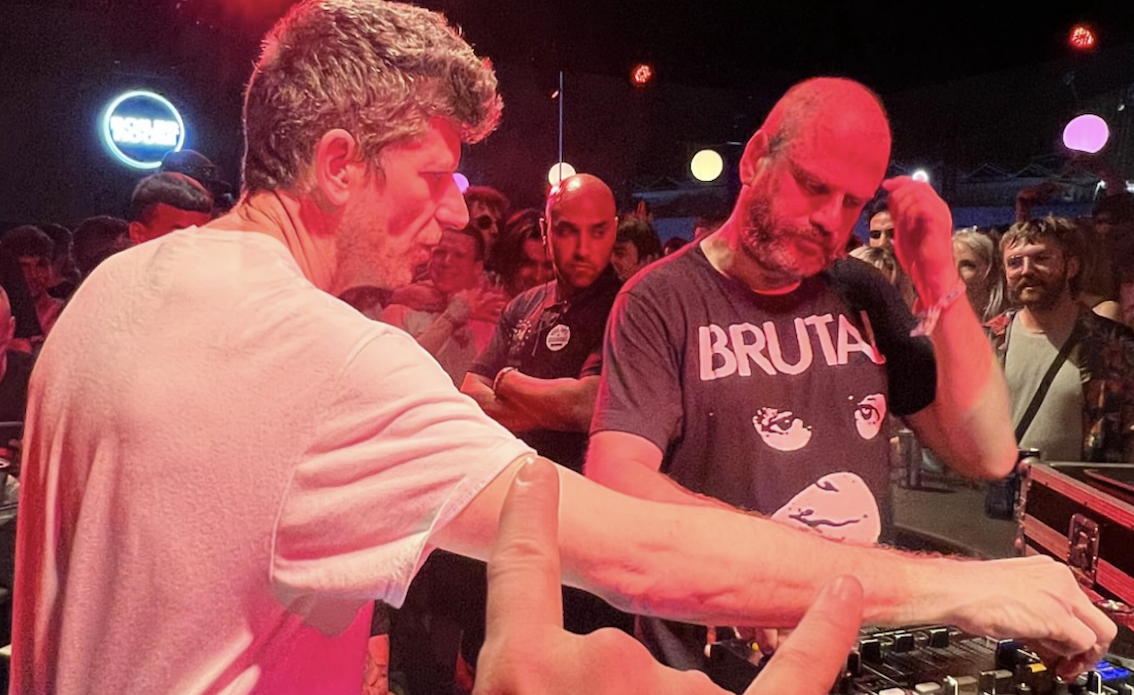
Jonnie Wilkes & Keith McIvor (Optimo), Primavera Festival 2022 (Ausschnitt aus einem Photo von Vivan Thi Tang)
His death came as no surprise; the severity of his illness had become known two months earlier and had prompted an outpouring of sympathy and support. It is a small consolation that he was able to feel how much everyone respected and loved him while he was still alive.
I hope it doesn’t sound presumptuous when I mention my injury, which in retrospect certainly seems minor, in the context of such a brutal and final illness. But for a few weeks, it definitely didn’t feel so minor to me. I mention it mainly because it intensified my reflections on vulnerability and finitude. When you lie down a lot, that comes naturally. You realise how thin the membrane between health and illness is. It’s a triviality, but how often do we escape bad things by just a few millimetres – and never know it. But when something happens, it’s a fact. Thoughts like these and many others constantly swirl through your head during long nights in hospital.
In the hours following the news of Keith’s death, I find myself thinking a lot about September 2024. I’m travelling with my friend Oli Isaacs again, this time in Philadelphia at our friend Dave P.’s Making Time Festival.
I only have to look at the lead image from the article at the time – and I’m already in tears. ‘Making Love with Lauren, Dave P, JG Wilkes (Optimo), Andrew Ferguson and Keith McIvor (Optimo)’ reads the caption. Among others, Keith is joined by his Optimo partner Jonnie Wilkes and Andrew Ferguson, one half of Bicep, in the picture – Matthew McBriar, the other half of Bicep, was supposed to be there that evening, but he was unable to attend due to a brain tumour.
It’s not something you can just shake off, especially when you’ve already lost several people to cancer in your life. So there were a lot of thoughts floating around in my head during the set. But certainly not the thought that one of the three other DJs, who were celebrated so enthusiastically after their set and were so happy themselves, would no longer be alive just one year later.
I don’t know if that’s understandable, but on the night of Keith’s death and even in the weeks that followed, these thoughts drove me pretty crazy.
All of us – at least, I assume that I am not alone in this, but that it is a collective trait – long for and strive for something like security and reliability in our lives – because it feels good, but also because otherwise you go mad.
I remember very well how my mother first sang us the children’s song ‘Tomorrow morning, God willing, you will be woken up again’ – more as a threat to make us behave than anything else. The song, composed by Johannes Brahms, is both a Christian and a family pressure tactic to frighten children and condition them to be good. Which works for a while, until you understand the bigotry and banal calculation behind it.
That night, when I hear about Keith’s death and think about the year 2024 and Matthew’s illness, memories of so many acquaintances and friends who died far too young suddenly creep out: my fellow student Katrin, who was consumed by cancer within weeks; my school friend Alex, who died so senselessly under a truck that ignored a stop sign in Morocco just weeks after graduating from high school; my childhood friend Kiese, who never revealed his depression and simply climbed a tall tree one day, never to climb down again; my friend Jessi, who fought so bravely and energetically against her brain tumour…
I also have to think about my trip to Japan in 2023, when – as a pandemic promise to myself and a reaction to all the experiences during this time – I travelled around Hokkaido alone on foot and by train and ultimately caused my own foot problem in my mania to keep going through walls; which is not to say that what came of it was not and is not the fault of a narcissistic, ignorant doctor.
But this is not about me, which I hope is clear, but about all of us, about our vulnerability, about the thin threads that separate life and illness or even death, and which, let’s not kid ourselves, can be severed at any time.
What can we learn from all this? Well, for me, at least, it means that I appreciate every moment with my friends even more than before. Because nothing is better than sharing your life with those you feel comfortable with. It sounds so trivial, but it’s not. And that’s why it was so important for me to write it down here.
To be honest, I was actually going to follow this up with another, longer digression about people who have disappointed me recently – not coincidentally, often ‘rich kids’ who could be doing so many other things, creating positive structures and networks of relationships – but don’t. But now that I’ve written all that, I just want to give them all a hug, because they’re serving the wrong gods.
The lyrics of the New Order song ‘Crystal’ include the lines: „…Here comes love / It’s like honey / You can’t buy it with money“. They don’t really make sense, but they stuck with me nonetheless. Probably because they are just as wrong as the belief that life itself is fair. It’s not fair. But we can live it fairly. Fair in the sense that we understand that only a shared world is a beautiful one.
I am typing the keywords for this text into my phone while flying from Tokyo to Munich. After desperately scanning the film selection, I chose ‘Cologne 75’ as an act of resignation, so to speak. The film tells the story of how Vera Brandes, then 18, organised Keith Jarrett’s famous ‘Cologne Concert’. The film is as mediocre as expected, but then again not as bad as I thought it would be. In the sequences between all the slapstick and pointless running around, as one would expect from a German film, there are repeatedly irritatingly thoughtful moments in which either the Keith Jarrett character or the music journalist (who acts as the explanatory narrator) want to explain the world and music to us. – I am struck by the moment when Keith Jarrett philosophises about silence, which means nothing other than that he desires it. Which, of course, makes sense for ‘him’ as an artist. But I have to think of my mother, who would prefer to have silence all day long, not as a state to stimulate her creativity, as is meant here in the film, but as the ideal state of her world. And she is certainly not alone in this; many people long for permanent silence. For them, noises and voices are the beginning of potential problems.
We humans are so different. Others, and I include myself among them, are constantly searching for sounds and voices and the interesting thoughts within them (to quote Frank Spilker).

Fuji (Photos: Sarah Szczesny)
Incidentally, this time the flight is not returning westwards from Japan for the first time, but eastwards, i.e. via Alaska, Canada and the Arctic. This is remarkable in that when you fly out of Japan, you land in Germany on the same day because (according to previous logic) you travel with the day. Why we have obviously travelled the other way round this time and still arrive on the same day is, at least to me right now, deep in the night, a mystery. I would be grateful for an explanation. But it doesn’t have to be, after all, most of our existence and the universe and everything else is a mystery and will remain so.
The negative effect of the flight route: we are left with one last wistful glance at Mount Fuji. That’s why I’d like to share a particularly beautiful photo here.
I would like to end this article, which was finally written while I was listening to all the records I bought on my trip to Japan (which Keith would certainly have been very pleased about, as he had a big heart for obscure music), with this link to a post by Kaput graphic designer and DJ Christian D, who asked Jonnie Wilkes, aka DJ Wilkes, ten questions in 2025, illustrated by a collage by Sarah Scczesny showing Christian kissing Jonnie on the cheek:
My favourite answer is to the question of whether there is a record he could play every night: ‘None of them are suitable for every night. No. You have to understand, I’ve had some really strange nights in my life.’
I think we can all agree on that, fortunately – and that’s the great thing about life. Here’s to many more strange nights and days together.
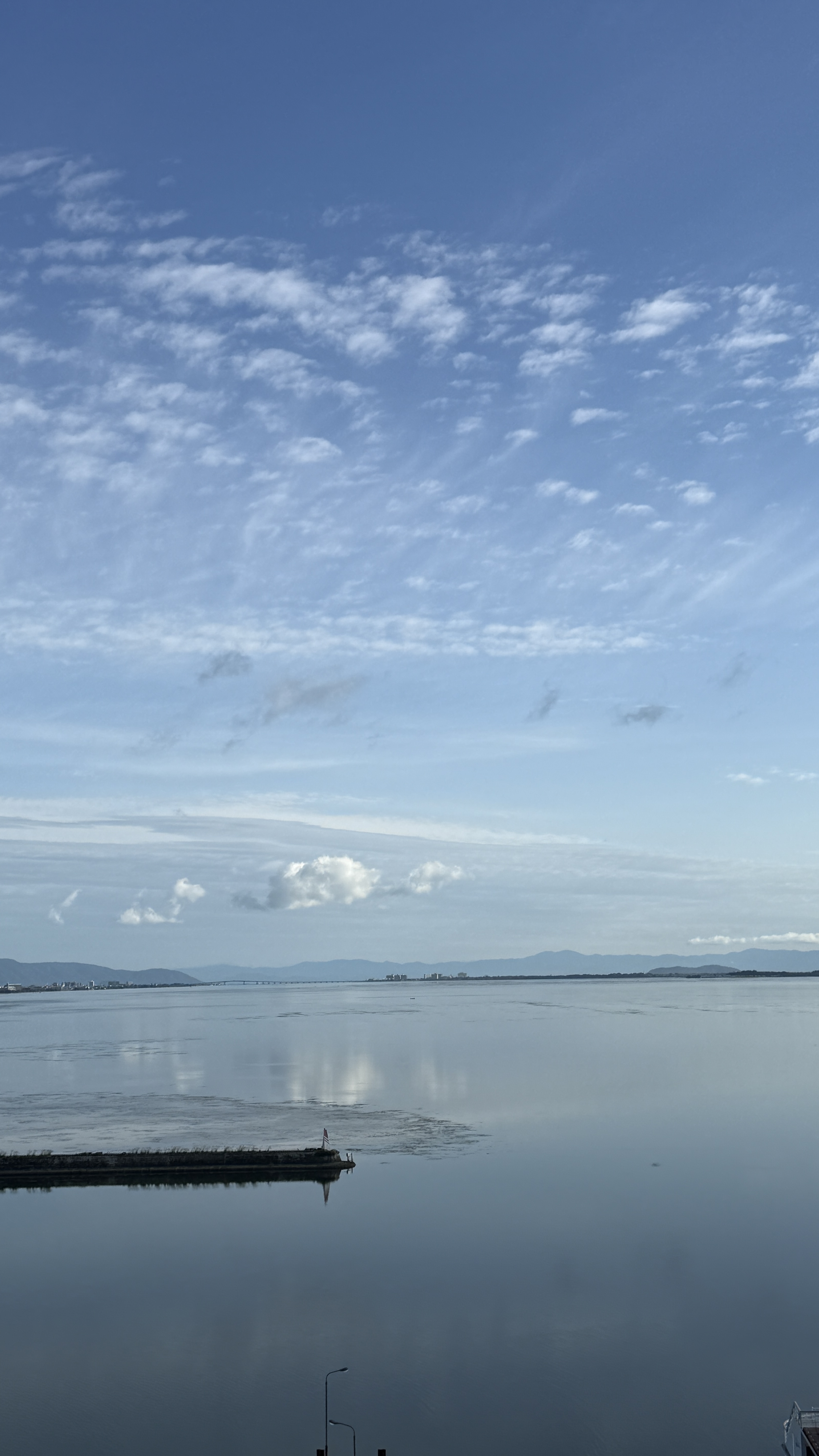
Der Biwa See, 19.9.2025 (Photo: Sarah Szczesny)