

»Der Klang von Kaiwa« III – Joe Baiza & Ece Özel
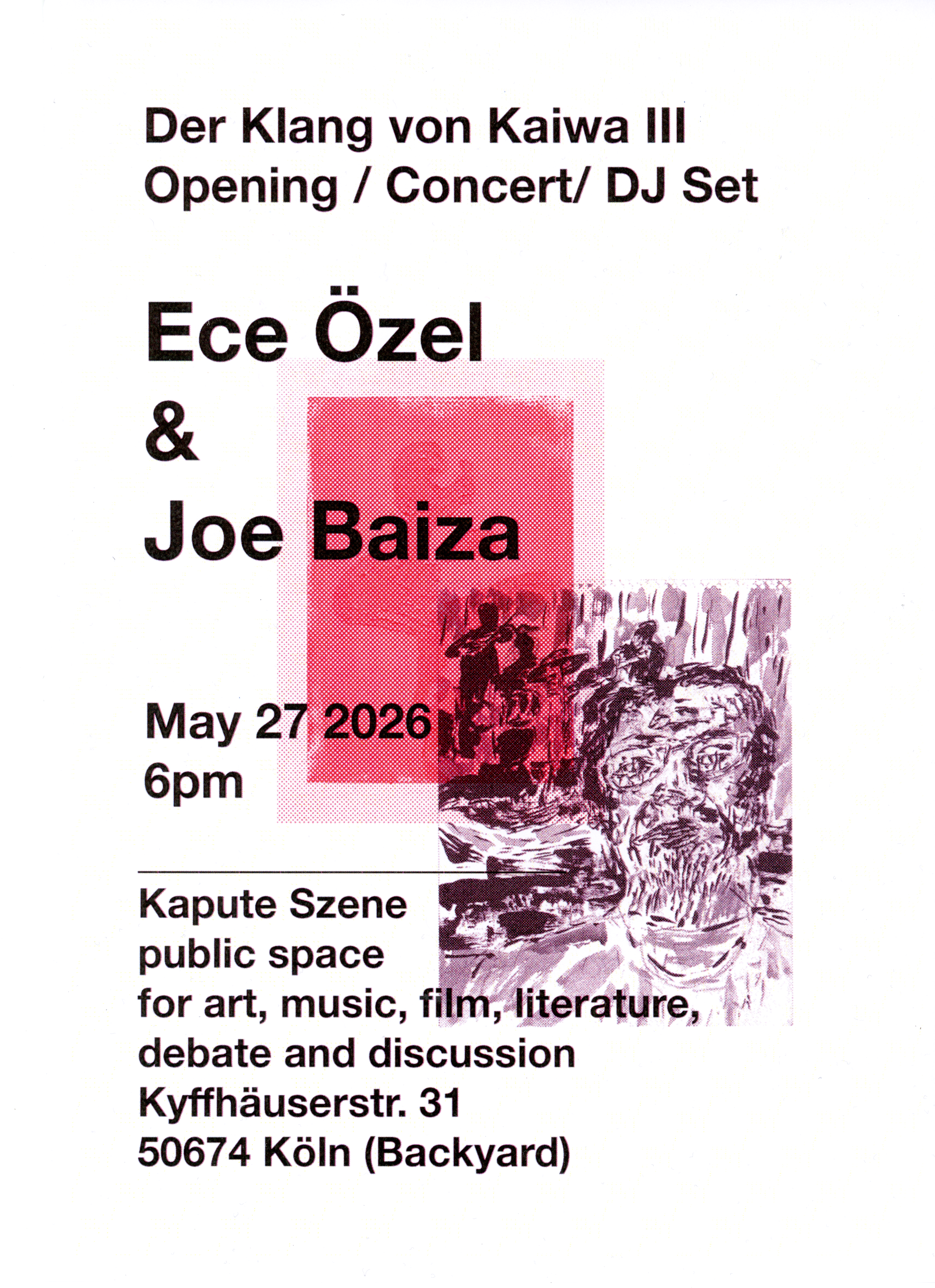
Poster: Sarah Szczesny / Kapute Szene
»Der Klang von Kaiwa« III – Joe Baiza & Ece Özel
at Kapute Szene, Cologne
Opening + Concert + DJ Set: May 27th, 6pm; on show till June 28th
______________________________________________________________________________________________
There are exhibitions that simply present paintings or objects and there are exhibitions that present artists and their personal states of mind and their views on the world: emotional climates, sedimented histories, sonic residues translated into visual form. The encounter between Los Angeles-based musician and artist Joe Baiza and Istanbul-based musician and artist Ece Özel belongs without doubt to the latter category. It is less a juxtaposition than an initiated dream dialogue, a subversive zone in which two distinct artistic languages, both deeply informed by music, begin to speak to each other. Somehow, it’s what works of art become when the sun and the moon shine at the same time.
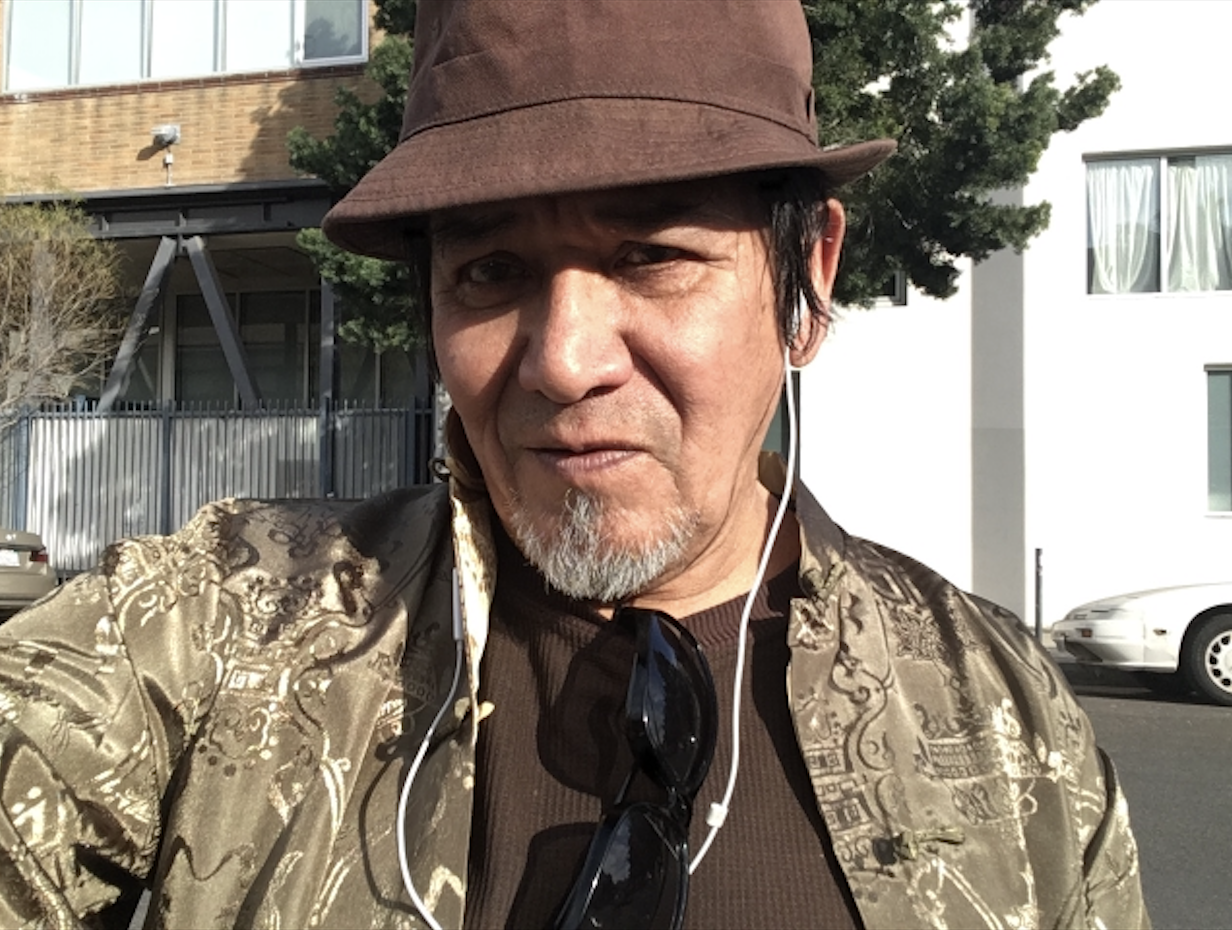
Joe Baiza (self portrait)
Joe Baiza’s work emerges from a life lived at the intersection of punk, jazz and the expansive, politically charged underground of Southern California. Best known as a guitarist in bands such as Saccharine Trust and Universal Congress Of, Baiza has long operated within a musical vocabulary full of improvisation, rupture and the refusal of clear stylistic boundaries. That same ethos permeates his drawings. Executed primarily in black ink, they carry a raw immediacy that feels like a direct puncture to the heart.
His Los Angeles is not the city of surfaces and cinematic illusions, but something closer to what might be called an “under the black sun” condition, a term that has circulated in both visual art and music for some time. One might think of the exhibition “Under the Big Black Sun: California Art 1974-1981” at the Geffen Contemporary in 2012 (sadly without works by Joe Baiza, at least as far as I know), or of the epochal album by X of the same name; of course also of “Give Up the Sun” by The Gun Club and, not least, of the music of Saccharine Trust itself. Tracks like “Belonging to October”, the closing piece of their 1981 LP “We Became Snakes” (produced by Mike Watt) carried meanings far beyond their origin. Or of course the October Faction record (SST release number 36), bringing together an all star outfit of Joe Baiza, Tom Troccoli, Greg Cameron, Greg Ginn and Chuck Dukowski. On its cover, a Baiza drawing of the band; on the back a wild group of weirdos (whom Baiza has given a comic-like touch) that presents like a strange hybrid of imagined listeners and the Hades waiting for all of us. Fittingly, the back sleeve features a quote attributed to George Washington: “He who would trade freedom for security deserves to lose both.”; while on the cover one of the musicians wears a shirt saying “The Nazi Sex Doctor. ”
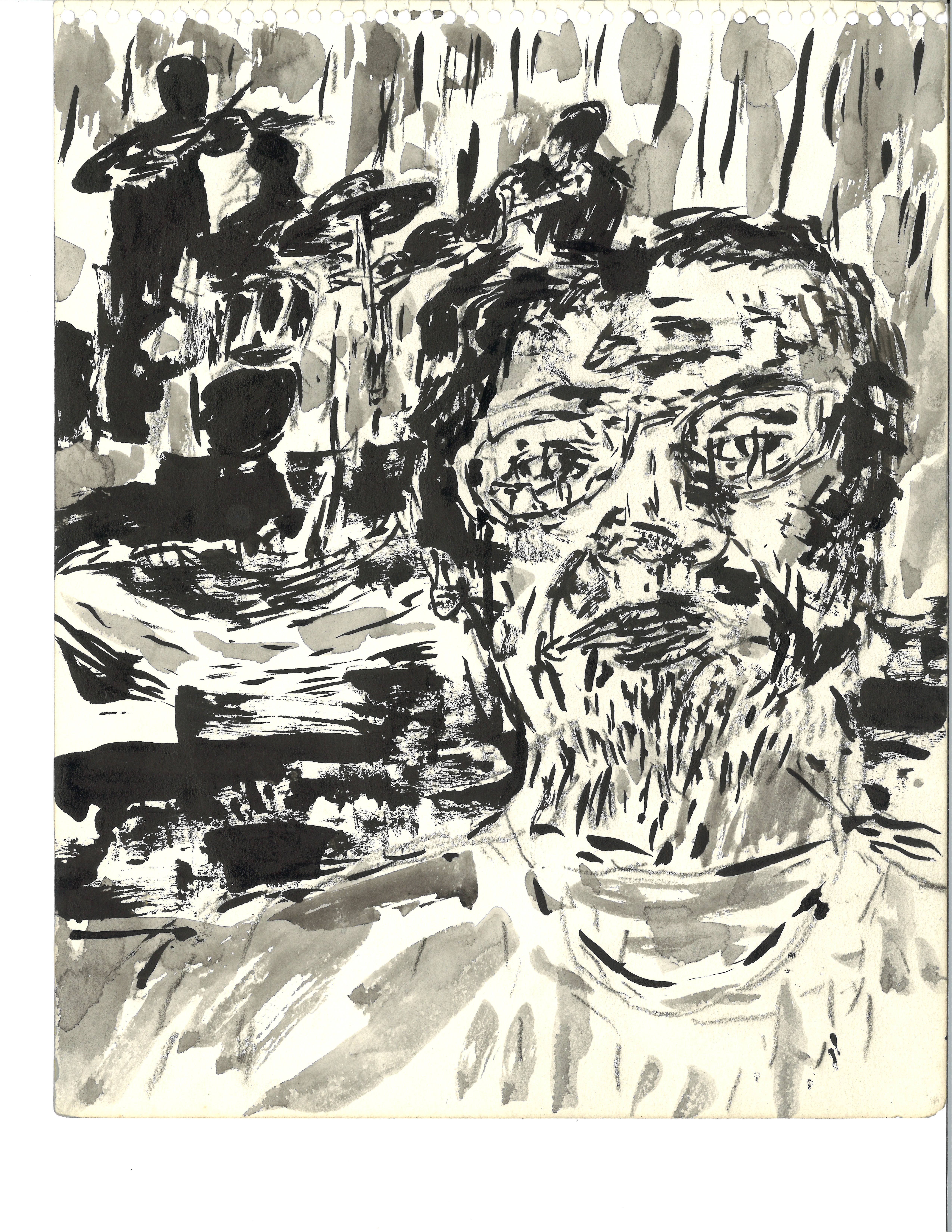
Joe Baiza, „Threadbare Aristocrats“
Some 9,500 kilometres away from Los Angeles, in a Stuttgart childhood bedroom, I somehow received that message: a vision of Los Angeles that was anything but the sunny, carefree place that the movies, television and books suggested. I came to understand, over time, that it is a space where brightness exists, but is always shadowed by systemic violence, class tension and the lingering ghosts of personal history. Looking closely at Baiza’s work “Threadbare Aristocrats”, you see a band playing for, or against those aristocrats, and what shall I say: there is no heaven waiting for them in his universe.
But this is not about my own distant reading of that world, the place where all this music was produced and performed daily, and which I became obsessed with in the late 1980s. This is about Joe Baiza, one of the key protagonists during the heyday of SST Records and a visual artist with a deeply moving, entirely unique signature style.
Looking at the works Baiza presents at Kapute Szene, I feel as though I am seeing Los Angeles through his eyes, much as I once did through his music and his cover art for some of my most beloved records over the last three and a half decades.
Perhaps obviously, but still worth stating, the motifs recur like riffs: donut shops crowned with oversized signage, punk leather jackets as both armour and mark of identity, the backyard of his grandmother’s house, where formative experiences seem to hover just outside the frame. These are not nostalgic images in Baiza’s work; they are sites of friction shared between the artist and the environment that shaped him.
Even when Baiza allows figures like a distorted, almost reluctant (or perhaps comatose) duck (“Ducky” as the work is titled) to enter the frame, it is not an embrace of pop iconography, but an acknowledgment of its inevitability, it is metabolised, folded into a visual language that remains insistently personal. His lines are rough, nervous, searching. The black-and-white palette of the other works by Joe Baiza in the exhibition reinforce a sense of urgency, of reduction to essentials. The same goes for this incredible work, it’s just that he decided to give Ducky colours (it is the only coloured work in the exhibition).
One has to appreciate once more , the way Baiza brings smoking oil wells into conversation with an alluring, or perhaps warning, donut on the horizon. In “Baiza’s Leather”, he himself takes the place of Ducky, while a small monster reaches for his guitar in the background. Many things can be said, but certainly not that Joe Baiza pretends to be at ease with the world around him.
What holds these works together is a complex emotional register: anger directed at institutions – the establishment, aristocratic structures of exclusion – coexists with moments of tenderness and self-reflection. Who else would so plainly title works “Negative Baiza” and “Positive Baiza”? It takes a certain clarity, perhaps even peace, to carry out such deft self-examination and yet present two equally unresolved versions of oneself. Baiza’s drawings are not didactic; they are dialogic. This ongoing conversation between different versions of the self – past and present, idealistic and disillusioned, wounded and resilient – resembles his guitar playing: improvisations that never fully resolve, but continue to circle, probe, and insist, even when long documented on record.

Ece Özel
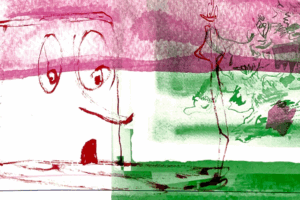
If Baiza’s work operates through subtraction, through the charged economy of black ink on white paper, Ece Özel’s paintings move in the opposite direction, toward saturation and chromatic insistence. Where Baiza’s images pull you inward, Özel’s leap outward – they do not wait to be discovered, they announce themselves almost physically in space.
Özel, whose practice spans DJing, radio work and visual art, approaches painting as an extension of her sonic experience over the last decade – even though she originally studied fine art before music entered her life. Art was her first love. “I started drawing the first moment I could hold a pencil,” she told me two years ago in a conversation for Kaput – Magazin für Insolvenz & Pop, “I was four or five years old. There was nothing else I wanted to do.”
Studying art was therefore the next logical step, even if it did not unfold as she had imagined. Like many before her, she quickly realised that the academy did not necessarily strengthen her love of art; the conservative climate of the Turkish art scene at the time reinforced this experience. The result was a rupture: she stepped away from painting for nearly a decade.
Today, however, the tone has shifted again. “Painting is my life when I’m not in the club,” Özel says and one senses the joy in that statement. Not long ago, she maintained two separate Instagram identities for painting and DJing, trying not to confuse audiences. Eventually, this division became unsustainable. “If people are confused, people are confused,” she remarks dryly and merges both practices into one continuous expression.
Her compositions often feel as if she has pressed a button that suspends time. Everything happens now. Colours collide without fully dissolving into one another, forming temporary constellations that evoke both figures and objects at once. There is a tactile intensity to these surfaces, a sense that colour itself is being tested, how much it can carry of Ece Özels worldly ballast.
At the core of her recent work lies a phrase she returns to repeatedly: “not my skin”. It functions less as a fixed statement than as an ongoing process, an attempt to locate the boundaries of the self not as stable identity, but as something porous, reactive, and in constant negotiation with its surroundings. “Still not sure what it means,” she notes, “still discovering.” This uncertainty is a condition of artistic truth, one that feels widely recognisable for all of us.
And yet, much like the transition from an idea to its opposite, then its resolution, her images emerge with a striking sense of completeness and form. They embrace the meanings she assigns to them and suddenly things feel lighter. The body no longer speaks only in riddles, it provides clear signals: what to approach, what to avoid. Her paintings invite us into spaces that feel fundamentally benevolent: places that do not entrap, but offer refuge, or the possibility of a positive, shared social experience.
Her works can be understood as maps of sensation, registering attraction and repulsion, what feels inhabitable and what must be refused. “My body is teaching me what and where to stay away from”, she says. There is an almost allergic logic at play, a heightened sensitivity to what no longer fits. But rather than withdrawing, Özel translates this into intensity, resulting in a visual language that is both vibrant and deeply attuned.
Once more, music is central. Just as Baiza’s drawings echo the improvisational structures of free jazz and what later came to be called post-punk, Özel’s paintings resonate with the dynamics of electronic music – the layering, the shifts in mood, the sense of timing. Whether or not she would fully agree with this reading, it remains present: in the faceless figures, in the fleeting silhouettes, in the sense of movement embedded in stillness.
Bringing Baiza and Özel together at Kapute Szene is not about contrast for its own sake. It is about tracing a shared commitment to art as lived experience; one that refuses to separate the aesthetic from the social, the personal from the political, or the visual from the musical. Both artists operate within traditions that resist institutional domestication: punk, experimental music, underground scenes built on autonomy rather than recognition.
Both artists entered my world through music first, and only later through their visual work. Yet once I fell in love with Baiza’s cover art – much as I had with Raymond Pettibon’s work for Black Flag, Minutemen, and other SST artists – and, much later, with Özel’s paintings, these practices became inseparable. In my own perception, they belong to a shared universe, not unlike the hidden geographies in Stephen King’s novels: in one moment you think they are far distant, in the next you understand they are emotionally right in front of you.
Their works, however, are anything but insular. Baiza’s Los Angeles opens onto broader questions of memory, class, and cultural production. Özel’s subjective explorations of the body resonate with wider discussions of identity, belonging and perception. What connects them is not style, but urgency – the need to articulate something that resists stabilisation.
Within the exhibition space at Kapute Szene, this produces a constant oscillation. Moving between Baiza’s drawings and Özel’s paintings means shifting between different artistic temperaments, different modes of attention. The eye must recalibrate. What initially appears as opposition gradually reveals itself as dialogue: black and white versus colour, line versus field, memory versus sensation, but also improvisation meeting improvisation, structure encountering structure.
If there is common ground besides me being a fan of the works of both artists, it may lie in the idea of translation; not from one medium to another, but from one state of being to another. Both artists translate music into very personal images – though they might resist such a formulation – not to fix meaning, but to keep it open. Not everything becomes clear, and perhaps that is precisely the point.
As a maybe overly optimistic viewer, I find myself feeling guided through Baiza’s darker “under the sun” scenarios, while in Özel’s more diffuse environments, I trust in the fact that she has shaped these spaces and the beings within them.
The exhibition does not offer resolution. It offers, instead, subtle shifts – ways of recalibrating how we perceive our surroundings. Between “Under the Black” Sun and “Not My Skin”, a dense, unstable and vividly alive environment emerges, one full of longing. Not a place where problems dissolve, but one where the strength to continue, despite everything, can be gathered again. Life is a mess, sure; but as Talk Talk stated, it is also what we make it.
Thomas Venker, Cologne, April 2026
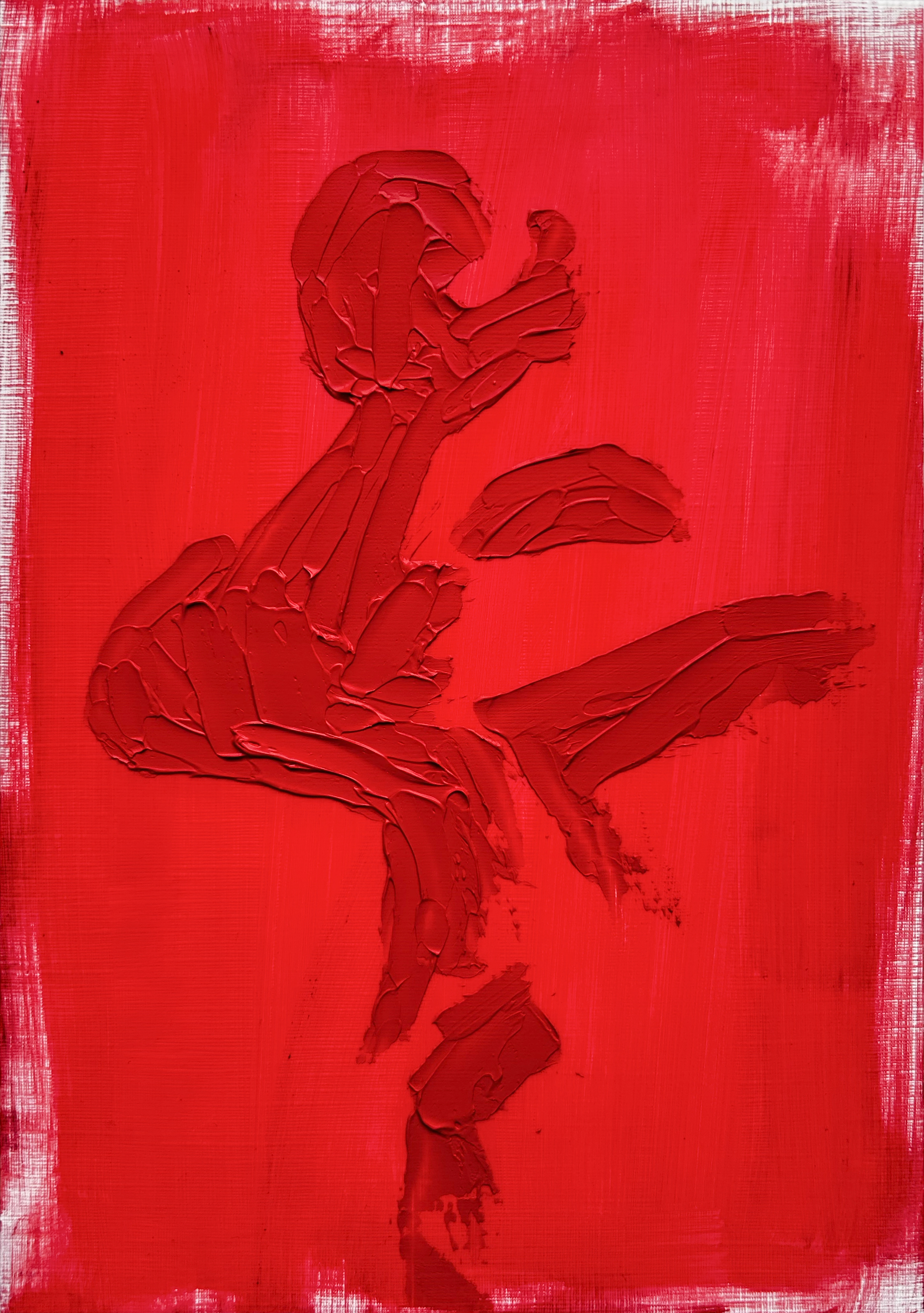
Ece Özel, „Not my Skin)
»Der Klang von Kaiwa« wird vom Musikfonds e.V. / Beauftragten der Bundesregierung für Kultur und Medien (BKM) und dem Kulturamt der Stadt Köln gefördert.